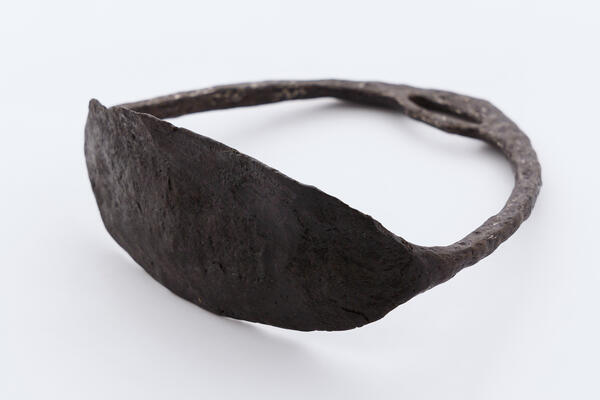
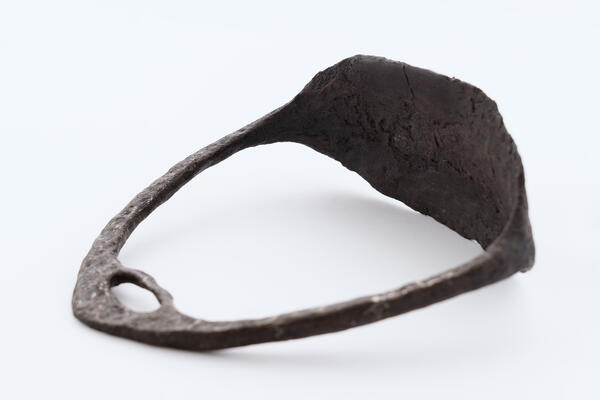
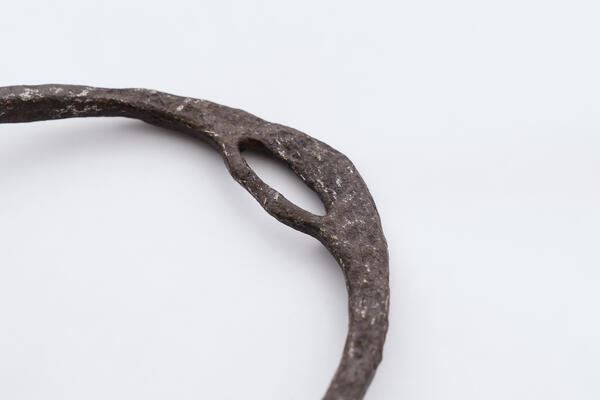
The stirrup, which is on display at the State Museum-Reserve “Kulikovo Field”, is a part of horse equipment, specifically a detail from a saddle from the 12th to 15th centuries. It has a wide, flat, curved footrest and a large, oval strap loop. It is preserved fairly well.
Throughout history, humans have developed a variety of devices to help them control horses and stay securely on their backs. Some of such devices are a bridle and a saddle.
A saddle is a piece of equipment that is placed on the horse’s back to control it and provide a stable platform for the rider. It consists of a saddletree with a saddle pad, and stirrups, which are attached to the saddletree using cloth or leather straps.
Stirrups are a device used for stable mounting on a horse and are an essential part of the saddle. They first appeared in the equestrian world at the turn of the 5th century in the eastern part of Eurasia. Their predecessor was a leather loop attached to the saddle. At first, stirrups hung from only one side and were used to help a heavily armed warrior mount the horse more easily rather than provide support for the rider. In mere decades, the stirrups spread to the western part of Eurasia and all the way to the Atlantic coast. Initially, stirrups were made from wood, bone, or horn, and it was not until later that they came to be forged from iron. Wooden and horn stirrups continued to be used in different parts of Eurasia up until the mid-20th century.
The word “stirrup” has been used in various popular expressions. In chronicle sources, there is such a phrase as “to flow at the stirrup” meaning “to follow next to the master, follow his orders”. The expression “to enter the golden stirrup” meant “to start a campaign”.
The literary accounts of the Kulikovo cycle, chronicle evidence of the battle, show Russian troops as mounted, “Their army was mounted”; “The Russian horses were strengthened by the voice of the trumpet, and each time they went under their banner”; “And their banners were guided by their strong commander Dmitri Volynets”. In this case, the word “banners” refers to mounted troops. Khan Mamai’s army was also entirely mounted.