Tumar is a small case in which the talisman was put. The amulet, which was kept in the case, was supposed to protect its owner from diseases, the evil eye, infertility and evil spirits.
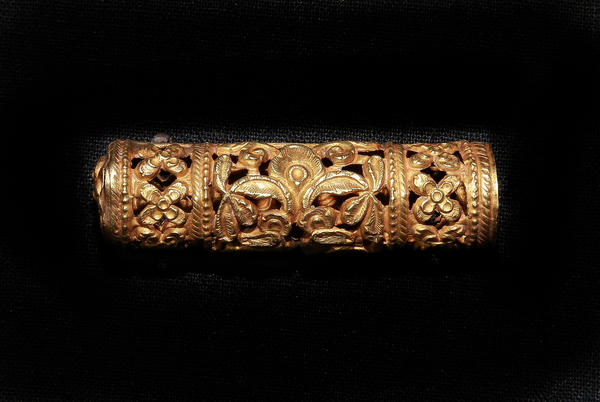
The cylindrical tumAr with slitted ornaments from the Astrakhan Museum Reserve collection was found in 1996 at the KrAsny Yar archeological site in the Astrakhan Region. Archaeologists determined that it was crafted in the XIII century AD. The amulet case is made of gold, while the eyes are of silver. It depicts two fallow deer near the flower that blooms so magnificently that it resembles a tree. Tumar was attached to a headdress — boktAg.
The headdress (bOcca, boktAg or googUn) distinguished women who belonged to the Mongol elite of the Chingisid states. The boktAg was made in the form of a round cap. The fabric base was attached to a frame made of branches, birch bark, bamboo strips or wire. A cylinder rose from the top of the head and then re-shaped into a cone with a flat top. The whole headdress was covered with a cloth that covered the back of the head; and finally a larger piece of fabric underneath rippled over the shoulders. The boktAg was richly decorated: embroidered with pearls and precious gems, sewn on appliques made of precious metals and feathers of rare birds.
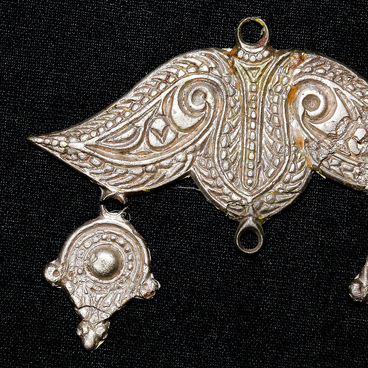
The costume, the appearance of the nomads was complemented by a whole complex of decorations: earrings, neck-chest ornamentals, for example, beads and necklaces, and sometimes bracelets and rings. They additionally decorated clothes, headdress, shoes. For this purpose, they used beads, amulets, appliques or bells, belt appliques and buckles, decorative buttons. The nomads used bags, cases, mirrors and other items as accessories.
Giovanni da Pian del Carpine, an Italian Franciscan, the first European to visit the Mongol Empire, left the memories of the appearance of the nomads. In his Ystoria Mongalorum, he wrote: ‘Girls and young women were very difficult to be distinguished from men, since they dress like men in everything.’ It is subject not only to the style of clothing (nomads often wore palls resembling a vest), but also meant that men also often decorated their outfits with decorative elements.
In 2005, the amulet case and other valuable archaeological finds from the Astrakhan Museum Reserve collection were exhibited at the Golden Horde: History and Culture show in Kazan (under the scientific supervision of the State Hermitage Museum).
The cylindrical tumAr with slitted ornaments from the Astrakhan Museum Reserve collection was found in 1996 at the KrAsny Yar archeological site in the Astrakhan Region. Archaeologists determined that it was crafted in the XIII century AD. The amulet case is made of gold, while the eyes are of silver. It depicts two fallow deer near the flower that blooms so magnificently that it resembles a tree. Tumar was attached to a headdress — boktAg.
The headdress (bOcca, boktAg or googUn) distinguished women who belonged to the Mongol elite of the Chingisid states. The boktAg was made in the form of a round cap. The fabric base was attached to a frame made of branches, birch bark, bamboo strips or wire. A cylinder rose from the top of the head and then re-shaped into a cone with a flat top. The whole headdress was covered with a cloth that covered the back of the head; and finally a larger piece of fabric underneath rippled over the shoulders. The boktAg was richly decorated: embroidered with pearls and precious gems, sewn on appliques made of precious metals and feathers of rare birds.
The costume, the appearance of the nomads was complemented by a whole complex of decorations: earrings, neck-chest ornamentals, for example, beads and necklaces, and sometimes bracelets and rings. They additionally decorated clothes, headdress, shoes. For this purpose, they used beads, amulets, appliques or bells, belt appliques and buckles, decorative buttons. The nomads used bags, cases, mirrors and other items as accessories.
Giovanni da Pian del Carpine, an Italian Franciscan, the first European to visit the Mongol Empire, left the memories of the appearance of the nomads. In his Ystoria Mongalorum, he wrote: ‘Girls and young women were very difficult to be distinguished from men, since they dress like men in everything.’ It is subject not only to the style of clothing (nomads often wore palls resembling a vest), but also meant that men also often decorated their outfits with decorative elements.
In 2005, the amulet case and other valuable archaeological finds from the Astrakhan Museum Reserve collection were exhibited at the Golden Horde: History and Culture show in Kazan (under the scientific supervision of the State Hermitage Museum).