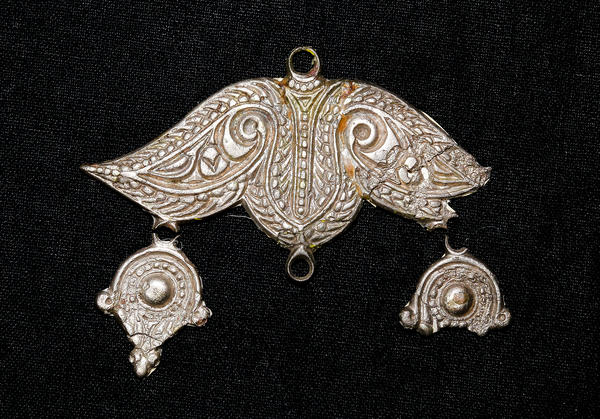
The sewn-on bird-shaped appliqué is decorated with a floral ornament. It also has two teardrop-shaped pendants attached to the jewelry body.
The appliqué was found by chance near the Volzhsky village in 1991 by local residents, and the Astrakhan Museum Reserve acquired it to enrich its collection. The adornment item was created around the 9th-10th centuries AD. To emboss the badge with the pattern, an ancient craftsman hammered a special tool (an embossing die). The eyes designed to sew the appliqué to the fabric and to attach the pendants are soldered.
Most researchers of nomadic antiquities believe that such ‘bird’ badges indicate OghUz burials. The Oghuz is a confederation of Turkic-speaking nomadic tribes from the Central and Middle Asia from the middle of the 1st to the beginning of the 2nd millennia.
The researchers also noticed that such bird-shaped badges are most often found in the women’s burials, and less often in the children’s burials. Such appliqués are divided into two types: with birds of prey and waterfowl (ducks or geese). The Turkic peoples especially revered waterfowl images: they personified the unity between the earth, water and sky. The predator images symbolized the upper world. The ancient people believed in the symbol of the world tree that divided the world into three parts: the upper (divine), middle (earthly) and lower (underground) ones.
Such bird images were popular in the religion and folklore of all ethnic groups of Eurasia. The Siberian peoples crafted bird-shaped ongons. The ongons are ritual objects that, according to a legend, are occupied with the spirits of ancestors and family deities. Shamans used high poles to install the figures of flying birds on near their dwellings.
It was also believed that birds served as intermediaries between people and the sky. Various peoples celebrate the arrival of birds in spring. Many images of birds were found among the Finno-Ugric peoples. Also, birds are quite often characters of myths and epic poems. For example, the AltAi mythology has a good deity UltEn who appears to people as a duck or a light goose. A plot about the bird-demiurge (creator) is popular in the KhakAss folklore and among other Siberian peoples.
The appliqué was found by chance near the Volzhsky village in 1991 by local residents, and the Astrakhan Museum Reserve acquired it to enrich its collection. The adornment item was created around the 9th-10th centuries AD. To emboss the badge with the pattern, an ancient craftsman hammered a special tool (an embossing die). The eyes designed to sew the appliqué to the fabric and to attach the pendants are soldered.
Most researchers of nomadic antiquities believe that such ‘bird’ badges indicate OghUz burials. The Oghuz is a confederation of Turkic-speaking nomadic tribes from the Central and Middle Asia from the middle of the 1st to the beginning of the 2nd millennia.
The researchers also noticed that such bird-shaped badges are most often found in the women’s burials, and less often in the children’s burials. Such appliqués are divided into two types: with birds of prey and waterfowl (ducks or geese). The Turkic peoples especially revered waterfowl images: they personified the unity between the earth, water and sky. The predator images symbolized the upper world. The ancient people believed in the symbol of the world tree that divided the world into three parts: the upper (divine), middle (earthly) and lower (underground) ones.
Such bird images were popular in the religion and folklore of all ethnic groups of Eurasia. The Siberian peoples crafted bird-shaped ongons. The ongons are ritual objects that, according to a legend, are occupied with the spirits of ancestors and family deities. Shamans used high poles to install the figures of flying birds on near their dwellings.
It was also believed that birds served as intermediaries between people and the sky. Various peoples celebrate the arrival of birds in spring. Many images of birds were found among the Finno-Ugric peoples. Also, birds are quite often characters of myths and epic poems. For example, the AltAi mythology has a good deity UltEn who appears to people as a duck or a light goose. A plot about the bird-demiurge (creator) is popular in the KhakAss folklore and among other Siberian peoples.