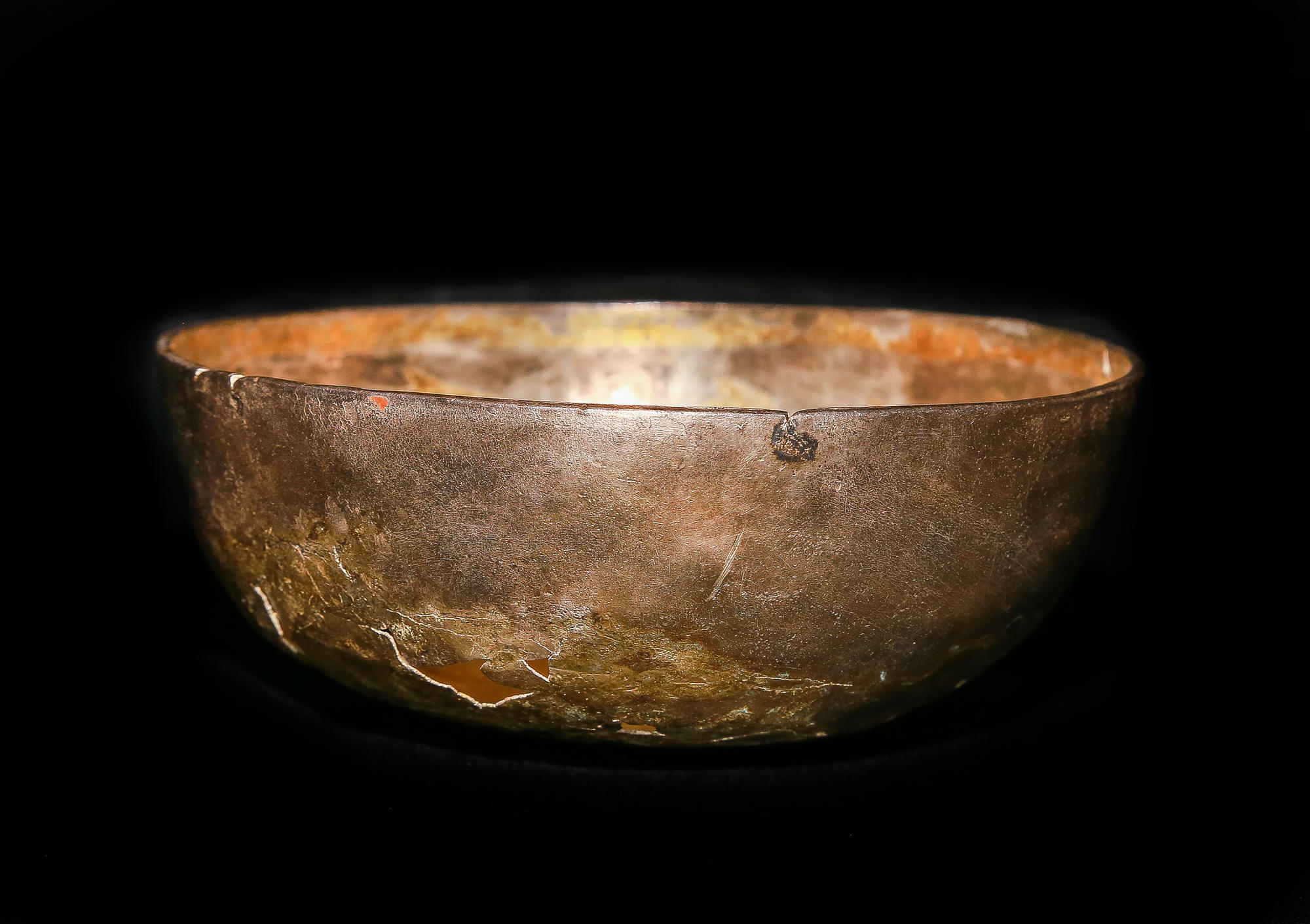


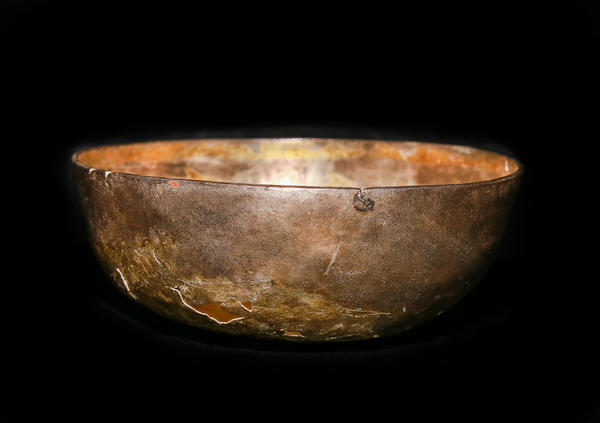
The phiale was a low sacrificial bowl without handles. It was often used as a part of rituals and ritual feasts, and as a container to keep incense as well. The vessel from the Astrakhan Museum Reserve collection was made around the 1st century BC. The valuable item was found in the BEra mound near the KOsika village in the YenotAyevsky District. This burial was opened and destroyed in 1984, when a water culvert trench was laid there.
There is an ornament on the inner surface of the bowl: there is a gilded ribbon under the ring; four fish and four dolphins swimming one after another are depicted along the perimeter. There is a ribbon of crests of running waves. The bottom of the phiale is decorated with a flower. Its long, sharp petals touch the waves, and heart-shaped ovary figures are visible in the middle. The flower could personify the world tree that, according to myths, connected three worlds: underground, earthly and heavenly. This symbol was present in the epics of many ancient peoples.
Fish images may be associated with the Iranian epic. The Iranian mythological picture of the world portrays a giant good fish Kara living in the Ranghe world river. The river washed one side of the world and personified the edge of the world. The fish guarded the world tree that grew in the middle of the Vorukasha Lake. Another giant fish swam in the ocean of the underworld and carried the bull on itself as the support for the world. Among the Iranian peoples, fish was considered a pure creature.
All images are engraved and also plated with gold. It was a technique where thin plates of precious metal were heated and then laid on the base. This decoration method was typical for the workshops of the Hellenistic East. Later on, in the era of late Antiquity and the early Middle Ages, it was inherited by the Sassanian craftsmen who were residents of an ancient state located within modern Iraq and Iran.
In 2005, the phiale and other ritual items from the Astrakhan Museum Reserve collection were exhibited at the Astrakhan Steppe Treasures show at the National Museum of the Palazzo Venezia in Rome.
There is an ornament on the inner surface of the bowl: there is a gilded ribbon under the ring; four fish and four dolphins swimming one after another are depicted along the perimeter. There is a ribbon of crests of running waves. The bottom of the phiale is decorated with a flower. Its long, sharp petals touch the waves, and heart-shaped ovary figures are visible in the middle. The flower could personify the world tree that, according to myths, connected three worlds: underground, earthly and heavenly. This symbol was present in the epics of many ancient peoples.
Fish images may be associated with the Iranian epic. The Iranian mythological picture of the world portrays a giant good fish Kara living in the Ranghe world river. The river washed one side of the world and personified the edge of the world. The fish guarded the world tree that grew in the middle of the Vorukasha Lake. Another giant fish swam in the ocean of the underworld and carried the bull on itself as the support for the world. Among the Iranian peoples, fish was considered a pure creature.
All images are engraved and also plated with gold. It was a technique where thin plates of precious metal were heated and then laid on the base. This decoration method was typical for the workshops of the Hellenistic East. Later on, in the era of late Antiquity and the early Middle Ages, it was inherited by the Sassanian craftsmen who were residents of an ancient state located within modern Iraq and Iran.
In 2005, the phiale and other ritual items from the Astrakhan Museum Reserve collection were exhibited at the Astrakhan Steppe Treasures show at the National Museum of the Palazzo Venezia in Rome.