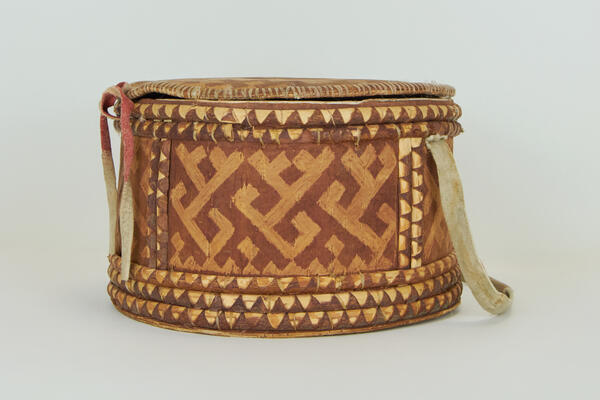
The history of birch bark craft has its roots in the distant past. In those times, people lived in complete unity with nature — their livelihood depended on it as nature provided food, building materials and tools. The word “tuyes” was borrowed from the Northern Russian dialects of the Komi language: “toy” meant “birch bark”. In the modern Komi language, the word has fallen out of use, only the word “tuyis” — “tuyesok”, “burak” — has been preserved, which may be a reverse borrowing from Northern Russian dialects. The object itself and the words denoting it are of Finno-Ugric origin.
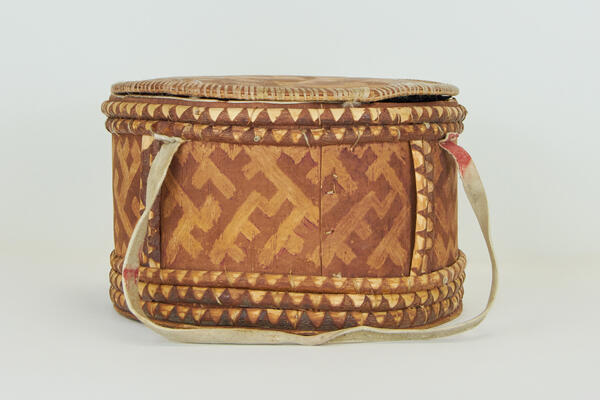
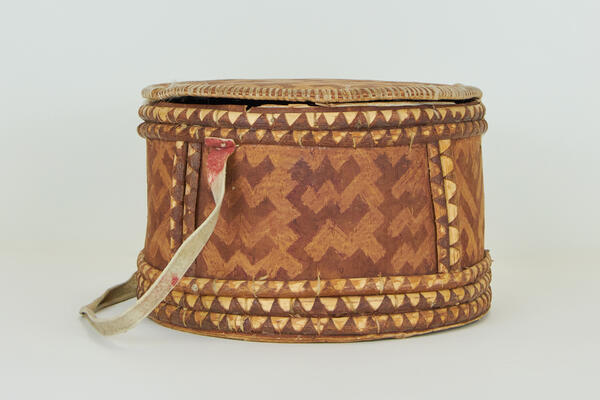
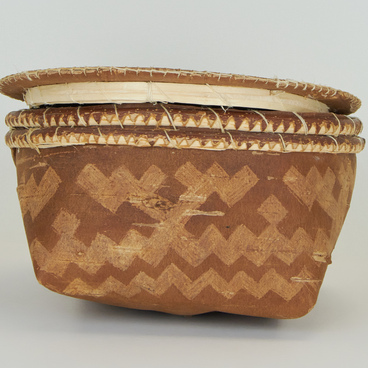
A classic tuyes is a small cylindrical or oval box made of birch bark that has a wooden bottom and a tight-sealing lid. Its inner layer is used to contain liquids. To make a tuyes, one needed a “skoloten” — a cylindrical piece of birch bark. Skoloten is harvested at a certain time of the year. The design of the tuyes is strikingly simple and practical. It resembles a thermos, because it has an outer and an inner layer, with a small air insulation area between them. A tuyes is assembled without nails, glue or other fasteners or adhesives. The edges of some of these boxes were reinforced with pine roots inserted between the layers. The exterior part of the tuyes was decorated with scratched vegetable or animal patterns. This tradition is especially widespread in the Shuryshkarsky district of the Yamalo-Nenets Autonomous Okrug.
Tuyes containers are very
durable. Birch bark has many layers which prevents liquid from leaking through. On
hot days, tuyes boxes kept water, kvass and
other soft drinks cool, and preserved the temperature of hot drinks. Birch bark boxes were used for storing small items and
food. Birch bark has antibacterial properties, so even perishable foods in it
stay fresh longer. A tuyes was used to store a variety of products: salt,
pickles, honey, berries… People took them everywhere — a tuyes accompanied
farmers in the field, hunters in the forest and fishermen on the river.