Ancient tableware has changed many names throughout its long history: “postavok”, “burak”, “kubyshka”. The word “tuyes” was borrowed from the Northern Russian dialects of the Old Permiс (Komi) language. Birch bark craft has a long history when people used to live in complete unity with nature. The livelihood of every person depended on it, as nature provided food, building materials and tools. Birch bark is the most common material for traditional Khanty crafts. It accompanied people throughout their lives: as infants they lay in cradles made of birch bark and when they were buried, their bodies were wrapped in birch bark. Kitchen utensils intended for cooking, carrying and storing food were made of the top layer of bark removed from the birch. Items made of birch bark were light, which was especially important for portable objects. As a raw material, it was elastic which allowed end-products to vary in shapes and sizes. Birch bark also has antibacterial properties, so even perishable goods stay fresh longer if stored in utensils made of it. They were also very durable and especially useful for transferring and storing products. Such items include “nabirushki”, “kuzovki” (both a type of a basket) and boxes. Such boxes and baskets were intended for collecting wild plants in large volumes. Harvesting birch bark was widely regarded as a woman’s job.
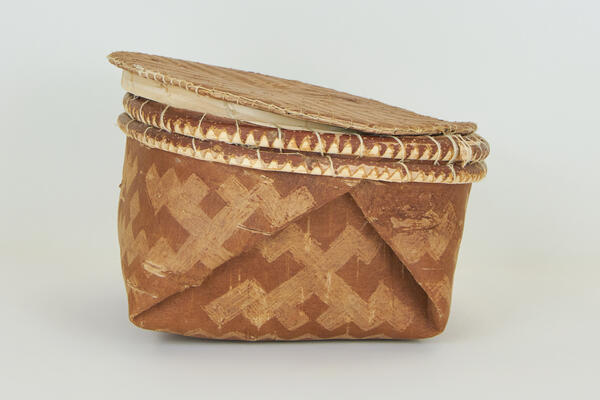
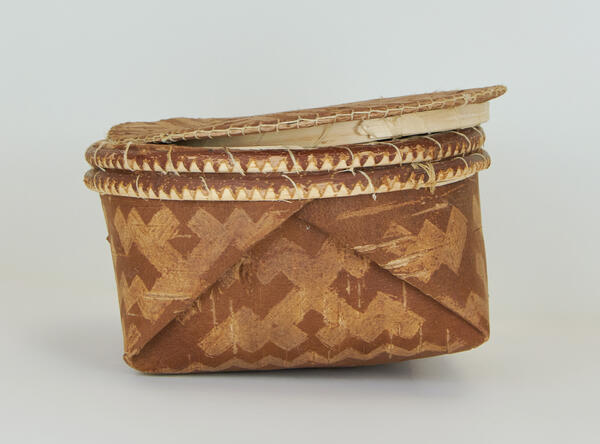
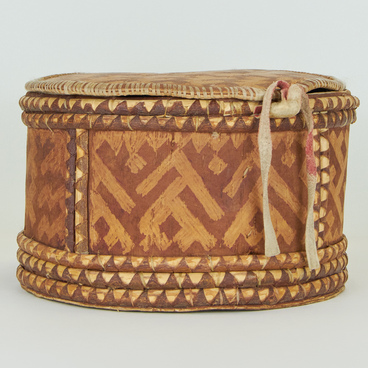
The tuyes box on display was
made of a single layer of a birch bark, folded inwards from the outside. There
is a wooden rim sewn into the top part of the box, giving it a round shape.
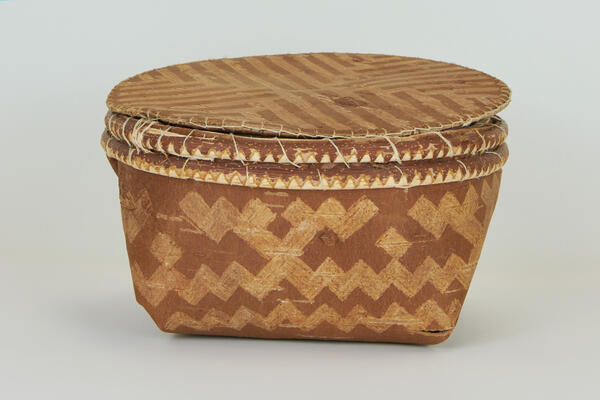
On the exterior, the tuyes box is decorated with a scratched pattern “Legs of a small frog”. The rims are decorated with
small carved triangles. The bottom is simplified and square. Its corners are
folded, bent upward and secured with two wooden rims fastened with a firm
thread. The round-shaped lid is made up of two birch bark discs sewn together
over the edges by threads and decorated with a straight-line pattern over its
entire surface. A wooden hoop is sewn to the inside of the lid, allowing it to
fit snugly to the top of the box.