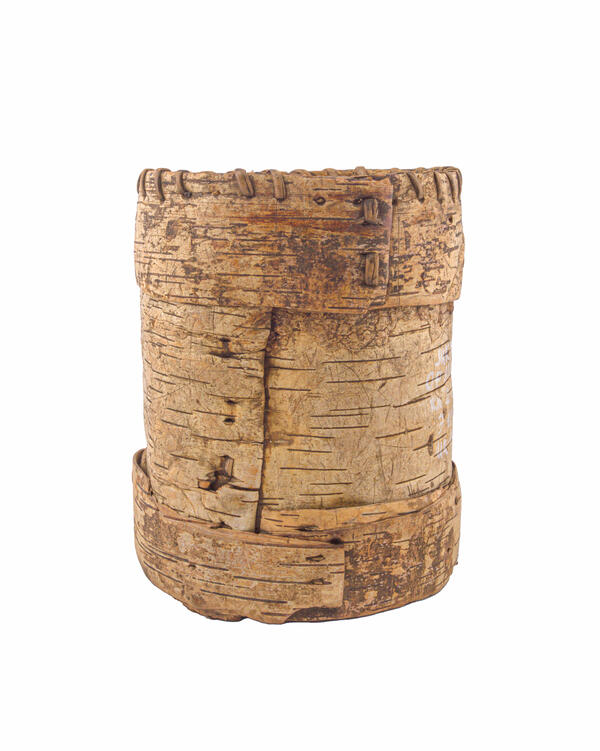
Having visited Siberia in the 18th century, the Swedish born engineer, traveler and Russian diplomat Lorenz (Lavrenty) Lang, wrote in his travel diary that all the utensils of the Tomsk Shors consisted of an iron cauldron and birch bark vessels. Vasily Vasilyevich Radlov also noted the importance of birch bark utensils in Shor communities.
Birch bark is the top thin layer that is pinkish cream in color. This material was harvested at the end of May — beginning of June, when birch trees were full of sap and the birch bark layer could be separated as easily as possible. With a certain skill and accuracy, it was removed without damaging the next layer, so that after a few years the trunk restored its bark.
The Shors also harvested bird cherry bark called “sarga”: using a knife, people cut it in “straps” from branches and then pulled through a special recess in the handle of the knife to straighten it. The sarga bark was rolled and stored, and immediately before use it was steamed with boiling water to restore the necessary flexibility.
Birch bark was used to make small cups, impressively sized kuspak vessels, which could contain from 9 to 12 buckets of liquid, and ulan boxes for storing grain with a capacity of up to 25 poods. Small items were joined with a braided seam. When making large containers and vessels, the Shors used ugum threads made from split cedar root (this seam was called kostan), horsehair or bird cherry bark.
The presented tozek vessel with a lid is made from kyuchen birch bark taken off like a “stocking” from a cut down tree. Such containers were used as thermoses: even in hot weather, the drink in them remained cold. A solid layer of bark ensures the vessel’s waterproof.
The front side of the vessel was wrapped in a “shirt” (a piece of birch bark cut on one side), which was fastened with a “lock” or sewn together. The workpiece was treated with steam and a wooden bottom was hammered between the walls. The dried bark covered it so tightly that no additional fastening was required.
If the artist wanted, he could decorate the tozek
with a geometric or zoomorphic ornament, using the technique of embossing or
slotted carving with a background.