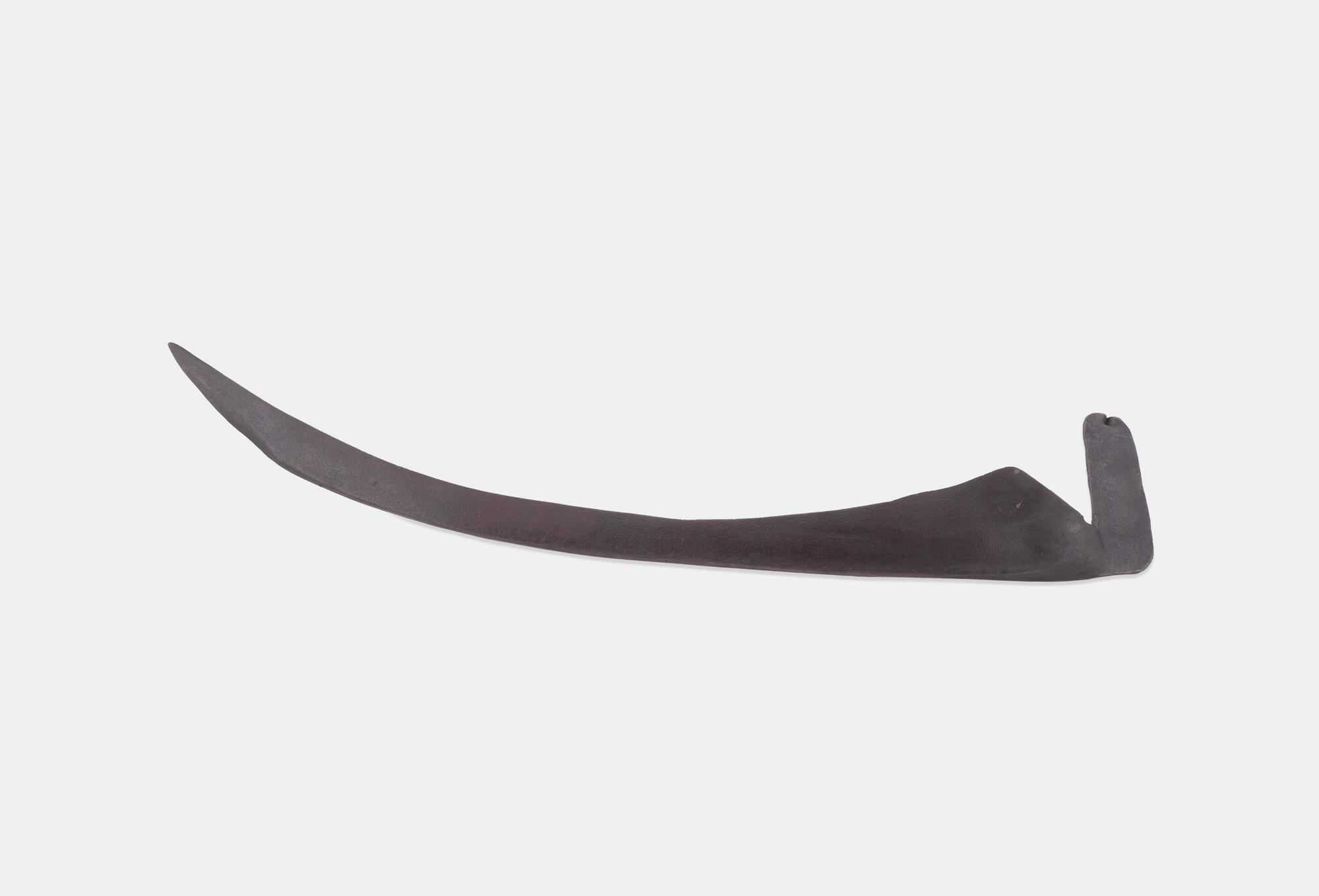


The scythe is used in agriculture for mowing grass, making hay, and preparing feed for livestock, as well as for harvesting crops. Before the scythe with a long straight handle people used a sickle and a short scythe, that required bending over while mowing. In Russian, the scythe with a long handle is called “litovka” or a “stand-up” scythe, which indicates that the mower does not have to bend down when working with it.
All these cutting tools came into use only with the development of metallurgy, at the end of the Neolithic era (6th –4th BC), since pointed stones were not suitable for such work.
The chine is made of high-quality steel: the blade is slightly bent inward, the stiffening rib along the outer edge is thickened near the base — the “heel”. A ring or a tang are used to mount the blade on the shaft. The grips were usually made of bird cherry or willow, the snaith was made of spruce or, less commonly, of birch or pine.
As an individual tool, the scythe requires adjustment to the height and style of mowing of a particular person, as well as to the height and hardness of the grass. The scythe allows the mower to change the inclination of the blade relative to the shaft. The correct setting is determined by the characteristic clear ringing sound of the tool cutting grass and the ease of movement. With sufficient skills, even long-term work does not cause excessive fatigue.
Traditionally, people went scything in the morning, before the heat of the day set in and, preferably, before the dew disappeared. The dew makes the grass and stems heavier, causing them to have greater inertial resistance, and the blade cuts rather than bends them to the ground. In addition, regular cooling with dew has a good effect on the cutting ability of the knife.
Places in river valleys are considered optimal for
haymaking. But, since they are occupied by Russian villages, the Shors have to
put up with average and even worse conditions. Shor cattle graze in forest
clearings and by mid-August almost completely trample down the pasture. For
this reason, the Shors are forced to drive animals out onto fresh grass in
haymaking areas. It is always delayed, just as the haymaking season is delayed
due to frequent rains. Almost every year it ends only at the end of autumn,
often coinciding with the grain harvest.