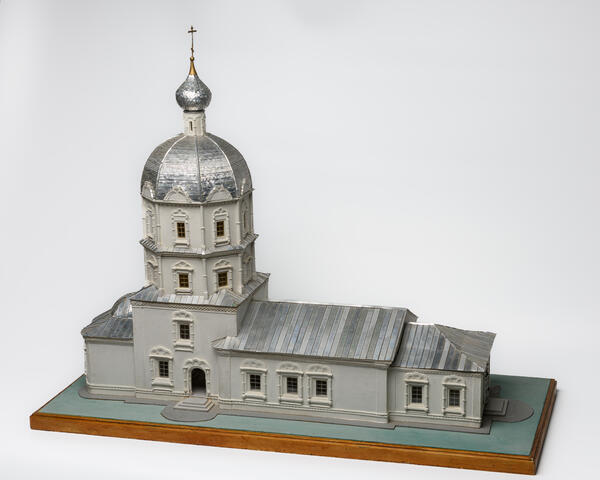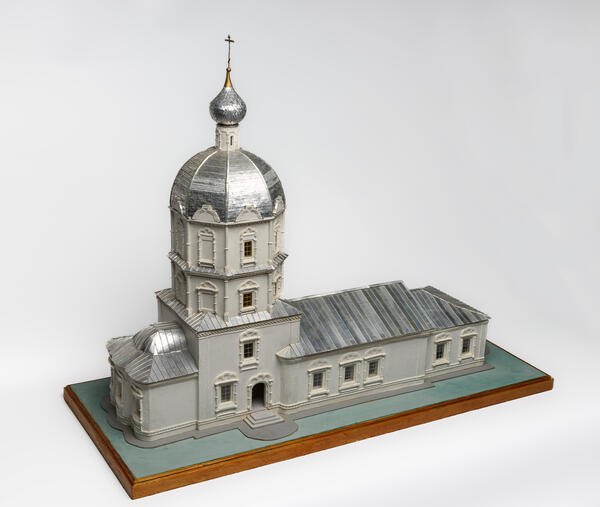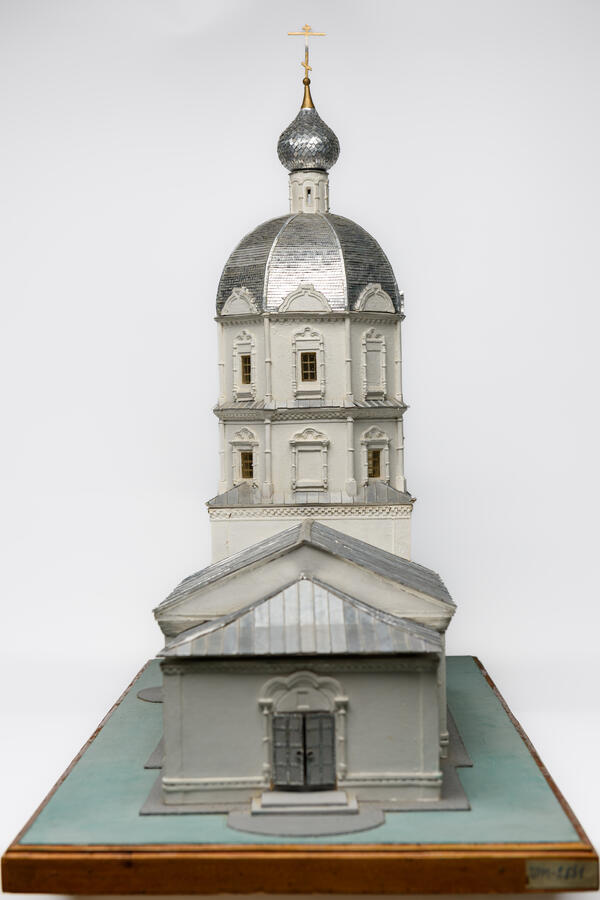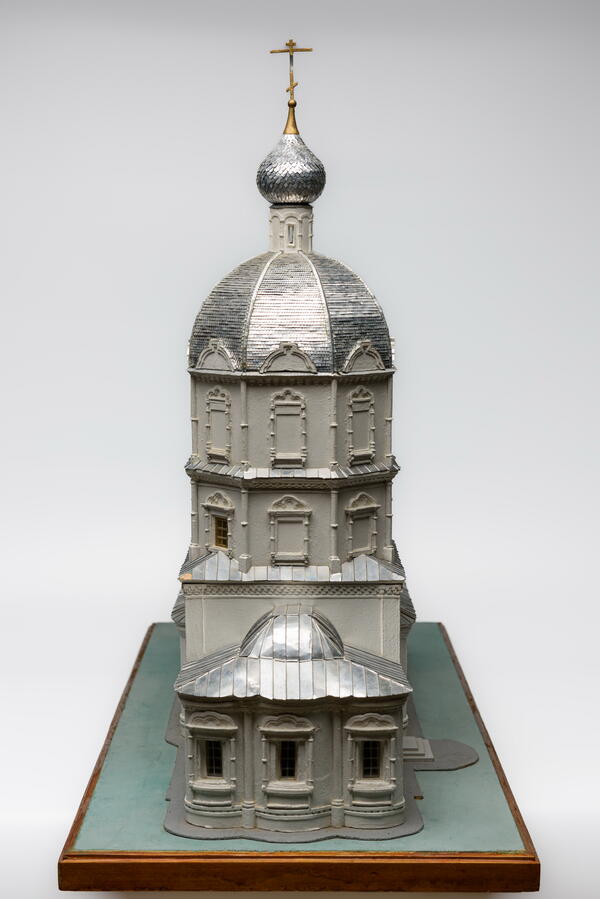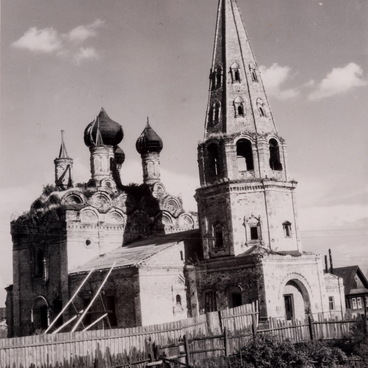
In 1757–1784, at the expense of the townspeople, the Church of the Most Holy Life-Giving Trinity was built in Balakhna. It became part of the ensemble of the first town cemetery, the Trinity Necropolis. Among others, the owners of the Charyshnikovs’ Bell Factory found their final resting place there, and in the 1940s — the soldiers who died in Balakhna hospitals.
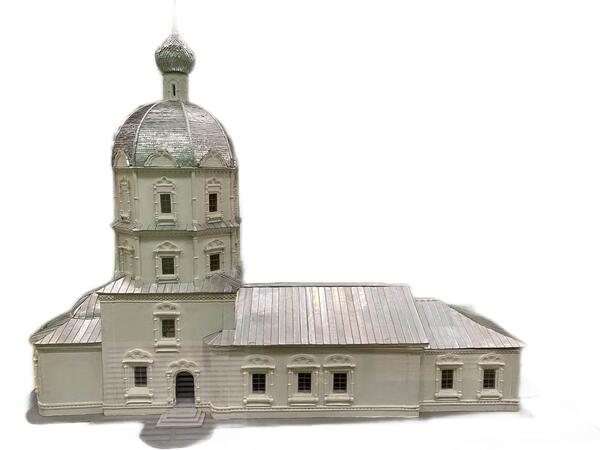
The design of the church is characteristic of the architectural traditions of the 18th century, but few buildings of this kind have been preserved in the Nizhny Novgorod region. A peculiar tower made of two octagons connected under the dome is installed on the cube-shaped part. The upper octagon is completed by an octagonal, small, tin-roofed “onion” dome on a round drum. It is covered with ceramic tiles. The church is decorated in the Baroque style.
All windows are rectangular, the moldings on the window frames are decorated on the sides with thin columns and kokoshniks.
Two chapels are adjacent to the main Trinity Chapel: one is consecrated in honor of the Dormition of the Most Holy Theotokos, the other is in the name of Michael the Archangel. When the church was built, a bell tower was attached to the northwest side. On the west side of the structure is a refectory; in its turn, it is connected to a heated narthex.
It is known that one of the donors of the church was Pyotr Semyonovich Latukhin, a merchant of the 1st guild, who for 23 years (starting in 1748) permanently held the post of Balakhna burgomaster. Before his death, he donated 2,000 rubles and two barrels of tin to make bells for his parish church — the Church of the Theotokos of the Sign — and for the Trinity Church at the cemetery. The cemetery bell, cast with these funds, weighed 103 poods (1 pood is about 16 kg).
In 1930, the bell tower was demolished. A year later, a similar fate almost befell the church, because it interfered with a high-voltage line. After the believers appealed to the Presidium of the Central Executive Committee, it was decided to cancel the demolition, but soon the church was abolished. In the mid-20th century, the property of other churches was stored in it, then a carpentry workshop was set up there, where coffins were produced.
Only in the mid-1990s the church was returned to the parishioners and restored. In 2014, a belfry was erected on the site of the demolished church. Now the church is a monument of federal significance.
The design of the church is characteristic of the architectural traditions of the 18th century, but few buildings of this kind have been preserved in the Nizhny Novgorod region. A peculiar tower made of two octagons connected under the dome is installed on the cube-shaped part. The upper octagon is completed by an octagonal, small, tin-roofed “onion” dome on a round drum. It is covered with ceramic tiles. The church is decorated in the Baroque style.
All windows are rectangular, the moldings on the window frames are decorated on the sides with thin columns and kokoshniks.
Two chapels are adjacent to the main Trinity Chapel: one is consecrated in honor of the Dormition of the Most Holy Theotokos, the other is in the name of Michael the Archangel. When the church was built, a bell tower was attached to the northwest side. On the west side of the structure is a refectory; in its turn, it is connected to a heated narthex.
It is known that one of the donors of the church was Pyotr Semyonovich Latukhin, a merchant of the 1st guild, who for 23 years (starting in 1748) permanently held the post of Balakhna burgomaster. Before his death, he donated 2,000 rubles and two barrels of tin to make bells for his parish church — the Church of the Theotokos of the Sign — and for the Trinity Church at the cemetery. The cemetery bell, cast with these funds, weighed 103 poods (1 pood is about 16 kg).
In 1930, the bell tower was demolished. A year later, a similar fate almost befell the church, because it interfered with a high-voltage line. After the believers appealed to the Presidium of the Central Executive Committee, it was decided to cancel the demolition, but soon the church was abolished. In the mid-20th century, the property of other churches was stored in it, then a carpentry workshop was set up there, where coffins were produced.
Only in the mid-1990s the church was returned to the parishioners and restored. In 2014, a belfry was erected on the site of the demolished church. Now the church is a monument of federal significance.