Wooden sculpture is a unique phenomenon of Russian church art. It became widespread in Novgorod, Perm, and the Arzamassky Uyezd; masters from the Balakhninsky Uyezd also created their own wooden sculptures and high reliefs.
Today, this genre is almost forgotten. Authentic Baroque interiors with carved figures on iconostases and individual sculptural compositions can be found in few urban and rural churches.
In the 18th–19th centuries, the Holy Synod opposed keeping sculptures in churches, but on the periphery the prohibitions were not so strict.
Monuments of pre-Petrine times preserve ancient folklore motifs. Peasant craftsmen, including carvers, were often engaged in the design of parish churches. They created images of favorite Christian patrons: Nicholas the Wonderworker, Paraskeva Friday and others. The masters frequently depicted them to resemble the characteristic features of their own people.
This art form was developed under the influence of sculptors of the Russian North and, since the Baroque era, Catholic trends.
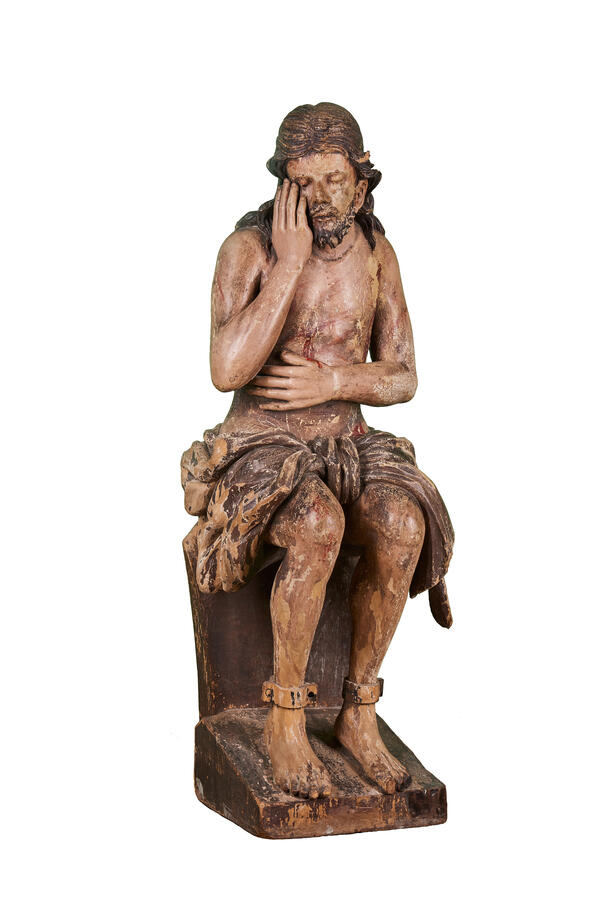
As to the image of the Savior, the masters rarely depicted Christ in Glory or the Almighty. More often, they chose to represent him as a “peasant” God who suffers for people: “The Suffering Christ”, “Christ in the Tomb” and especially “Christ in the Dungeon”. There was a specific canon of the latter image. The Savior, dressed only in a loincloth, sits on a pedestal, his shackled feet rest on a stand; his head with curly hair is wearily lowered, his eyes are closed. Jesus presses one hand against His pierced rib, the other touches the head wearing the Crown of Thorns. This life-size sculpture was carved from a single piece of wood. Initially, it was painted. The master painted smudges of blood on the head left by the thorns of the crown and the scars on the Savior’s body using tempera.
The presented monument is dated to the second half of the 18th century, the names of the carvers are unknown. The creation of holy images was considered a virtuous deed, and the masters did not put their signatures on them.
The Local History Museum of Balakhna received this sculpture for permanent storage on December 16, 1982.
Today, this genre is almost forgotten. Authentic Baroque interiors with carved figures on iconostases and individual sculptural compositions can be found in few urban and rural churches.
In the 18th–19th centuries, the Holy Synod opposed keeping sculptures in churches, but on the periphery the prohibitions were not so strict.
Monuments of pre-Petrine times preserve ancient folklore motifs. Peasant craftsmen, including carvers, were often engaged in the design of parish churches. They created images of favorite Christian patrons: Nicholas the Wonderworker, Paraskeva Friday and others. The masters frequently depicted them to resemble the characteristic features of their own people.
This art form was developed under the influence of sculptors of the Russian North and, since the Baroque era, Catholic trends.
As to the image of the Savior, the masters rarely depicted Christ in Glory or the Almighty. More often, they chose to represent him as a “peasant” God who suffers for people: “The Suffering Christ”, “Christ in the Tomb” and especially “Christ in the Dungeon”. There was a specific canon of the latter image. The Savior, dressed only in a loincloth, sits on a pedestal, his shackled feet rest on a stand; his head with curly hair is wearily lowered, his eyes are closed. Jesus presses one hand against His pierced rib, the other touches the head wearing the Crown of Thorns. This life-size sculpture was carved from a single piece of wood. Initially, it was painted. The master painted smudges of blood on the head left by the thorns of the crown and the scars on the Savior’s body using tempera.
The presented monument is dated to the second half of the 18th century, the names of the carvers are unknown. The creation of holy images was considered a virtuous deed, and the masters did not put their signatures on them.
The Local History Museum of Balakhna received this sculpture for permanent storage on December 16, 1982.