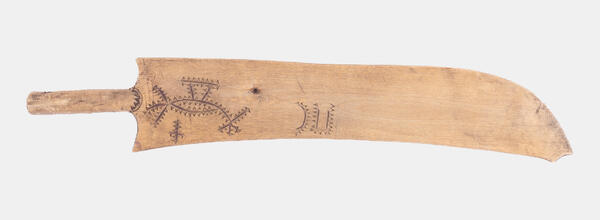
Most homespun items were made from flax or hemp yarn, and the raw material was carefully prepared for spinning. The stalks of flax and hemp were crushed and then cleaned of shives and coarse particles (so called “otrepja”). The process of cleaning was called scutching. Sometimes a bundle of fibers was beaten with force on a pole or wall, but more often a special tool, a scutching knife, was used.
Scutching knives were flat planks with a turned handle. They were usually made of oak, birch or maple wood. People believed that lighter woods should be used for slightly soiled flax, and heavy woods were required for processing stiffer flax or hemp.
Scutching was an exclusively women’s occupation. A peasant woman held a bundle of crumpled stalks (povesmo) in her left hand, winding it around her wrist. With her right hand she would strike the flax or other raw material hard and fast, alternately from both sides, trying to reach the middle of the bundle and then scraping it down as if combing through the fiber, cleaning it from shives while smoothing it at the same time. If there was a lot of work, the scutching woman could lean with her left hand on a barrel or a special stand.
As a result, the woman obtained not only long fibers for yarn, but also coarse short ones — codilla, suitable for weaving ropes, caulking windows and other household needs.
It was not a difficult task to produce a simple working scutching knife. But more often craftsmen wanted to decorate the tool with paintings and one-sided or through carvings. As a rule, such a job was done by skilled artisans. An elegantly decorated scutching knife was considered a good gift for a beloved girl or a young wife. It often had the initials of the owner or family marks on it. It was not only a decoration, but also an identification mark, so that the scutching knife, which had become “perfect fit” for the owner over the years, could not be mixed up with others during the collective autumn works.
Scutching was considered one of the most important skills in the life of a girl and a woman. People used to say that for a woman a scutching knife is the same as an axe for a man, and they suggested that those choosing a wife for their son should pay attention to how the girl works at scutching flax or hemp, and whether she is praised by older women. The Russian proverb says, “Look for a future groom in the steam room, and future bride — in the scutching house”.