

#1
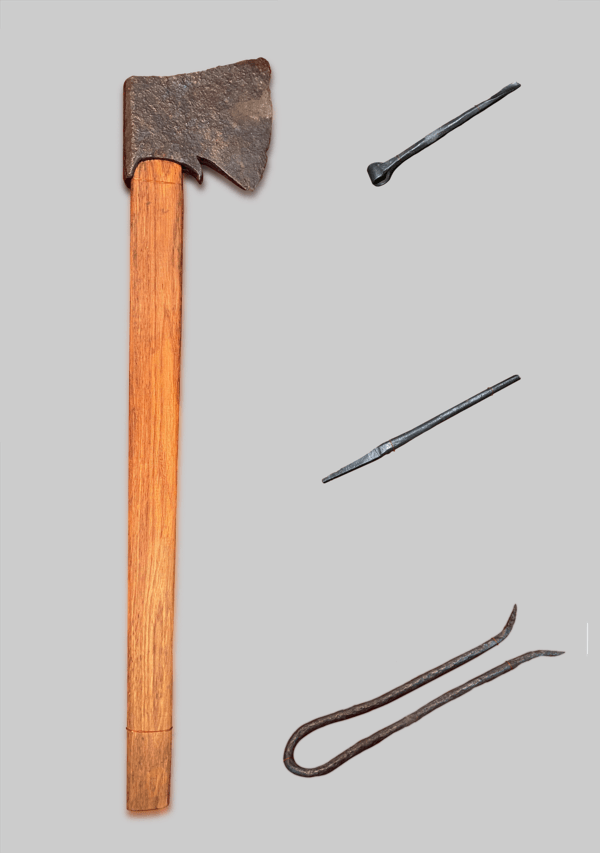
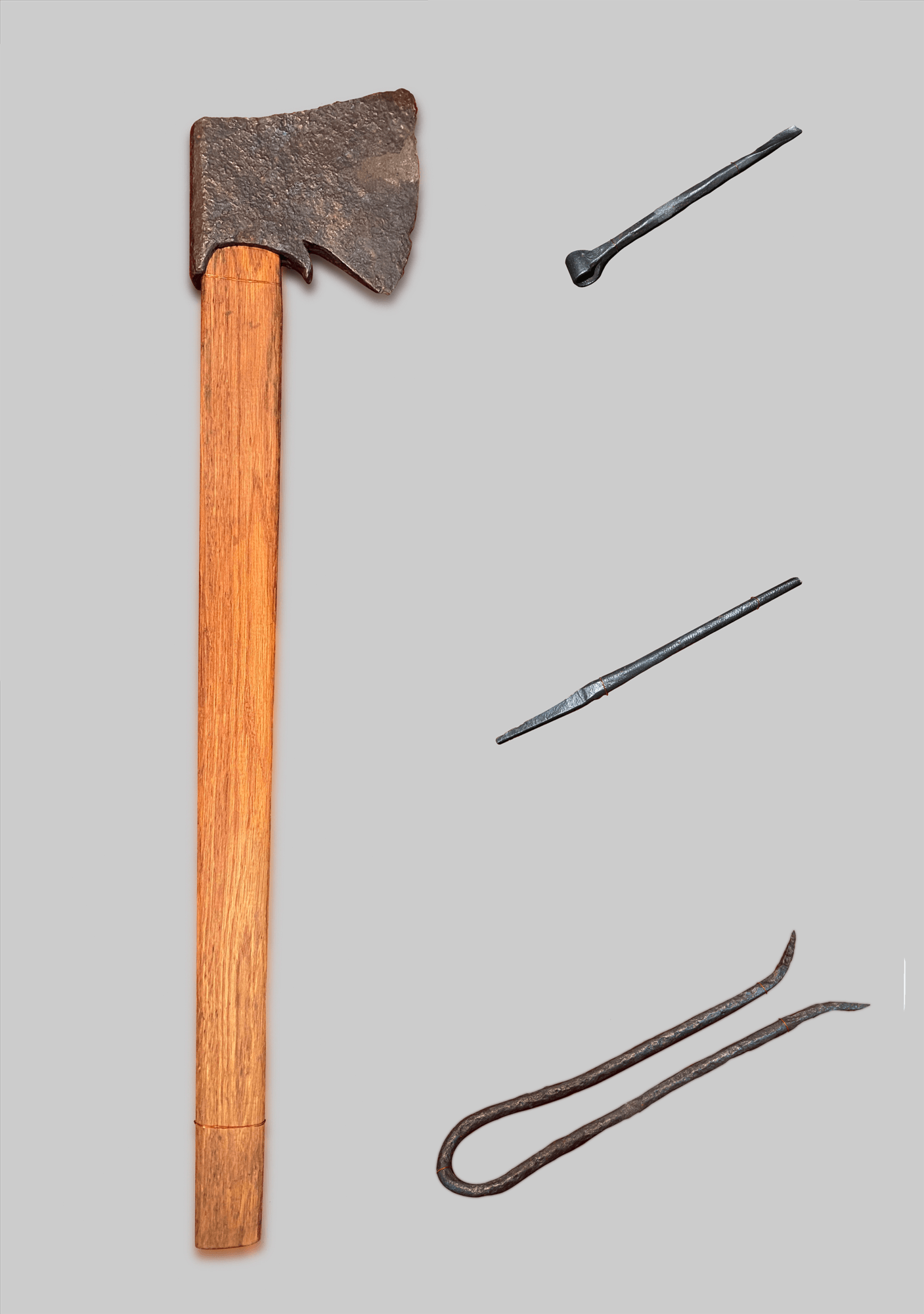
Axe, flat drill, file, scriber
#14
#2
#6
Service class people of Kuznetsk ostrog participated in military expeditions and long-distance special duty assignments, pulled duty on the town walls, they were sent out to collect yasak (tribute paid off in furs). But their principal occupation was construction: they built fortifications, dwellings and housekeeping areas. Wood processing tools from the excavations in Kuznetsk ostrog are an important source of information for learning the city history.
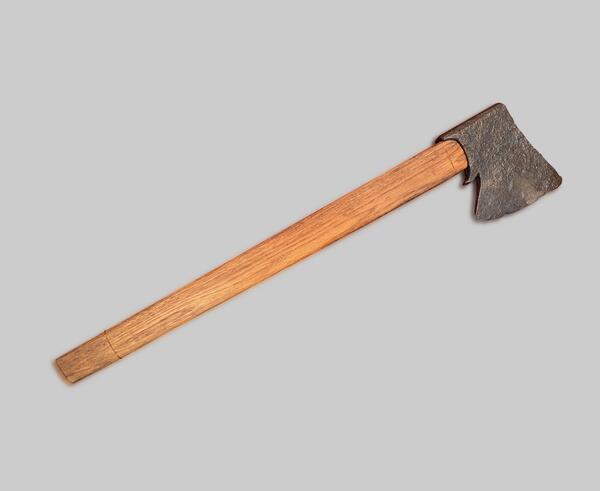
The axe in the museum permanent exhibition was used for cutting and hewing. It is an iron shaft-hole axe with an arc-shaped cutting surface. The axe has been restored, i.e. cleared from corrosion and helved.
Traditionally, the axes consisted of three parts – a metal blade, a wooden handle and a wedge to fix the axe on it. The handle could be of various shapes. The longer was the handle, the stronger could be the strike upon sweeping the axe.
The axe handle was driven into a special eye in the blade and then the run-in end was expanded with a wedge. The principal part of the axe is a blade, as the durability and convenience of the tool depended on the blade properties. The axe handle was removable, it could be easily replaced by a beer one when required.
The metal part of the axe was made of hard steel. The edge was tempered applying a special method, to improve its cutting properties. The rest of the blade remained soft thus preventing chipping of the metal due to strong strikes. The axe yielded to the knife on hardness of the cutting edge, that is why it was easier and quicker to sharpen.
From a professional point of view, the axes differ by the blade size – wide, mid-size and narrow, or, to be more correct, by the width of the axe head: wide, mid-size and narrow. Wood cutting axes had a wide head; universal axes had a mid-size head, and a narrow head was typical for the axes of carpenters and for those used for fine work.
The axes are also divided by the length of the handle, the width and shape of the blade. The axes with straight sharpening were designed for making cutting strikes, while the curved sharpening allowed both cutting and chipping.
By their purpose, the axes are classified as universal wood processing tools. They were widely spread among the Siberian population in XVII century. Relevant evidence can be found in the customs books of Siberian cities where in the range of goods imported from Rus there were ‘small, mid-size and large axes’.
A specialist in fabrication technology of the articles made of ferrous metals, Nikolay Maximvch Zinyakov studied the axes found in excavations of Kuznetsk ostrog. The analysis showed that two axes found had been manufactured using different process schemes.
#7
Full name Iron axe
Date XVII century
Place Russia
Technique forging
Dimensions Width - 14,3 cm, height of axe head - 9,5 cm, blade height - 13,2 cm
Collection XVII – XVIII cent. Kuznetsk ostrOg – the town of Kuznetsk. Excavations of various years
Copyright Kuznetsk fortress
Restorers Scheglakov A.P.
Goskatalog Number 6539405
#15
Flet drill
#3
#8
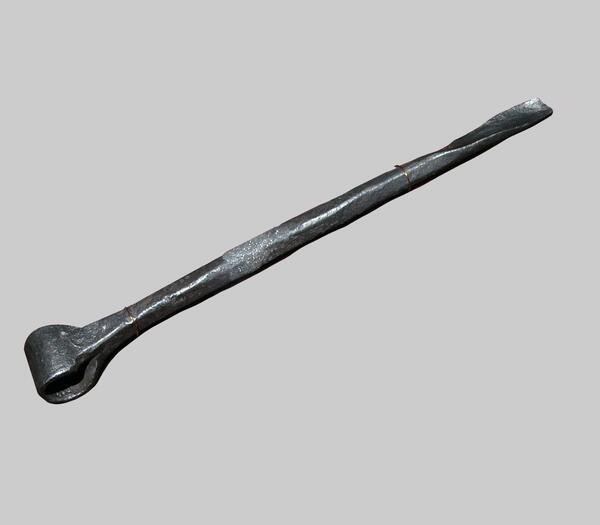
Pyorka is the name of a flat wood drill. In the documents of XVII century the drill is called ‘buravets’ (borer) or ‘buravchik’ (gimlet). Such drill was operated manually, holding the wooden handle with two hands and rotating it. The hand spiral flat drill in the museum permanent exhibition was found in Kuznetsk ostrog excavations. PyOrka was used to drill 9 mm holes. A small groove was designed for cuttings discharge. The drill is made of low carbon steel using ordinary pressure metal treatment.
As processes developed, the drill became one of the most universal tools. Over several millenniums, an ordinary wooden stem operated manually or by the bow string developed into a head of hand and automatic tools for making holes in various materials. As a rule, the drill is a cylinder stem with a spiral groove with a razor edge. Its point has sharpened razor edges that rotate to cut into the processed material. Sharpened side edges shape the side surface of the hole and the grooves discharge the cuttings from the processing area.
Cosmic iron and self-originated copper and other alloys that were added to the toolbox of ancient blacksmiths allowed them to manufacture the first metal drills. Initially, they were cone-shaped, square or triangular. In order to drill a deep hole, much effort was required, increasing the risk of breaking the tool – despite their sharp edges, the drills were rather crumpling than cutting the wood fibers. To facilitate the work, the drills were improved: a larger head was added, and then a large handle that was more convenient to hold.
The drills were both installed into the driving tools and hand operated. In ancient times the wood drills were called ‘napArye’, another name for them was ‘perovOye’. Its principal distinctive feature was the availability of just one cutting edge.
The arrow-headed drill was used by carpenters. The blacksmith forged the stem, shortened the working part by one third and shaped the cutting edge through round spreading. That drill became a significant step forward vs. tbe triangular and square drills — now the razor cut the fibers instead of crumpling them. When the arrow-headed drill was operated for a long time, removal of cuttings from the hole was time-consuming.
That is why the drills gradually became screw shaped. It allowed reducing the time of removing the cuttings by turning the tool in the rotational direction.
The wood pulp has a beautiful natural color and various types of texture, good thermal insulation and water resistance. Low density of wood made it convenient for processing. That is why it was used to construct dwellings, city walls and fortifications, churches and bridges. Household items were also made of wood: buckets, barrels, spoons, coops, salt cellars, bowls and cups. Wood processing crafts were developing in the areas rich in forests, and traditions were established. Each nation developed its own approach to wood processing, identified their preferences in fabrication of wooden items and decoration techniques.
#9
Full name Flat wood drill ‘Pyorka’
Date XVII century
Place Russia
Technique forging, forge welding
Dimensions Total length - 16,2 cm, bushing diameter - 1,3 cm
Copyright Kuznetsk fortress
Collection XVII – XVIII cent. Kuznetsk ostrOg – the town of Kuznetsk. Excavations of various years
Restorers Scheglakov A.P.
Goskatalog Number 6539975
#16
File
#4
#10
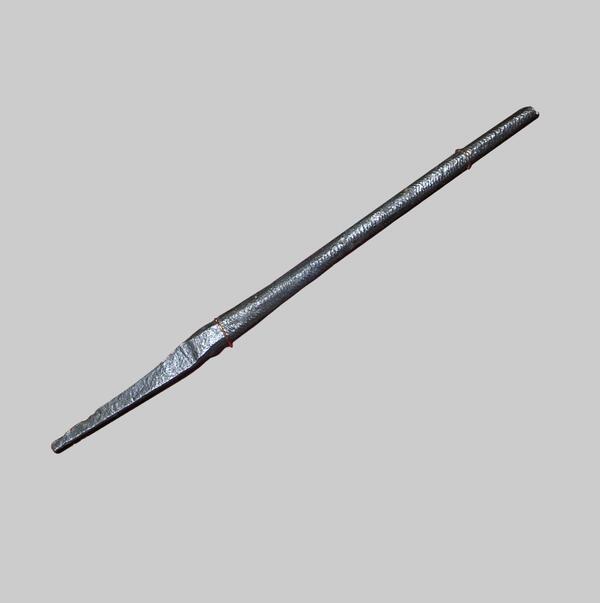
The file from the museum permanent exhibition was found during archaeological excavations in Kuznetsk osrtrOg. (small wooden fort). The body of the file gets narrower towards the end. It was forged from steel and thermo-hardened in cold water, and a special herring-bone notch was made on the file with a special chisel.
The history of the file started with processing stones, shells and other hard but fragile materials. Initially, flat stones with water and sand were used as files. But the stone roughness was insufficient for processing wood, that is why the craftsmen considered replacing the tool.
Metal files appeared as soon as people learned to process metals. Blacksmiths encountered certain difficulties while manufacturing files as the hardness of the file surface and that of the chisel used to manufacture the file were practically the same. They had to heat the file blank before notching it in order to reduce its hardness. But even such heating could hardly improve the chisel durability.
After the craftsmen mastered the methods of iron processing, the hardness of cutting tools improved within quite a short time – it became possible to harden the razor edge. After that its durability increased several-fold.
Gradually, various file manufacturing techniques were developed in medieval Europe. Theophole Gautier’s essay а “Schedula diversarum artium” dated X–XI cent. and dealing with various arts and crafts, described the manufacture of a file. Heavy and mid-weight files were made of homogeneous steel. They were four-sided, three-sided and round-shaped. Besides, there existed heavier files. Inside those there was soft iron covered with steel from the outside. After manufacturing them, the craftsman smoothed them using a round grinder and then notched it using a hammer pointed on both sides.
Other files were notched with a chisel. It was meant for fine processing of an item upon its preliminary rough sawing. At the final stage of manufacture the file was hardened.
Another chapter of the essay tells about the manufacture of small files from iron, followed by cementing of the notching dents and thermohardening. The first known automatic unit for notching the files was described in a manuscript by Leonardo da. Vinci. The carriage with a blank fixed in it is moved by a screw feed from the main shaft drive. On the same shaft a wheel with “fingers” is installed raising the hammer head with the chisel. The main shaft was rotated manually.
A file is an indispensable tool for fitters. Judging by its appearance, it was used for making round or oval holes and daps. In excavations, rasp files are also encountered, i.e. the files for processing soft materials – wood, bone, soft metals. Large spaced notches allow processing soft materials without clogging with chip scrap.
#11
Full name File
Date XVII century
Place Novokuznetsk, Russia
Technique forging, tooling, thermohardening
Dimensions length - 14,7 cm
Collection XVII – XVIII cent. Kuznetsk osrtrog (small wooden fort) – the town of Kuznetsk. Excavations of various years
Copyright Kuznetsk fortress
Restorers Scheglakov A.P.
Goskatalog Number 6540020
#17
Scriber
#5
#12
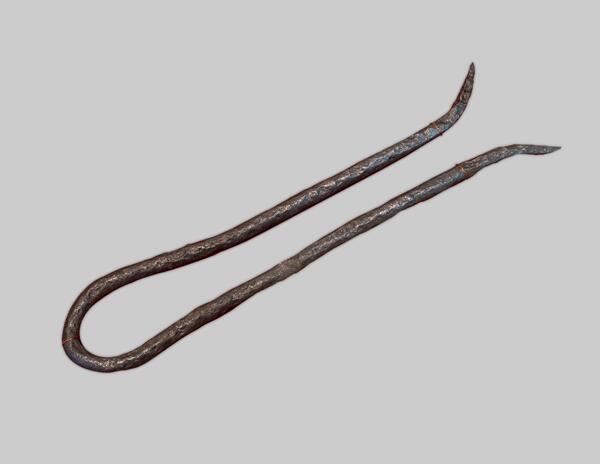
Log scriber is a special construction tool to mark levels in carpentry. It is a circular bar bent as a narrow bow with diverging pointed ends.
The log scriber was used while making a log structure for a residential house or a utility building. The name of the tool tells that it was used to mark the visible dap boundaries to be further cut with an axe. Each row of logs had a longitudinal groove for strengthening the log structure. First, the notch and the dap were cut in lower hump of upper logs thus protecting the wooden log structure from rotting due to potential penetration of water.
In XVII century, a new method started to be applied, with sealing grooves cut both on the upper and lower parts of the log simultaneously (‘raznopAz’). Typical for the traditional wooden house building in the Russian North was the roof made without nails (‘samtsOvaya’): progressively shorter logs were raised up to the ridge, with long logs (purlins) framed into the log stumps that completed the house pediment in a triangle, and those purlins were used as the basis for laying think planks on both pitches.
The Siberian housebuilding traditions are mainly borrowed from the Russian North as most of the Russian population of Siberia at the time of its exploration were native of those regions.
‘First, a simple round log was laid. Then a line is marked with a scriber. This tool is called scriber, it is used for… marking the dap. The line is marked on the log, a very straight line. Then the lines are marked on both sides, on the inside and on the outside. The log is turned to the side where the lines are marked, and the dap is started to be cut with an axe, for it to fit for the first row of the logs. The same is repeated for another row, until the very top…’
M.V. Novgorodtsev, a resident of Shuevo village, Omsk region, talking to a researcher, Larissa Tataurova, explained how the scriber was handled
Over the centuries, people kept polishing up the wooden housebuilding skills and improving the wood handling practices, and finally, they came to a conclusion that simple and reasonable methods allowed the Russian carpenters to install the houses within very short periods of time and to move disassembled wooden buildings to other places and reassemble them there very quickly.
The process of manufacturing the scriber was rather simple, comprising ordinary hot metal forging methods. Low-carbon steel was used as the feedstock.
This artefact was discovered as part of archaeological study of Kuznetsk ostrog in the facilities located near the building of former Uyezd Treasury. In some places, signs of metal corrosion and superficial distortion can be seen.
#13
Full name Marking tool — Scriber
Date XVII century
Place Novokuznetsk, Russia
Technique forge work
Dimensions 21,2×5 cm, diameter - 0,7 cm
Collection XVII – XVIII cent. Kuznetsky ostrog — the town of Kuznetsk. Excavations of various years
Copyright Kuznetsk fortress
Restorers Scheglakov A.P.
Goskatalog Number 2890424
Date XVII century
Place Novokuznetsk, Russia
Technique forge work
Dimensions 21,2×5 cm, diameter - 0,7 cm
Collection XVII – XVIII cent. Kuznetsky ostrog — the town of Kuznetsk. Excavations of various years
Copyright Kuznetsk fortress
Restorers Scheglakov A.P.
Goskatalog Number 2890424
read morehide
00:00
00:00
1x
1
 Point your smartphone camera to open in the app
Open in app
Share