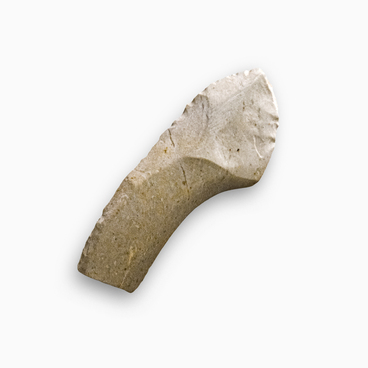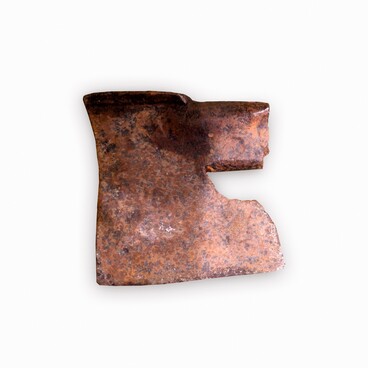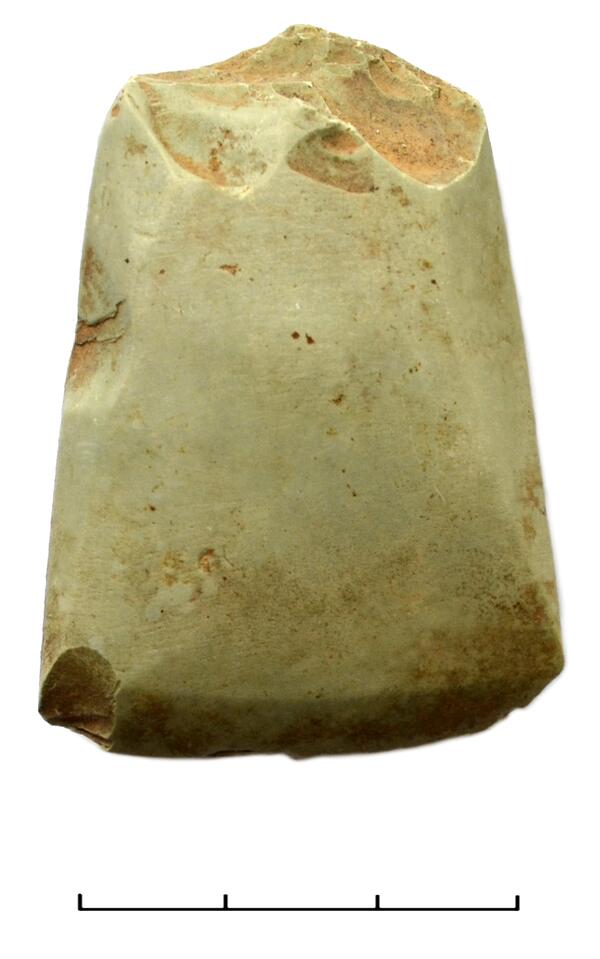
The ax presented in the museum’s collection was found during the archaeological study of the Borovyanka-XVII burial ground by the expedition of the National Archaeological Natural Park “Batakovo” under the leadership of Albert Viktorovich Polevodov and Leonid Ivanovich Pogodin. The burial site containing the ax dates back to the Andronovo period (Bronze Age, 14th–11th centuries BCE).
The object has a trapezoid shape; on both sides of the blade there are faint diagonal marks from work. The wide base is designed in the form of an arc-shaped blade with double-sided sharpening. Faint diagonal marks from work can be seen on both sides of it, one corner is chipped off.
The manufacturing technology of the ax was quite complicated. First, flakes were chipped from the workpiece, which could later be used in other tools. Then the working edge was refined using retouching. Sometimes an additional groove was made in the upper part to ensure a stronger connection with the handle. The handle could be made of both wood and bones of large animals. The ax was tied to the handle with the help of tendons, which, when dried, compressed and allowed the parts of the tool to be tightly connected.
Such objects were widely used during the Neolithic — early Bronze Age, after which they were gradually replaced with metal tools similar in functionality (the so-called “celts”). The small size of the ax is noteworthy. It indicates a shortage of stone raw materials in Western Siberia: the necessary materials were transported to the region from Altai or the Urals. Such a desire for microlithism (“micro” — small, “lithos” — stone) is generally characteristic of stone tools from archaeological sites of the Bronze Age of the West Siberian Plain.
The finds of these tools indicate the early
settlement of the territories, the presence of extensive cultural and economic
ties and advanced woodworking techniques. For example, it took 15 minutes to
cut down a pine tree with a diameter of 25 centimeters with a stone ax. This
made it possible to quickly and efficiently arrange and heat dwellings, among
which dugouts and semi-dugouts prevailed which allowed the people to live
comfortably in the harsh conditions of Western Siberia.