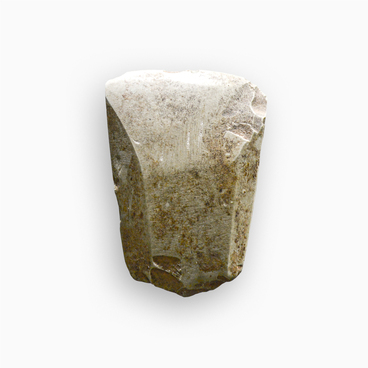
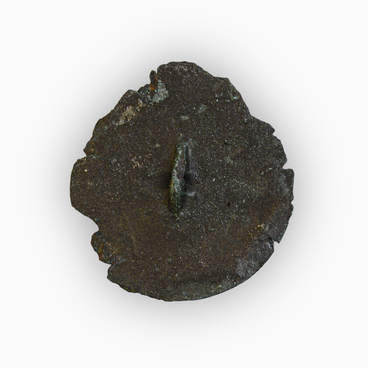
The ax presented in the museum’s collection is quite unusual for Western Siberia. In most sources, such items are called Finnish axes, less often they are designated as carpentry axes of the Canadian type (perhaps they came to Canada from Finland).
This ax is almost square, with a blade one side of which resembles a poleax, smoothly rounded to the poll. The ax is forged from a single piece of iron.
This ax differs from typical Russian axes both in shape and in that it does not have a through hole in the poll, where the ax handle was inserted. This item only has an eye with a length of just four centimeters. The eye is deformed. Probably, such a design required special care when attaching the handle: a poorly mounted ax could easily pop out of such an eye, especially since there are no special holes in it with which the ax could be fixed using nails or screws.
By its purpose, this ax can rather be attributed to cleavers adapted exclusively for chopping firewood. Unlike carpenter’s axes, this specimen lacks a sharp toe on the blade, while the blade itself is not wide and thin enough.
Cleavers as a special type of axes for harvesting (chopping) firewood became widespread in Siberia at the end of the 18th century; they were made mainly in Ural factories.
Finnish axes, similar to the one presented in the exhibition, began to be massively sold in Russia only in the middle of the 19th century. Although Finland became part of the Russian Empire in 1809, the tax on Finnish goods was abolished only in 1835. After that, the number of Finnish axes sold began to rapidly increase from year to year. Thus, by the end of the 19th century, up to two thousand axes per day were being manufactured at one of the largest Billnäs factories. The shape and features of these objects reflect the traditions of Finnish blacksmiths. In particular, one can note a slightly shifted center of gravity, which facilitates chopping firewood in the humid climate of Finland.
The ax was transferred to the funds of the Omsk
Museum-Reserve in 1969.