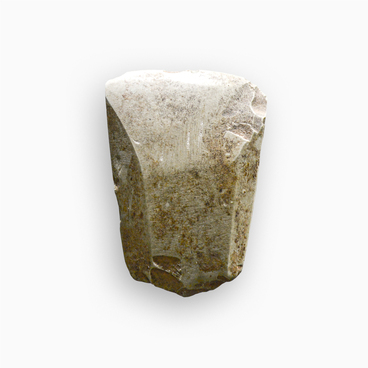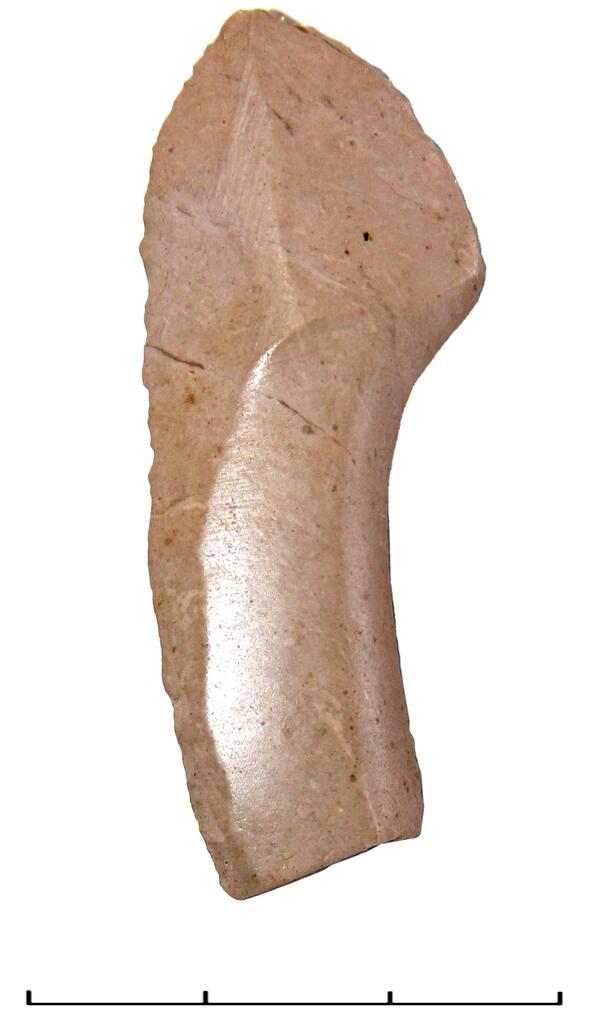
The scraper presented in the museum’s collection was discovered in 2005–2006 during the archaeological study of the Borovyanka-XVII burial ground by the Omsk archaeologists Leonid Ivanovich Pogodin and Albert Viktorovich Polevodov, in one of the ground burials dated to the Andronovo time (Bronze Age, 14th–11th centuries BCE). The scraper is made of light brown jasper. Its “stem” part is well polished, on the right side it is trimmed with edge retouching, the left side is concave. The working edge is arched in a characteristic way for such items.
The manufacturing technology of such scrapers was quite complicated. The stone from which the flakes were chipped off had to be free of cracks and visible flaws. Then the craftsman struck it with a hammerstone until he got a roughly cylindrical nucleus. This was the first and extremely important stage in the manufacture of tools. A poorly processed nucleus did not produce flakes from which tools of the correct shape could be obtained.
Afterwards it was necessary to fix the nucleus rigidly so that it did not swing and did not divert the craftsman’s hand. Then, with special tools, a chisel and a pressure flaker made from horn, the craftsman chipped off the flakes. If necessary, the working edge was refined and retouched with the help of the same pressure flaker, as happened in this case.
There are no natural stone deposits in the Omsk Irtysh region, therefore, raw materials for tools were transported from the Urals or Altai, and stone processing was carried out on site. All the flakes received were sought to be used in one way or another in the household.
The finds of these tools indicate the early settlement of the territories, the presence of extensive cultural and economic ties and advanced stone processing techniques. Such tools were widely used for processing hides, horn, bone and wood products, as well as for butchering carcasses. This suggests the high degree of development of the craft, the skill to hunt large animals of local Andronovo people, and, in general, the adaptation of ancient collectives to the harsh natural conditions of the Omsk Irtysh region.
The dressing of the skins took place as follows: scrapers, like the one presented in the museum’s collection, removed subcutis (the innermost, fatty layer of the skin) and wool, after which they were left to dry on special spreaders, later making dwellings and shoes from such skins and using them in composite tools.