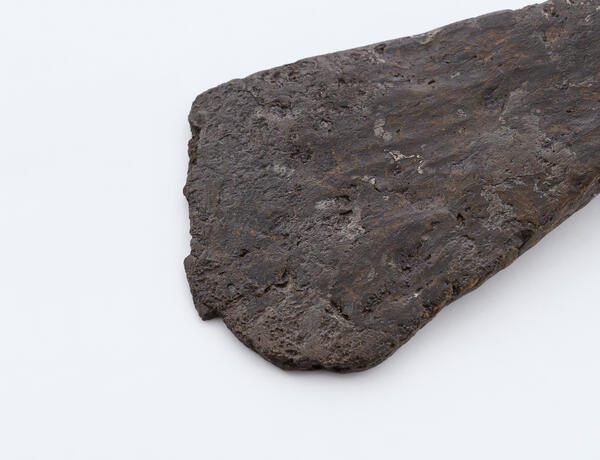
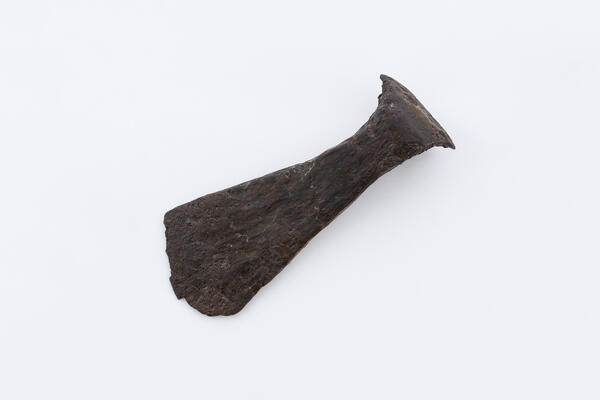
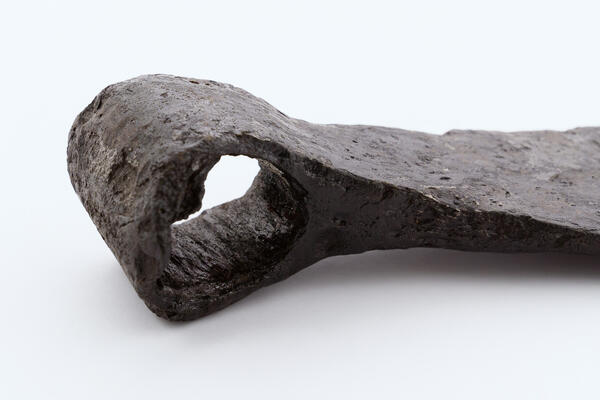
The battle ax on display at the State Museum-Reserve “Kulikovo Field” is a part of the offensive weaponry of a warrior from the 12th–13th centuries. It features a narrow, wedge-shaped blade with a welded tip and an eyelet with an elongated handle, the edges of which are made as sharp protrusions.
In early societies, the ax was one of the most affordable and common weapons, alongside maces. By the mid-first millennium BCE, it gradually fell out of use for military purposes and became a tool of professional warriors only. Over the next millennium, during the Migration Period and the Early Middle Ages, it virtually disappeared from military usage.
Axes became widespread again in the 10th century, but these were specialized battle axes. Meanwhile hafted axes appeared in Russia in the 12th century and became an essential attribute of ordinary warriors. During this period, specialized battle axes were the exclusive prerogative of the military elite. Almost all of these weapons were richly decorated with precious or non-ferrous metals. One striking example is the “hatchet of Prince Andrei Bogolyubsky”, which is stored in the State Historical Museum and is decorated with a stylized capital letter “A” in the form of a curled dragon pierced by a sword, engraved with leaf silver.
In the late Middle Ages, when the Battle of Kulikovo took place, things changed dramatically. Hafted axes lost their popularity, and battle axes became an attribute of professional warriors. They were sometimes decorated, but not always, nor as extravagantly as before. At the same time, battle axes are practically absent from the Golden Horde’s armament during the Battle of Kulikovo period.
This particular ax is classified as belonging to the local Dnieper group (type III according to the system proposed by Anatoly Nikolayevich Kirpichnikov), which was common in the 11th and 12th centuries. At the same time, the narrow blade indicates that it is clearly a later representative of this group, most likely made no earlier than the 12th or even 13th century.