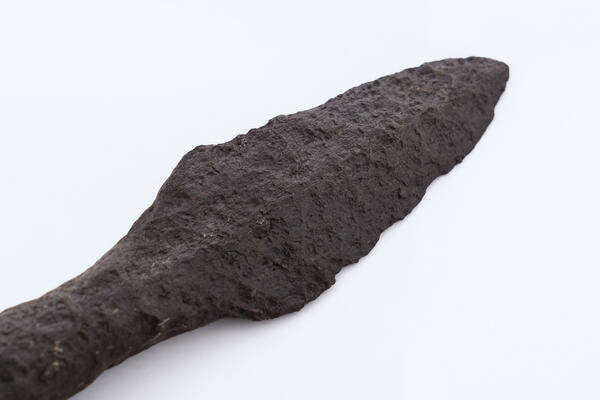
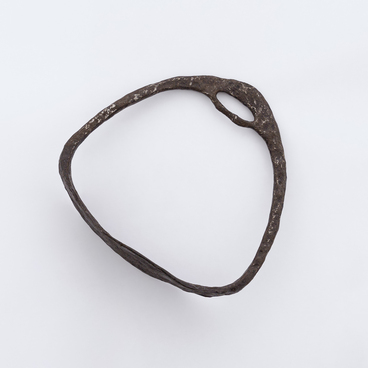
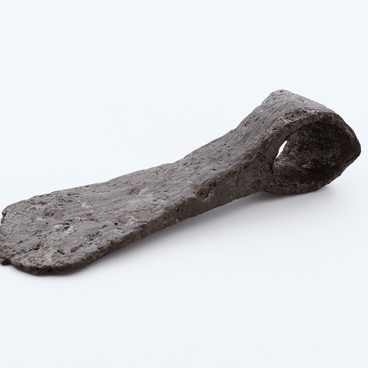
The exhibition at the State Museum-Reserve “Kulikovo Field” includes an iron bear spear, known in Russian as a “rogatina”. Not all spears with large heads are bear spears. They are distinguished by a characteristic smoothly pointed head. Where the tip meets the stem, the spear is particularly robust and stable.
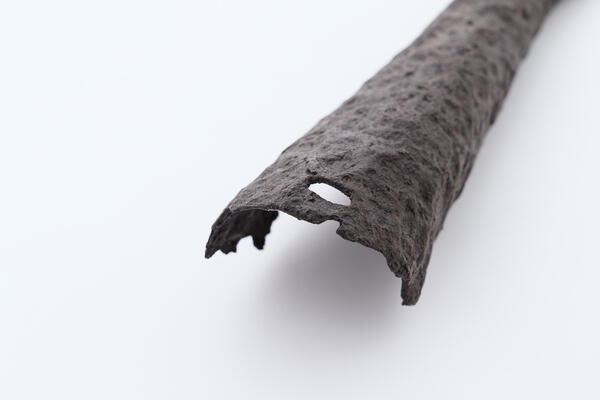
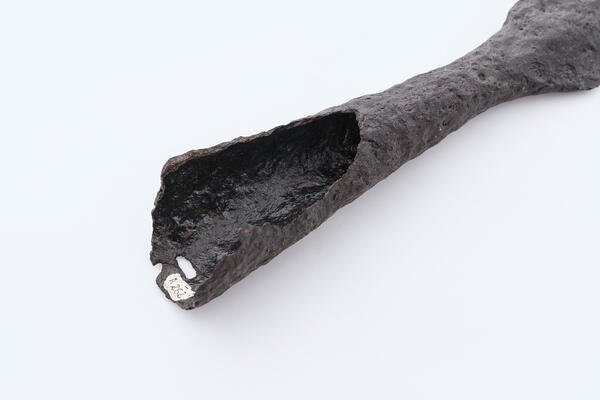
The item has a small, powerful head. At the base of the stem, there is a small rectangular hole for a nail, which was used to secure the spearhead to a wooden shaft.
In head-on confrontation, the bear spear was less effective than a regular spear because it was too heavy and less maneuverable. However, it had another purpose. It was effectively used to defend against cavalry, particularly when the horses were armored. A running horse struck by a powerful bear spear that penetrated its armor would suffer a devastating wound and fall dead.
During the era of the Battle of Kulikovo, there were three types of spearheads: narrow, faceted heads used for stabbing unarmored or poorly armored enemies; powerful bear spears with a strong stem and head, designed for unseating opponents from their horses; and large, robust spearheads measuring between 40 and 60 centimeters in length that could break through armor.
The displayed spearhead belongs to the category of bear spears. Such spearheads are frequently discovered during excavations near Veliky Novgorod, Ryazan, and Moscow. At the same time, such spearheads have not been found in the territory of the Golden Horde.
Bear spears emerged in Russia in the 12th century. They were first mentioned in the chronicles of 1149, which is also supported by archaeological evidence. In these early references, bear spears were primarily combat weapons but were also used for hunting. For example, in 1255, Prince Daniel of Galicia killed three wild boars using a bear spear while hunting.
Bear spears were employed by both infantrymen and cavalrymen. This type of weapon likely originated in Eastern Europe as it was distributed exclusively across Ancient Rus, the Grand Duchy of Lithuania, and Polish lands. This type of spear is almost completely absent outside these regions.