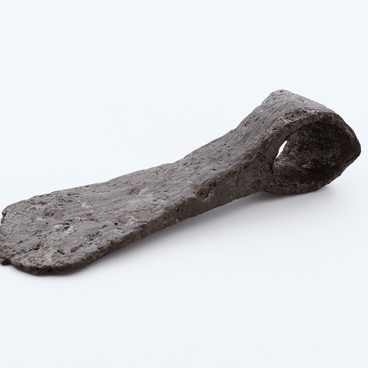
The three-bladed tanged arrowhead on display at the exhibition was made of iron and shaped using swaging. It features a three-bladed head and an elongated tang, which was used to fit the arrowhead in the center of the arrow shaft. Tanged arrowheads were most widely used in Russia. Each blade of the arrowhead has a complex trapezoidal shape. At the bottom of each blade, there is a hole with a shape that resembles a heraldic heart.
For many centuries, the bow and arrow were among the most effective weapons used in Russia and neighboring countries. An arrow typically consists of a striking arrowhead made from materials such as bone, stone, copper, copper-based alloys, iron, or steel, along with a wooden shaft and fletching. Fletching was usually made from bird feathers, although leather or wood could also be used, planed together with the shaft.
The size and weight of an arrow determined the tension force of a bow or crossbow. For example, the tension force of bows used by medieval nomads ranged from 50 to 75 kilograms.
During the Middle Ages, nomads widely used composite bows. The base of such bows, known as a kibit, was composed of several short pieces made of various materials. This design enabled nomads to utilize various types of arrows, including both light and heavy ones.
Arrowheads came in various shapes depending on
their intended purpose. The displayed arrowhead was designed for heavy arrows.
Its construction with crossed blades required twice as many raw materials as a regular
flat arrowhead. As a result, it was heavier. Consequently, the shaft of such an
arrow needed to be stronger and thicker to support the weight of the arrowhead.
These three-bladed arrowheads caused serious damage to unarmored enemies —
causing wide wounds that led to severe bleeding and quickly incapacitating
them, whether they were on foot or horseback.