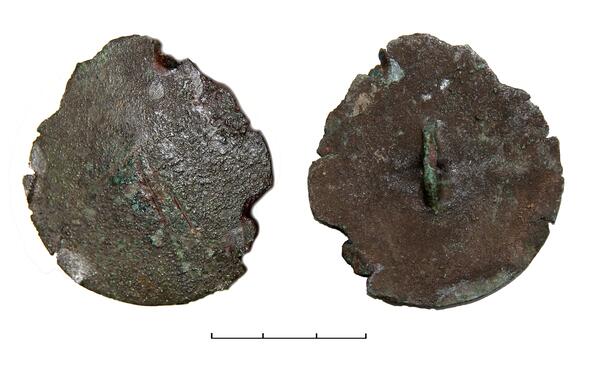
The object is round in shape, its outer surface is convex, its inner surface is concave. The edges were broken off in ancient times. The object dates back to the early Bronze Age (14th–9th centuries BCE). It belongs to the Andronovo cultural and historical community. Direct analogies can be traced in the materials from the Chernoozersk-Tomsk type of monuments (a type of the Andronovo cultural and historical community), although archetypally similar objects are present in many Bronze Age cultures of the forest-steppe belt of Northern Eurasia.
The plaque was found in a grave along with other objects made of bronze, wood and the operculum bone of a large fish. In the grave, inside the unburned remains of a wooden structure, there were the skeletons of two deceased, buried in an elongated position on their backs, with their heads facing southeast. The entire inventory belonged to one of them, a mature man with severe spinal pathology. According to the researchers of the excavations, this numerous inventory belonged to the burial of a shaman.
The remains of a characteristic costume element — a breastplate of ten different-sized plaques — were in the grave. The plaques were arranged in three rows. There was also a wooden maskoid (an object similar to a mask, its miniature copy, which was suspended from the clothes and hats of shamans) and a bronze knife. Such items were made by casting in special molds. The quality of the item depended on the quality of the raw materials and the mold.
The object was discovered during the archaeological
study of the Burial Ground Borovyanka-XVII by the expedition of the National
Archaeological Natural Park “Batakovo”
under the leadership of Leonid Ivanovich Pogodin and Albert Viktorovich
Polevodov in 2005–2006. This burial ground is located on the left bank of the
Irtysh River in the northern subzone of the forest-steppe, in the Chigar meander
core near the village of Rostovka and the village of Borovyanka in the
Bolsherechensky district of the Omsk region. The burial ground belongs to two
epochs at once. Numerous ground burials of the Andronovo period (Bronze Age,
14th–11th centuries BCE), as well as no less numerous mounds of the Sargat
culture dating back to the Early Iron Age (5th century BCE — 5th century CE)
have been recorded and studied here.