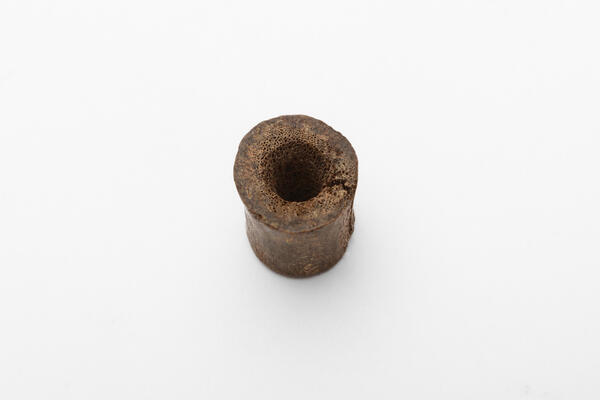
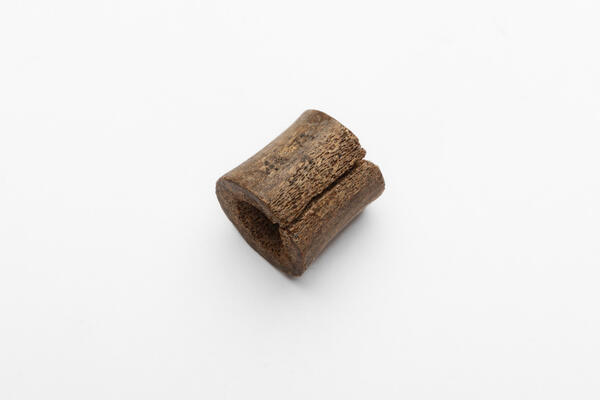
A tomar is a cylinder-shaped bone arrowhead, which has concave walls. This tomar was found during archaeological excavations of the Idnakar hillfort in 1999. Udmurts used similar blunt arrowheads when hunting forest birds or fur-bearing animals since they preserved the valuable fur intact.
Tomars is the general Russian name for blunt arrowheads. They could be made of bone or iron. Similar hunting arrowheads are found in cultural deposits of many regions and various nationalities. This name was mentioned in ethnographic materials of some indigenous tribes of Eurasia.
The Khanty called blunt arrows “Am’AR”, the Mansi — “manum-nyal”, the Nenets — “so”, the Yakuts — “onogos”, the Evenks — “orochony”, the Udege — “zanta”, the Chukchi — “tomar” or “tumar”. Such arrows did not get stuck in high tree crowns and did not break when they hit a heavy wood grouse and it fell to the ground.
A bow remained the main weapon for several thousand years: it was easy to make, carry and handle and had great destructive power and range. The Udmurts made bow strings from tendons, rawhide or catgut. Arrows were usually made of pine, spruce or birch, and their length did not exceed one meter. The arrow shafts were carefully polished using bone drawknives and sandstone bars so that the archer would not injure his hands.
Hunting has always been important for people living in forests. The development of a profitable fur trade was influenced by the proximity to Volga Bulgaria with important water and land trade routes passing through its territory. They connected the southern countries with the southeast of Europe and involved Udmurts in trade.
Chepetsk furs became the international currency of the Middle Ages and allowed the residents of Idnakar to trade actively. Separate large pelts of fur-bearing animals, such as squirrels, martens, arctic foxes and foxes, as well as bundles of small squirrel tails could be used as money. According to the 9th century Eastern encyclopedist Ahmad ibn Rustah, “they (the Bulgars) do not have their own coins; they replace hard money with marten pelts. Each pelt is equal to two dirhems and a half… They get dirhems from Muslim countries by trading their goods.”