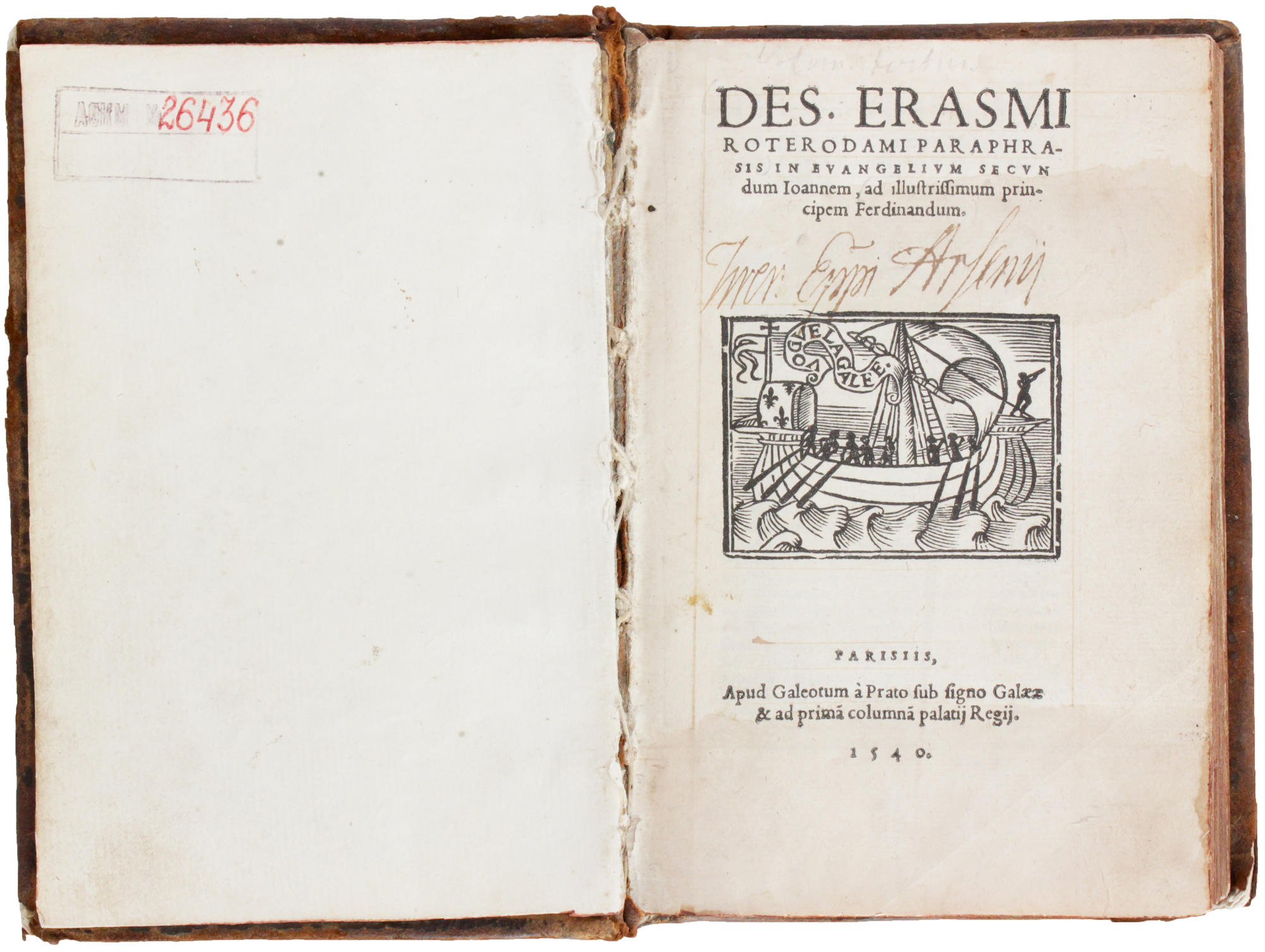


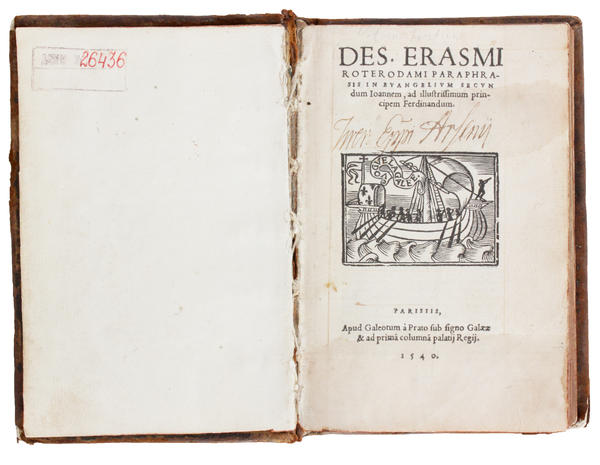
The book ‘Paraphrases of the Gospels’ by Erasmus of Rotterdam, written in Latin, is the earliest Western European book in the Arkhangelsk region. It was part of the personal library of the first bishop of Kholmogory and Vaga Athanasius (Lyubimov). It entered the museum in 1982.
The book was published in Paris, as evidenced by the decorative image of the printing house brand located in the center of the title page. The cardboard binding is covered in gold-embossed leather, the trim is also gold. On the title page is a personal autograph of a prominent church figure, Archbishop Arseniy of Yaroslavl and Rostov. The end of the 17th-century ex-libris with the coat of arms of Philip van Swinden, a Dutch nobleman, is glued to the inside of the cover. He was the owner of the book in the 17th — early 18th century.
Erasmus of Rotterdam was a writer, a major humanist of the 15 — 16th centuries (his real name was Gerhard Gerhards). Born in the town of Rotterdam, from his youth he studied theology, history, philosophy, and literature. He spent several years as a priest. He was considered the best Latin writer of his time and the most published author. His books have been translated into many European languages. Erasmus of Rotterdam explored and commented on scripture texts. He published a large-scale work, the Greek original of the New Testament with commentary. The scholar also studied ancient poetry and philosophy in depth, and saw in it the ideal of human perfection, which he wished to revive in medieval society.
Having gained pan-European glory with his freedom-loving views, Erasmus did not accept the Reformation and in his works snickered at various social foundations, including the church ones. The scholar opposed formalism in the church and abstract theoretical reasoning not confirmed by life experience. The most famous work of Erasmus is the ‘Praise of Nonsense.’ It is a comic work, in which all medieval social classes are ridiculed in the form of satire. The writer occupied an unprecedentedly honorable and influential position in society and had a great influence on Western European consciousness.