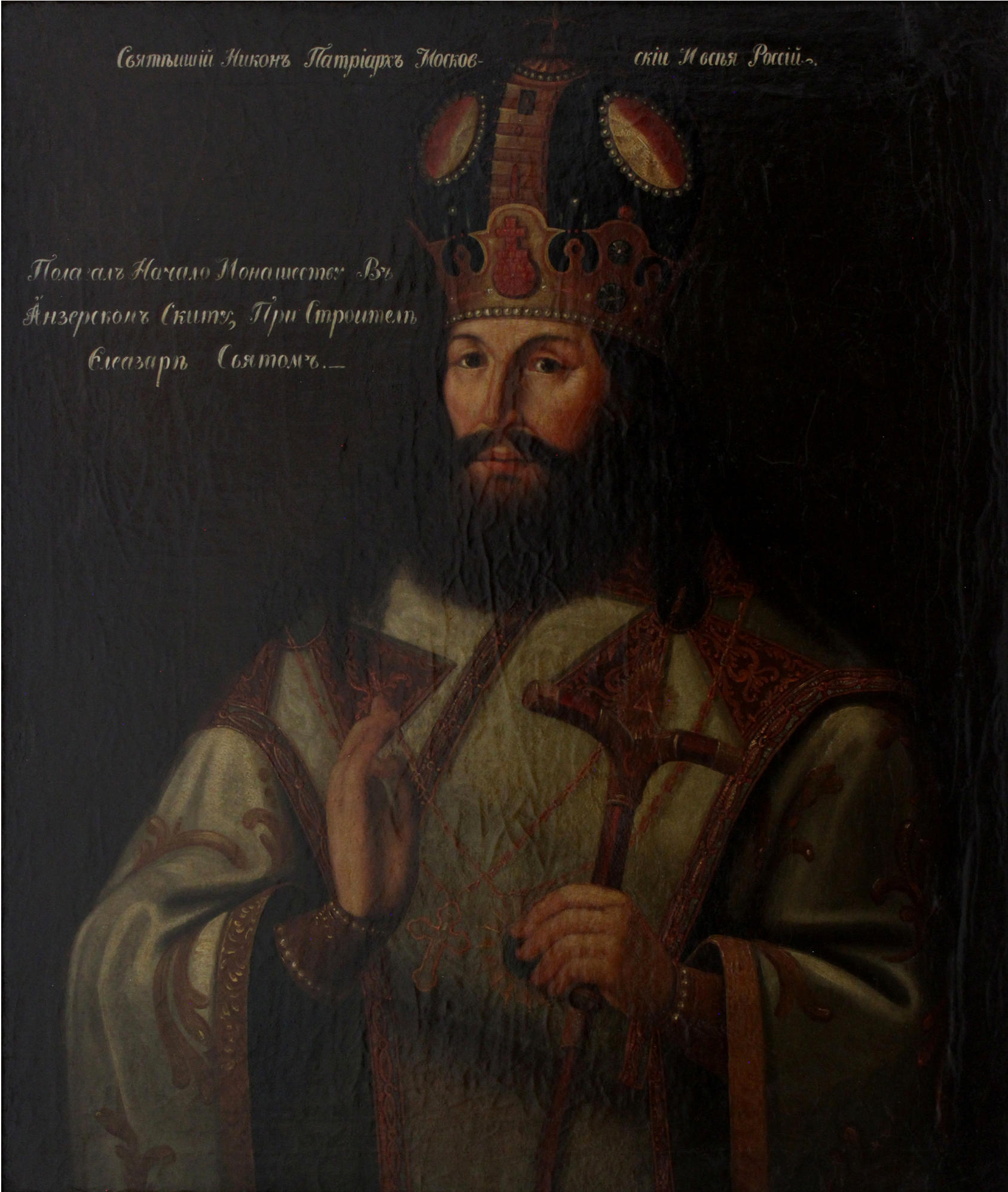


This half-length portrait of the Moscow Patriarch Nikon was kept in the sacristy of the Solovetsky Transfiguration of the Saviour Monastery (it is mentioned in the monastery inventory of 1866). The painting entered the Northern Regional Museum (now the Arkhangelsk Regional Museum) in 1923 and is now in its permanent exhibition. In 2001-2003, the portrait was conserved at The Arkhangelsk branch of the Grabar Art Conservation Centre.
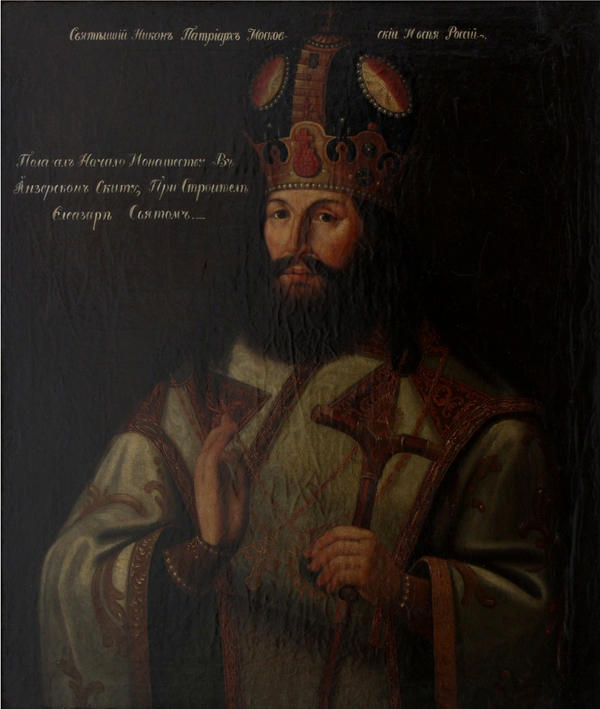
Patriarch Nikon is depicted in a pale green saccos, on his chest are a precious cross and encolpion. The patriarch’s right hand is raised in a blessing gesture (a special position of the fingers used only by bishops and priests for blessing), in his left hand he holds a staff. On the head of Nikon is a miter with a decorative trim and ornamental inserts.
Along the top edge of the portrait there is an inscription:
“СВЯТЕIШИЙ НИКОНЪ ПАТРИАРХ МОСКОВСКIЙ И ВСЕЯ РОССИИ”.
(“HOLY NIKON PATRIARCH OF MOSCOW AND ALL RUSSIA”).
To the left of the miter there is an inscription in three lines:
“ПОЛАГАЛЪ НАЧАЛО МОНАШЕСТВУ ВЪ// АНЗЕРСКОМЪ СКИТУ, ПРИ СТРОИТЕЛЕ// ЕЛЕАЗАРЕ СВЯТОМЪ”.
“STARTED A MONASTERY IN // ANZERSKY SKIT, UNDER THE BUILDER // ELEAZAR THE SAINT”.
“СВЯТЕIШИЙ НИКОНЪ ПАТРИАРХ МОСКОВСКIЙ И ВСЕЯ РОССИИ”.
(“HOLY NIKON PATRIARCH OF MOSCOW AND ALL RUSSIA”).
To the left of the miter there is an inscription in three lines:
“ПОЛАГАЛЪ НАЧАЛО МОНАШЕСТВУ ВЪ// АНЗЕРСКОМЪ СКИТУ, ПРИ СТРОИТЕЛЕ// ЕЛЕАЗАРЕ СВЯТОМЪ”.
“STARTED A MONASTERY IN // ANZERSKY SKIT, UNDER THE BUILDER // ELEAZAR THE SAINT”.
Nikon (secular name Nikita Minov, 1605-1681) became a monk in Anzersky monastery around 1635. He was the head of the Kozheezersky (1643-1646) and archimandrite of the Novospassky monasteries (1646-1648), the metropolitan of Novgorod (1648-1652); he founded the New Jerusalem Resurrection (1655), Iversky on Valdai (1652), and Kiy Cross (1656) monasteries. Nikon had great authority with Tsar Alexei Mikhailovich and had an influence on state affairs. In 1652, he received the position of the Patriarch of Moscow and All Russia. During the period of his patriarchate, he initiated church reform, which led to a split in society. Nikon was officially removed from the patriarchal position in 1666, exiled to Feropontov, and then to the Kirillo-Belozersky Monastery.
By the end of the 19th century, many famous Russian monasteries and bishops' houses had large collections of paintings, which included portraits of historical figures and clergy, religious paintings, architectural landscapes with views of famous monasteries, places of pilgrimage. In the Solovetsky Monastery, portraits of prominent people associated with the history of the monastery were kept.