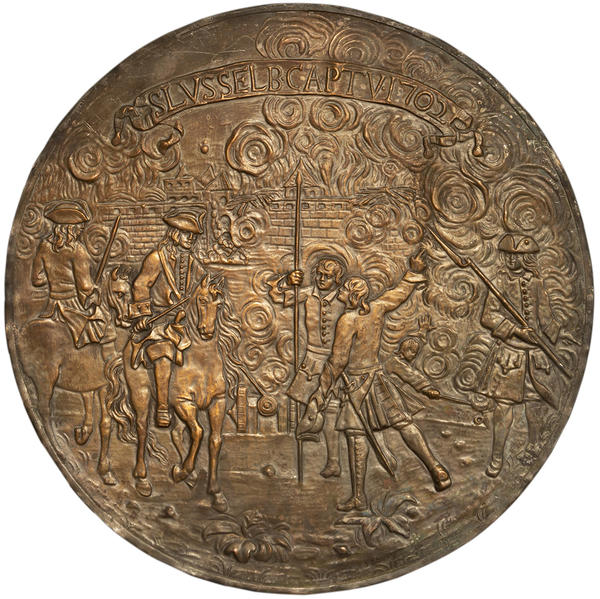
The medallion in memory of the capture of Shlisselburg is a copy of the bas-relief for the triumphal pillar dedicated to the victories of Russia in the Northern War (1700-1721). The authors of the original model are B. Rastrelli and A. Nartov (first half of the 1720s, St. Petersburg).
The project of the triumphal column was commissioned by Peter I in 1721 to the Italian artist and sculptor Bartolomeo Carlo Rastrelli. Wax samples with views of the most important battles were ready by 1723. From those in 1927 that models of red copper were minted, and it was planned to use them to make bronze bas-reliefs. The construction of the pillar of triumph did not happen for various reasons. As for the models of bas-reliefs, they became museum exhibits. A set of 35 galvanic copies of the bas-reliefs of the triumphal pillar, made after the originals which are in custody of the State Hermitage Museum, is kept in the Arkhangelsk Regional Museum. Other museums which are connected with the history of the Petrine period also own copies of similar sets.
The round bas-relief is made of copper. Its surface is covered with a patinating composition. In the background is a besieged fortress in flames and puffs of smoke. In the foreground are Russian guardsmen, mounted and on foot, with weapons in their hands, and gunners at cannons facing away from the viewer. A cartouche in the shape of a draped ribbon with the inscription ‘SLVSSELB ∙ CAPTV ∙ 1702’ is depicted above the fortress.
The image on the medallion is dedicated to the battle of Shlisselburg. Before its capture by Peter’s troops, the fortress was called Noteburg (Walnut City). Initially, it was the Russian fortress Oreshek (Russian: “little walnut”), founded by the Novgorodians in 1323. In 1612, the fortress was occupied by Swedish troops, who retained the essence of the name, but translated it into their own language. The fortress belonged to the Swedes for 90 years, until the end of September 1702, when it was besieged by the troops of Peter I. On October 11 (22), 1702, after a 13-hour assault, Noteburg surrendered, opening the way to the mouth of the Neva river. Peter I ordered the key to the fortress to be nailed over the gates of one of the towers and renamed the fortress to Shlisselburg — “Key City”.
Peter led the preparation of the siege of Noteburg from Arkhangelsk, where he arrived with a large retinue and regiments in the summer of 1702 under the pretext of an expected attack by the Swedes. The Arkhangelsk Admiralty fully provided equipment for the vessels of the river flotilla that participated in the siege of the fortress.