By the 6th–5th millennia BC, looms already existed in Egypt and Mesopotamia, and about 4000 years later the oldest machine with a rigid frame appeared. To operate such a machine, people had to work in pairs, manually dragging the shuttle with the weft through the shed and passing it back and forth between each other.
In 1733, the Englishman John Kay, revolutionized the weaving industry by creating a mechanical shuttle. A special device drove it through the warp threads, unfolded and then drove it in the opposite direction. From then on, one worker could operate the weaving machine.
The shuttle was made of a plank (from the bottom part of the tree trunk) of beech, pine, flowering dogwood or hornbeam. In the beginning of the 20th century, this expensive material was replaced with compressed wood, which was sufficiently durable and had a smooth surface.
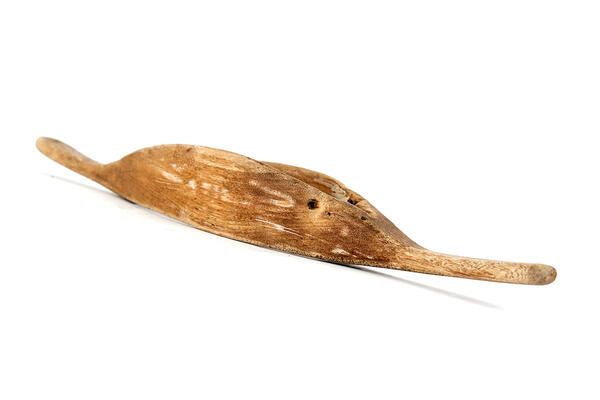
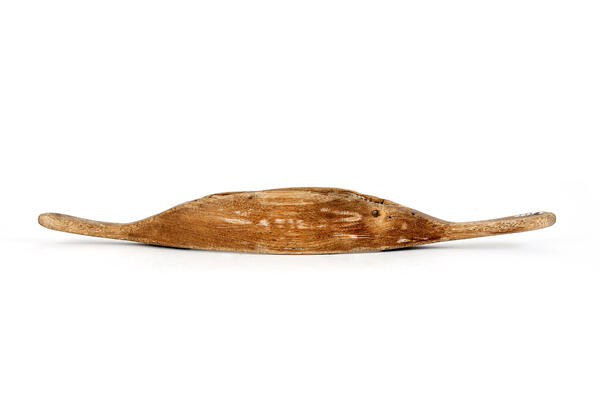
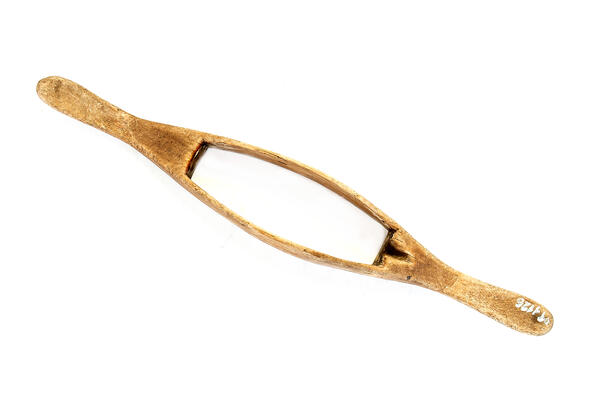
The simplest shuttle was made by hand from a single piece of wood, with notches for fixing the weft at the ends. In a more complex design, the yarn was wound on a bobbin. With the help of a wooden rod — a pirn — the bobbin was inserted into a hole in the center of the shuttle called the eye. The shuttle is a piece of wood pointed at both ends. It is designed to move freely between the threads of the warp.
To hold the bobbin and set it in the right direction, a special locking mechanism is used. To slow down the movement of the thread when unwinding the bobbin and create the necessary tension, a piece of fur or some bristles were attached to the inside of the shuttle.
The design of the shuttle depended on how it was intended to move, the type of raw materials and the way the thread was wound onto the spool. In weaving, primary packaging is called a cob. Several skeins tied with cords to avoid entanglement make up a hank. With the cross winding method, the threads are not tangled and their separation by a cord is not required. It is in this way that the yarn is wound on bobbins.
The development of weaving had a noticeable impact on the economies of different countries. In the Russian Empire, thanks to weaving factories, the modest village of Lodz turned into a large city, and the Morozov and Prokhorov dynasties of entrepreneurs rose to prosperity.