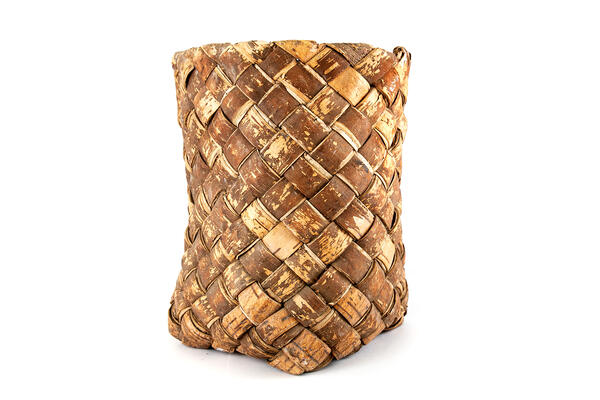
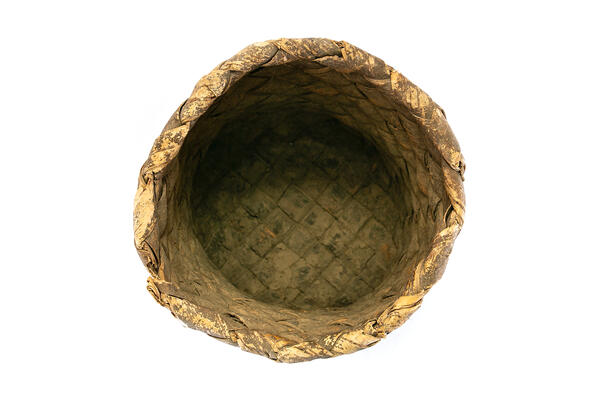
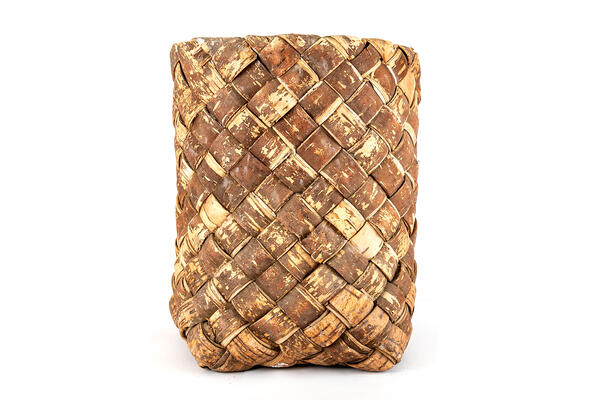
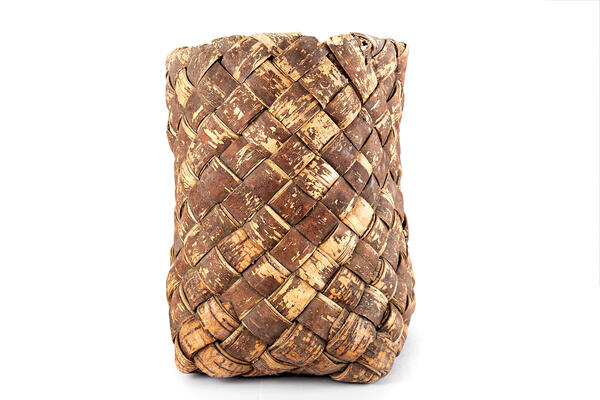
The peoples of Siberia and the Russian Far East have long used birch bark. In construction it served as insulation for bottom logs of log cabins, window sills, ceilings. Around the house, birch bark was used for repairing broken clay pots and making all kinds of household utensils: baskets, salt shakers, pestles, floats and horse harnesses. A basket with straps worn on the back and one with handles intended to be carried by hand were called “kuzov” or “kuzovok”.
The old-fashioned name for “kuzov” is “tuyes”, however, these words currently refer to different items. A tuyes is a cylindrical container made of birch bark and equipped with a tightly fitted wooden bottom and lid with an arch or knob handle. For a long time, such containers were used not only for storing and carrying food, but also as thermoses for water and kvass, and “refrigerators” for storing dairy products, berries and vegetables. Making a tuyes did not require any glue, nails or other fasteners.
Beside birch bark, a kuzov basket could be made of shingles and bast, by either stitching or weaving. The handle for such baskets featured a bow-like handle for ease of carry. They had no wooden bottom, but the lid, like that of a tueyes, was made of wood and tightly fitted to the top. A basket for gathering berries and mushrooms in the woods featured either birch bark straps or a belt for wearing the basket over the shoulder.
Raw materials for making such baskets were harvested in the summer, when birch bark became pliable and could easily be peeled off from the trunk. When collected, birch bark was rolled up and stored until late autumn or winter when more time was spent at home. Before making anything of birch bark, it was boiled and dried under a press, making it more durable and water resistant.
Birch bark could be weaved in two ways: at a right angle (straight) and at a 45-degree angle (oblique). The techniques differed in difficulty, with the former being more complex.
The basket on display is made
of birch bark. Craftspeople took notice of the way this lightweight
multi-layered material protected the trunk of the tree from moisture and
overheating, and used these properties for their benefit.