#1
Prison, Imaginary prisons, The Melodrama
#13
#12
#11
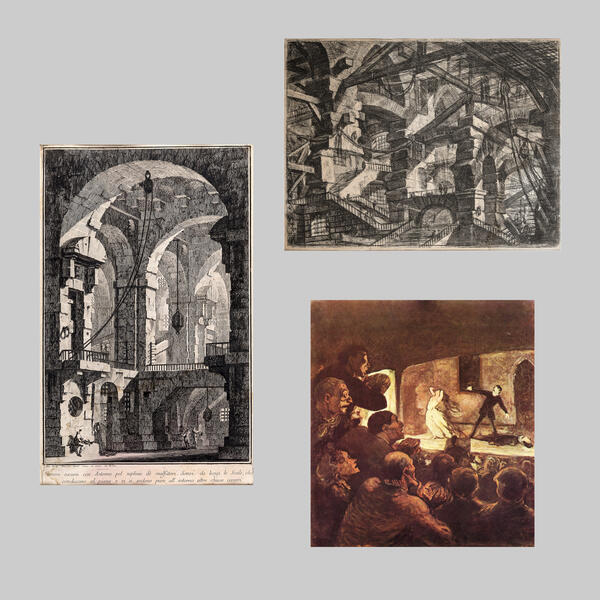
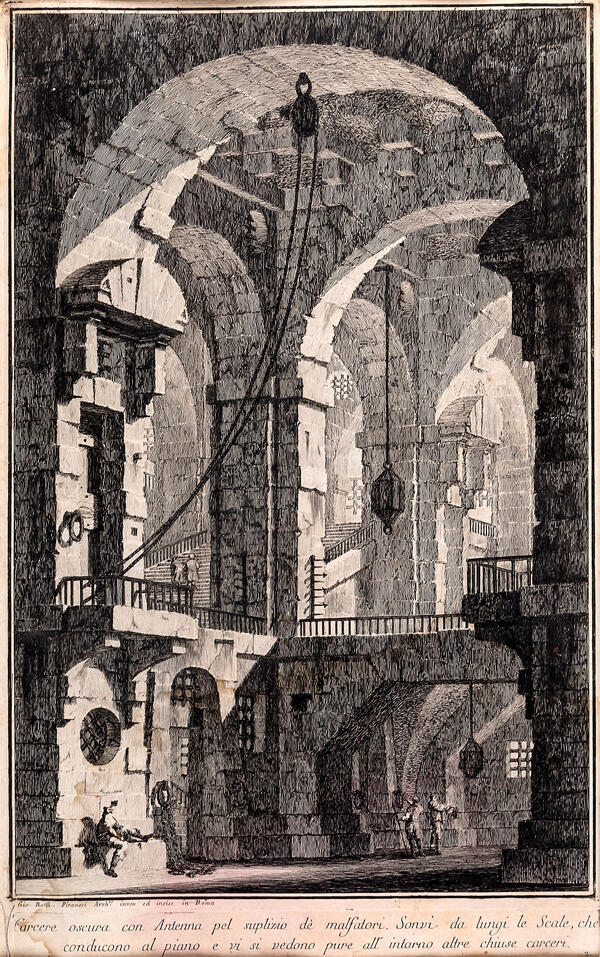
Two original aquafOrti of an Italian architect and artist GiovAnni BattIsta PiranEsi were displayed in Sergei Eisenstein’s study: “Prison, ” from the early “Various architecture objects” series, and page 14 from the “Imaginary prisons” series.
According to the director, he obtained both of these aquaforti via exchange with a peripheral museum. Both of these aquaforti were explored in “Piranesi, or the Fluidity of the Form” chapter of the “Pathos” study (1946–1947) published in the “Compassionate nature” book. These prints helped Eisenstein to solve the mystery of the structure of the pathetical works of art that could evoke strong feelings — heroic or tragic ones.
The director has quoted “The History of Art” by Alexander Benua where the author described Piranesi: “Throughout history, there were few artists who could express their art with such force, such flaming passion… Their amazing ability to combine in themselves a scholar and a poet (nobody could tell where Piranesi the Archaeologist ends and Piranesi the Artist begins, where does the poet become a scholar, and where a fiction writer becomes a scrupulous researcher)…”
Eisenstein wrote the following about this page from his collection: “I”ve always admired the fierce nature of Piranesi”s Prisons. But in these matters I”m an enthusiast, not a scholar. And what strikes me initially about his perfection is the… prominence of his balanced humility. This is, perhaps, because I recall so vividly the later “Prisons”, but this appears harmless, almost devoid of pathos. Unecastic…’ Eisenstein wanted to confirm his impression and translated a description of this print from a book of the german art critic Albert Giesecke: ’…soft silver light, just like the Venetians like it; it flows from above into this airy room and dissipates in the shadows stretching far beyond. The forms are quite soft, and aren’t at all defined… the picture itself is dissipating into a myriad of flowing lines…’ Sergei Eisenstein then conducted an experiment: he reimagined the image of the prison in a “flaming” fashion, and he found this exact composition hanging right next to the one he was researching: it was the print from the “Imaginary Prisons” series.
According to the director, he obtained both of these aquaforti via exchange with a peripheral museum. Both of these aquaforti were explored in “Piranesi, or the Fluidity of the Form” chapter of the “Pathos” study (1946–1947) published in the “Compassionate nature” book. These prints helped Eisenstein to solve the mystery of the structure of the pathetical works of art that could evoke strong feelings — heroic or tragic ones.
The director has quoted “The History of Art” by Alexander Benua where the author described Piranesi: “Throughout history, there were few artists who could express their art with such force, such flaming passion… Their amazing ability to combine in themselves a scholar and a poet (nobody could tell where Piranesi the Archaeologist ends and Piranesi the Artist begins, where does the poet become a scholar, and where a fiction writer becomes a scrupulous researcher)…”
Eisenstein wrote the following about this page from his collection: “I”ve always admired the fierce nature of Piranesi”s Prisons. But in these matters I”m an enthusiast, not a scholar. And what strikes me initially about his perfection is the… prominence of his balanced humility. This is, perhaps, because I recall so vividly the later “Prisons”, but this appears harmless, almost devoid of pathos. Unecastic…’ Eisenstein wanted to confirm his impression and translated a description of this print from a book of the german art critic Albert Giesecke: ’…soft silver light, just like the Venetians like it; it flows from above into this airy room and dissipates in the shadows stretching far beyond. The forms are quite soft, and aren’t at all defined… the picture itself is dissipating into a myriad of flowing lines…’ Sergei Eisenstein then conducted an experiment: he reimagined the image of the prison in a “flaming” fashion, and he found this exact composition hanging right next to the one he was researching: it was the print from the “Imaginary Prisons” series.
#10
Full name: Prison [Carcere oscura con Antenna…] (from the “Opere varie di Architettura” series)
Author: Giovanni Battista Piranesi
Date: 1743 or earlier
Technique: paper, aquafortis
Place: Rome, Italy
Dimensions: 42.7×27.8 cm
Collection: Study
Copyright: Cinema museum
Author: Giovanni Battista Piranesi
Date: 1743 or earlier
Technique: paper, aquafortis
Place: Rome, Italy
Dimensions: 42.7×27.8 cm
Collection: Study
Copyright: Cinema museum
#9
Imaginary prisons Page XIV
#8
#7
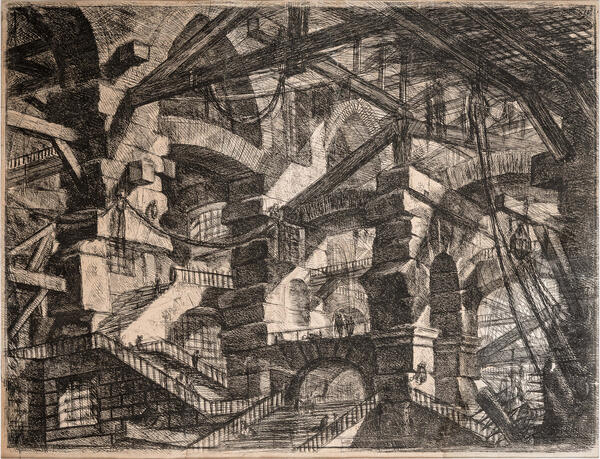
Italian archaeologist and artist GiovAnni BattIsta PiranEsi created his ‘Imaginary Prisons’ (‘Carceri d’Invenzione’) series in 1761. The series comprises 16 prints, and the fourteenth print ended up in Eisenstein’s apartment on PotYlikha Street.
In ‘Compassionate nature, ’ Eisenstein wrote that everything in that print ‘seemed to be demolished by a hurricane’, and that ‘in place of a modest and lyrically timid page of the early Prison, there is a great storm that pulls everything out of place: ropes, staircases leading in all directions, exploding arches, huge boulders toppling from one another…’ Every object within this print is bursting out of the static and transitioning to a new dynamic state. Eisenstein has describes it thusly in the chapter titled ‘Piranesi: the Fluidity of the Form’ of his work, ‘Pathos’: ‘The nature of the architectural fantasies themselves, where one system of views flows into others; where certain plans unfold endlessly behind others and beckon the sight to follow them into the unknown; where staircases go up one cliff after another, ascending straight into heavens, or cascade down from there along the same cliffs. Some interpret the “Carceri” as the delusions of an archaeologist who took the stern romanticism and former glory of ruins of Rome a little too close to heart. Others see them as manifestations of persecution mania that plagued the artist at that stage of his life. Real reasons are listed for this occurrence, but many prefer the imaginary reasons to real ones. I think that over these few years Piranesi… has a flash of inspiration.’
In the grim Imaginary Prisons, with the hallways leading nowhere in particular, with overseers — or perhaps prisoners? — wandering through them; where light is swallowed by the darkness. These are not landscapes, and these are not architectural fantasies — these are the images of Italy during the tragic age of decline, wars, and fears. Shakespeare once said that the world is a stage. Piranesi is saying that the world is a prison. But his ecstatic art was the way to overcome the tragic nature of his time. Having analyzed Piranesi’s prints, Eisenstein derived a “Pathos formula” from them. He tested this formula against the works of writers, such as GOgol and Emile ZolA, and artists such as El GrEco and PicAsso. He himself used this formula to create the “IvAn GrOzny” cinematic tragedy.
In ‘Compassionate nature, ’ Eisenstein wrote that everything in that print ‘seemed to be demolished by a hurricane’, and that ‘in place of a modest and lyrically timid page of the early Prison, there is a great storm that pulls everything out of place: ropes, staircases leading in all directions, exploding arches, huge boulders toppling from one another…’ Every object within this print is bursting out of the static and transitioning to a new dynamic state. Eisenstein has describes it thusly in the chapter titled ‘Piranesi: the Fluidity of the Form’ of his work, ‘Pathos’: ‘The nature of the architectural fantasies themselves, where one system of views flows into others; where certain plans unfold endlessly behind others and beckon the sight to follow them into the unknown; where staircases go up one cliff after another, ascending straight into heavens, or cascade down from there along the same cliffs. Some interpret the “Carceri” as the delusions of an archaeologist who took the stern romanticism and former glory of ruins of Rome a little too close to heart. Others see them as manifestations of persecution mania that plagued the artist at that stage of his life. Real reasons are listed for this occurrence, but many prefer the imaginary reasons to real ones. I think that over these few years Piranesi… has a flash of inspiration.’
In the grim Imaginary Prisons, with the hallways leading nowhere in particular, with overseers — or perhaps prisoners? — wandering through them; where light is swallowed by the darkness. These are not landscapes, and these are not architectural fantasies — these are the images of Italy during the tragic age of decline, wars, and fears. Shakespeare once said that the world is a stage. Piranesi is saying that the world is a prison. But his ecstatic art was the way to overcome the tragic nature of his time. Having analyzed Piranesi’s prints, Eisenstein derived a “Pathos formula” from them. He tested this formula against the works of writers, such as GOgol and Emile ZolA, and artists such as El GrEco and PicAsso. He himself used this formula to create the “IvAn GrOzny” cinematic tragedy.
#6
Full name: Page XIV of the “Carceri d"Invenzione’ (Imaginary prisons) series
Author: Giovanni Battista Piranesi
Date: 1761 or earlier
Technique: paper, aquafortis
Place: Rome, Italy
Dimensions: 43×56 cm
Collection: Study
Copyright: Cinema museum
Author: Giovanni Battista Piranesi
Date: 1761 or earlier
Technique: paper, aquafortis
Place: Rome, Italy
Dimensions: 43×56 cm
Collection: Study
Copyright: Cinema museum
#5
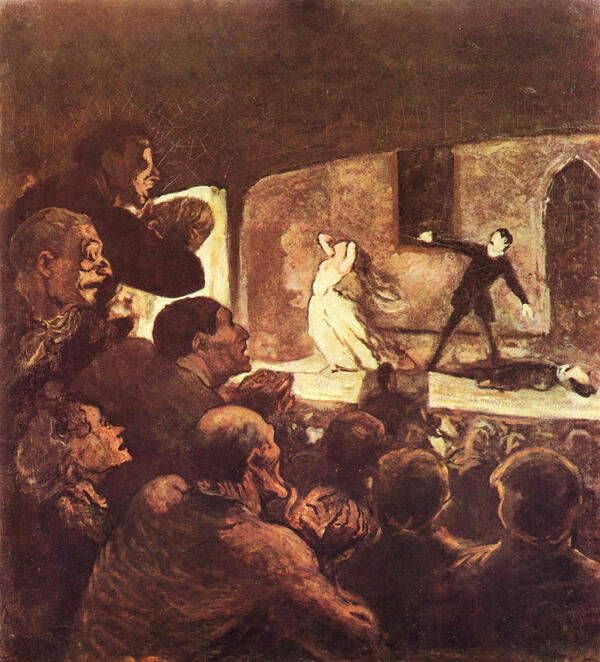
The Melodrama
#4
#3
This painting is a perfect example of Eisenstein’s favorite deep composition: with the contrast of dark profiles on the balcony and the brightly lit scene, the artist created an almost stereoscopic effect. What the director found most important in Daumier’s /do’mjez/ canvas was that in the foreground there was the audience absorbed by the performance, not the actors playing “murder out of jealosy.” This echoes the ideas of the manifesto MontAge of Attractions (1923), which begins with the words: “The spectator himself constitutes the basic material of the theater.”
The French painter, graphic artist, sculptor Honoré /ono’re/ Daumier /do’mje/ (1808 - 1879) was one of Sergei Eisenstein’s favorite artists. The director remembered that the first book he bought on his own as a child was a book with his drawings. Later he gathered a large collection of books, albums, original prints and reproductions by Daumier. In 1935, when he got an apartment in Mosfilm’s house on Potylikha Street, he decorated his office with facsimile reproductions of two paintings by Daumier: he found them in the catalog of London bookseller Zwemmer and asked to send them as a fee for publishing his articles in England.
Daumier created The Melodrama in 1860 (the original is now held in the Munich Museum Neue Pinakothek). It reflects the artist’s love for stage art - not for the court academic theaters, but for the so-called boulevards, as they were located in Paris on the Grand Boulevards. They did not stage sublime tragedies for aristocrats there, but rather played sensitive melodramas, fascinating detectives and prickly comedies about modern manners and these genres were loved by the ordinary audience.
In the background of Dumier’s there is a performance on stage. The plot of the melodrama is known from Daumier’s graphic sketch on the same subject. A man with a sword, pointing to a corpse, shouts out to a woman who broke her arm: ‘Il était votre amant, Madame! ’ (‘He was your lover, Madame! ’). The foreground depicts Parisians excited by the sight of ‘murder out of jealousy.
Eisenstein also loved and knew well the repertoire of the boulevard theaters and believed that the genres of these performances and the style of play of their best actors largely determined the future of cinema.
The French painter, graphic artist, sculptor Honoré /ono’re/ Daumier /do’mje/ (1808 - 1879) was one of Sergei Eisenstein’s favorite artists. The director remembered that the first book he bought on his own as a child was a book with his drawings. Later he gathered a large collection of books, albums, original prints and reproductions by Daumier. In 1935, when he got an apartment in Mosfilm’s house on Potylikha Street, he decorated his office with facsimile reproductions of two paintings by Daumier: he found them in the catalog of London bookseller Zwemmer and asked to send them as a fee for publishing his articles in England.
Daumier created The Melodrama in 1860 (the original is now held in the Munich Museum Neue Pinakothek). It reflects the artist’s love for stage art - not for the court academic theaters, but for the so-called boulevards, as they were located in Paris on the Grand Boulevards. They did not stage sublime tragedies for aristocrats there, but rather played sensitive melodramas, fascinating detectives and prickly comedies about modern manners and these genres were loved by the ordinary audience.
In the background of Dumier’s there is a performance on stage. The plot of the melodrama is known from Daumier’s graphic sketch on the same subject. A man with a sword, pointing to a corpse, shouts out to a woman who broke her arm: ‘Il était votre amant, Madame! ’ (‘He was your lover, Madame! ’). The foreground depicts Parisians excited by the sight of ‘murder out of jealousy.
Eisenstein also loved and knew well the repertoire of the boulevard theaters and believed that the genres of these performances and the style of play of their best actors largely determined the future of cinema.
#2
Full name: A facsimile reproduction of the painting The Melodrama
Author: Honoré Daumier
Date: 1935 or earlier
Technique: paper, colored lithograph
Place: France
Dimensions: 73.4×68.1 cm (sheet size); 69.5×64.7 cm (image)
Collection: Study
Copyright: Cinema museum
Author: Honoré Daumier
Date: 1935 or earlier
Technique: paper, colored lithograph
Place: France
Dimensions: 73.4×68.1 cm (sheet size); 69.5×64.7 cm (image)
Collection: Study
Copyright: Cinema museum
read morehide
00:00
00:00
1x
0
 Point your smartphone camera to open in the app
Open in app
Share