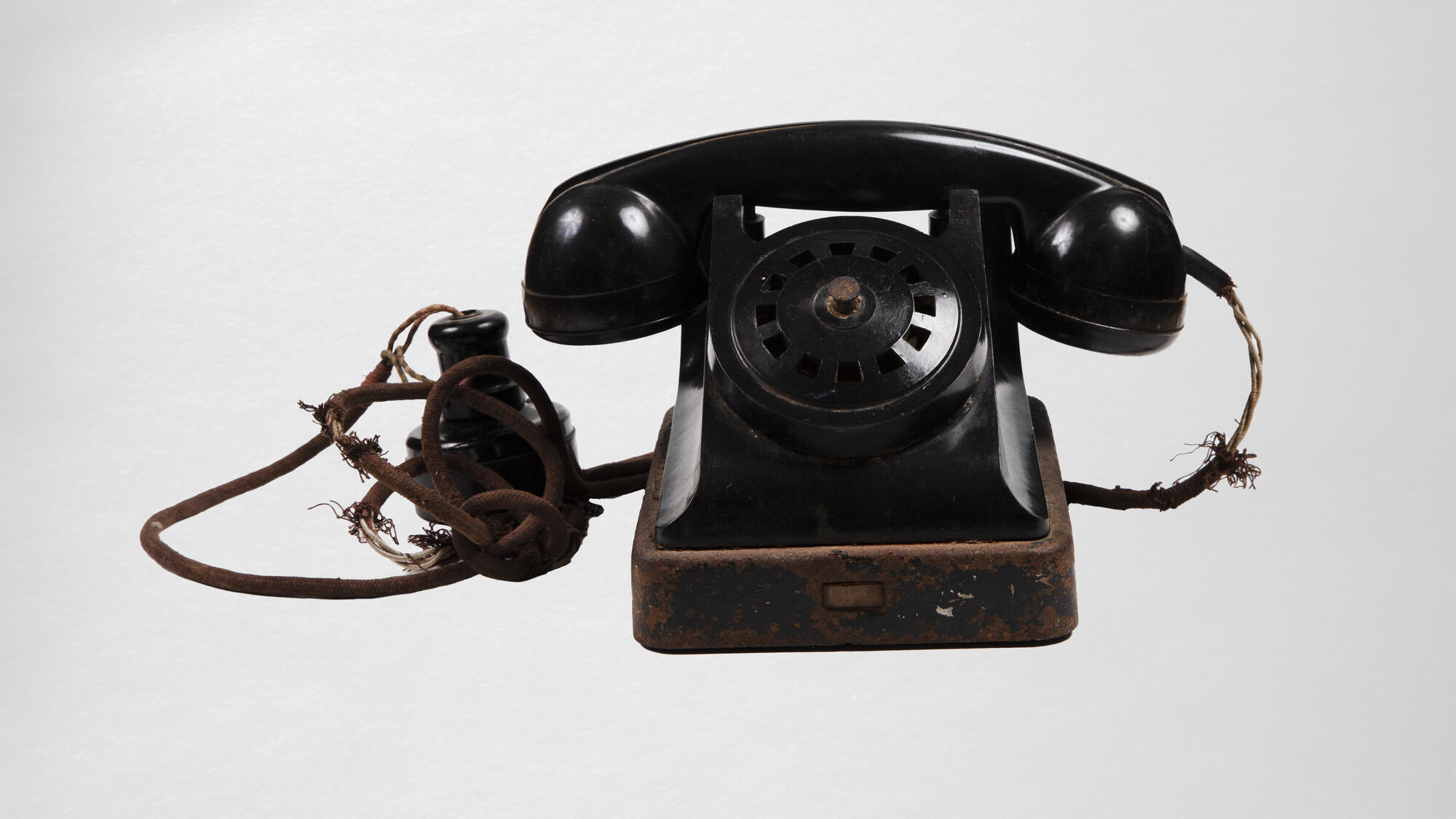


During the Great Patriotic War radio communication already existed, but it was used only by aviation troops, tank divisions, and the navy used them. The rest of the units communicated with each other using ordinary wired telephones. One of these devices is housed in the collection of the Zimovniki Museum of Local History.
The phone presented in the exhibition is a disk one: to dial a number, the disk was rotated clockwise until it reached the desired digit. The case of the apparatus was originally black and glossy, but over time, the coating wore off, and the disc with the numbers was lost.
At the end of the 1930s, the USSR Ministry of Defense planned to equip the communications troops with new radio sets. Wire telephones had several disadvantages: if in front conditions the telephone line was broken or damaged by enemy soldiers, it meant an almost total loss of communication. Moreover, if a unit changed location, the wire had to be re-routed. It was the job of the radio operators, who often worked under fire and risked their lives. Radio communications solved these problems.
However, the conversion plan could not be implemented, as the country did not have the necessary number of enterprises to produce radio communications equipment. Throughout the USSR, there were three plants: the Krasnaya Zarya plant produced various telephones, the Kulakov plant produced telegraph equipment, and the Kominterna plant produced radio equipment.
In addition, many military commanders were skeptical about radio communications. Among the military, there was even a special word for this phenomenon: “radio-phobia”. The situation was changed by drastic measures: in 1942, the Supreme Commander-in-Chief’s General Headquarters introduced personal radio stations for all unit commanders. Wherever the Front Commander or the Army Commander was, he always had his personal radio station with him. The radio operator, operations officer and cipher officer were also always near. Thanks to this decision, radio communication became predominant in the second half of the war, and controling the troops became more effective.
The phone presented in the exhibition is a disk one: to dial a number, the disk was rotated clockwise until it reached the desired digit. The case of the apparatus was originally black and glossy, but over time, the coating wore off, and the disc with the numbers was lost.
At the end of the 1930s, the USSR Ministry of Defense planned to equip the communications troops with new radio sets. Wire telephones had several disadvantages: if in front conditions the telephone line was broken or damaged by enemy soldiers, it meant an almost total loss of communication. Moreover, if a unit changed location, the wire had to be re-routed. It was the job of the radio operators, who often worked under fire and risked their lives. Radio communications solved these problems.
However, the conversion plan could not be implemented, as the country did not have the necessary number of enterprises to produce radio communications equipment. Throughout the USSR, there were three plants: the Krasnaya Zarya plant produced various telephones, the Kulakov plant produced telegraph equipment, and the Kominterna plant produced radio equipment.
In addition, many military commanders were skeptical about radio communications. Among the military, there was even a special word for this phenomenon: “radio-phobia”. The situation was changed by drastic measures: in 1942, the Supreme Commander-in-Chief’s General Headquarters introduced personal radio stations for all unit commanders. Wherever the Front Commander or the Army Commander was, he always had his personal radio station with him. The radio operator, operations officer and cipher officer were also always near. Thanks to this decision, radio communication became predominant in the second half of the war, and controling the troops became more effective.