The Bronze Cross of Merit is a Polish state award which was presented ‘…with the aim of rewarding outstanding merit contributing to the glory and benefit of People’s Poland’. It was awarded to both Polish and foreign citizens.
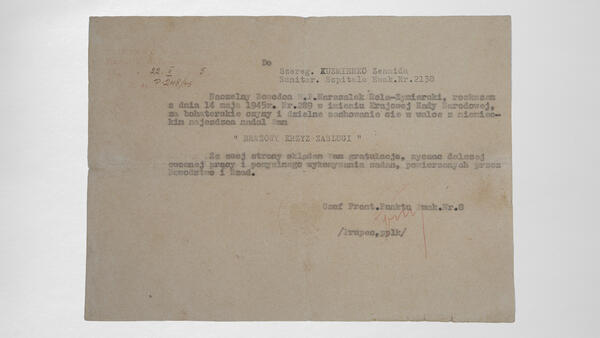
One of the Bronze Cross of Merit’s owners was Zinaida Lomakova, a resident of the Zimovniki village. Her award and certificate are housed in the collection of the Zimovniki Museum of Local History.
Zinaida Lomakova was born on October 16, 1925, in the village of Kuleshovka, Krasnodar Krai. Before the war, her family moved to Zimovniki. In March 1943, when Lomakova was 17 years old, she began working as a nurse at a local military hospital, located in the high school No. 1.
The hospital did not stay long in Zimovniki. The front line moved, and medical staff moved as well. With time, Zinaida Lomakova reached Poland where the Polish Liberation Army began to manage the hospital. All staff received new uniforms and Polish documents.
Colleagues reminisced that Lomakova was a kind and compassionate nurse. She took good care of each wounded soldier. The nurse was the only one of all the medical staff who received the Bronze Cross of Merit for her compassionate attitude. Years later, the recovered soldiers sent letters of gratitude to Zinaida Lomakova — in total, she received 57 letters.
The bronze Cross of Merit was established in June 1923 by order of Stanislaw Wojciechowski, President of the Republic of Poland. When World War II broke out in 1939, the awarding stopped. Only in 1944, the National Liberation Committee proposed to re-establish it. The Order had three grades: gold cross, silver, and bronze. The first and second ones could be awarded twice, but the bronze one was awarded only once.
The order was a ruby four-pointed cross from which golden rays radiated in different directions. After the war, the monogram ‘PRL’ (Polska Rzeczpospolita Ludowa, People’s Republic of Poland) was added to the center of the medallion. That was the official name of Poland in 1952–1989.
The cross was awarded for major services to the state. For example, for extraordinary results and records in production, sports victories, scientific discoveries as well as for achievements in art.
One of the Bronze Cross of Merit’s owners was Zinaida Lomakova, a resident of the Zimovniki village. Her award and certificate are housed in the collection of the Zimovniki Museum of Local History.
Zinaida Lomakova was born on October 16, 1925, in the village of Kuleshovka, Krasnodar Krai. Before the war, her family moved to Zimovniki. In March 1943, when Lomakova was 17 years old, she began working as a nurse at a local military hospital, located in the high school No. 1.
The hospital did not stay long in Zimovniki. The front line moved, and medical staff moved as well. With time, Zinaida Lomakova reached Poland where the Polish Liberation Army began to manage the hospital. All staff received new uniforms and Polish documents.
Colleagues reminisced that Lomakova was a kind and compassionate nurse. She took good care of each wounded soldier. The nurse was the only one of all the medical staff who received the Bronze Cross of Merit for her compassionate attitude. Years later, the recovered soldiers sent letters of gratitude to Zinaida Lomakova — in total, she received 57 letters.
The bronze Cross of Merit was established in June 1923 by order of Stanislaw Wojciechowski, President of the Republic of Poland. When World War II broke out in 1939, the awarding stopped. Only in 1944, the National Liberation Committee proposed to re-establish it. The Order had three grades: gold cross, silver, and bronze. The first and second ones could be awarded twice, but the bronze one was awarded only once.
The order was a ruby four-pointed cross from which golden rays radiated in different directions. After the war, the monogram ‘PRL’ (Polska Rzeczpospolita Ludowa, People’s Republic of Poland) was added to the center of the medallion. That was the official name of Poland in 1952–1989.
The cross was awarded for major services to the state. For example, for extraordinary results and records in production, sports victories, scientific discoveries as well as for achievements in art.