

Military field telephones were used to organize communications during hostilities. Germany first used these devices during World War I (1914–1918) — they replaced the flag communication system and telegraph.
TAI-43 model of field telephone was developed at the Red Army Communications Research Test Institute (NIIIS KA) in 1943. The serial production began a year later. The abbreviated name of the device model was deciphered as ‘telephone set with inductor call of 1943’. The project was supervised by the engineer Olga Repina. After the war, she was engaged in the development of the TA-57, the next version of the field telephone for the Soviet Army.
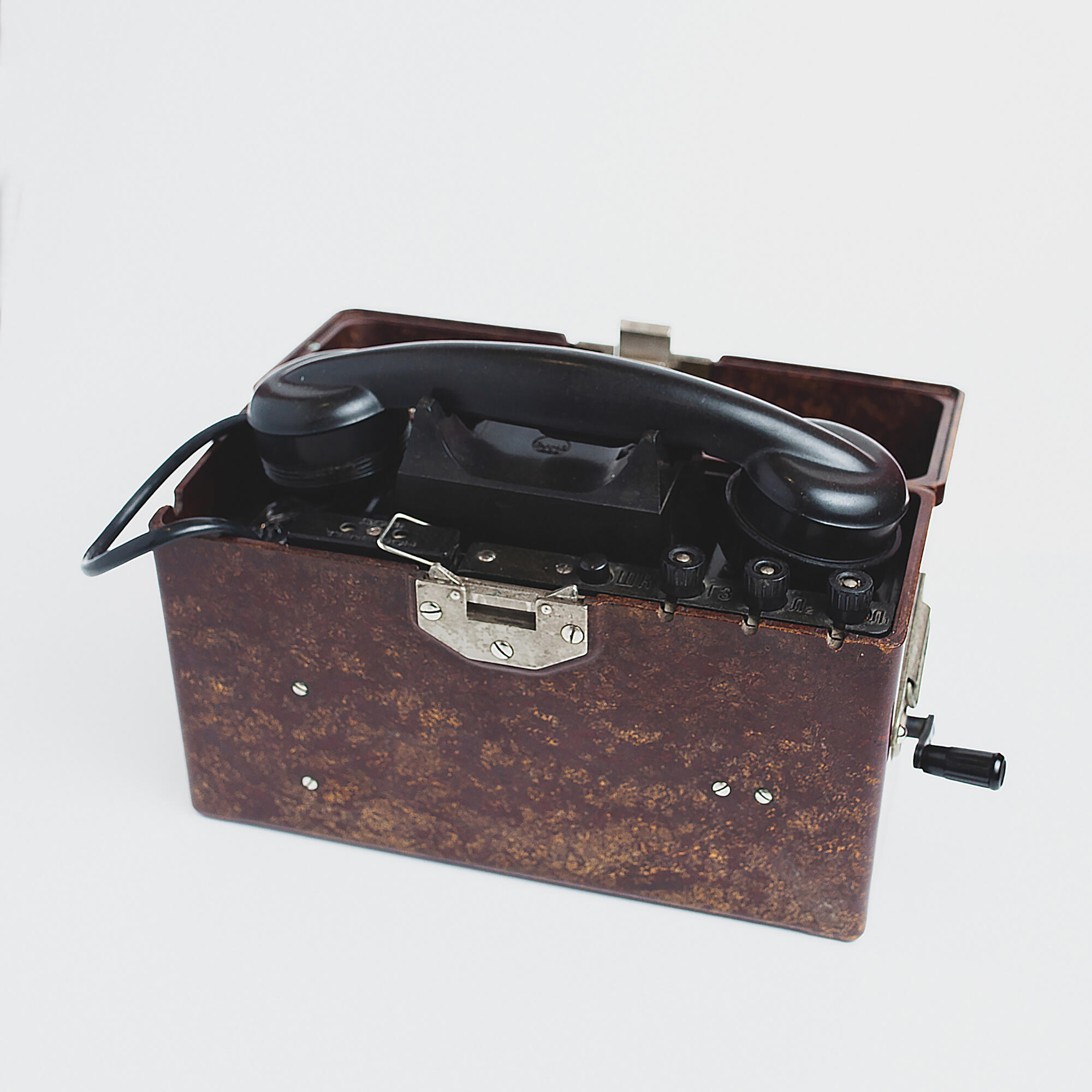
The TAI-43 telephone belonged to the MB (local battery) class of field telephone systems with an internal battery. The phone was produced along with a protective case. The lid was hinged, and the handset was located inside on a lever. Its wire was folded inward on the left side of the case. There were three buttons on the front panel. There was a handle on the right side of the body. The TAI-43 telephone had a good range for those years — up to 25 km on the field wire and up to 250 km on the overhead line.
Up to the end of the Great Patriotic War, the TAI-43 was produced in wooden cases of green color. Later, bakelite, a strong and heat-resistant material, was used for them. The technology changed because after the war, the equipment of the German factory, which produced FF-33 field telephones in bakelite casings, was brought to the USSR.
Retired Lieutenant General, Yuri Tolmachev, Chief of the USSR KGB Government Communications Troops, recalled that at the beginning of the war, Soviet specialists examined captured German FF-33 field telephones, model 1933, including in battlefront conditions. This data was used when developing the model, and therefore the TAI-43 had much in common with the German device.
Until 1957, the TAI-43 was the main means of communication in the Red and Soviet armies. It has now been discontinued. The exhibit from the Anzhero-Sudzhensk Museum of Local History was made in the 1960s and donated to the exhibition in 2001.
TAI-43 model of field telephone was developed at the Red Army Communications Research Test Institute (NIIIS KA) in 1943. The serial production began a year later. The abbreviated name of the device model was deciphered as ‘telephone set with inductor call of 1943’. The project was supervised by the engineer Olga Repina. After the war, she was engaged in the development of the TA-57, the next version of the field telephone for the Soviet Army.
The TAI-43 telephone belonged to the MB (local battery) class of field telephone systems with an internal battery. The phone was produced along with a protective case. The lid was hinged, and the handset was located inside on a lever. Its wire was folded inward on the left side of the case. There were three buttons on the front panel. There was a handle on the right side of the body. The TAI-43 telephone had a good range for those years — up to 25 km on the field wire and up to 250 km on the overhead line.
Up to the end of the Great Patriotic War, the TAI-43 was produced in wooden cases of green color. Later, bakelite, a strong and heat-resistant material, was used for them. The technology changed because after the war, the equipment of the German factory, which produced FF-33 field telephones in bakelite casings, was brought to the USSR.
Retired Lieutenant General, Yuri Tolmachev, Chief of the USSR KGB Government Communications Troops, recalled that at the beginning of the war, Soviet specialists examined captured German FF-33 field telephones, model 1933, including in battlefront conditions. This data was used when developing the model, and therefore the TAI-43 had much in common with the German device.
Until 1957, the TAI-43 was the main means of communication in the Red and Soviet armies. It has now been discontinued. The exhibit from the Anzhero-Sudzhensk Museum of Local History was made in the 1960s and donated to the exhibition in 2001.


