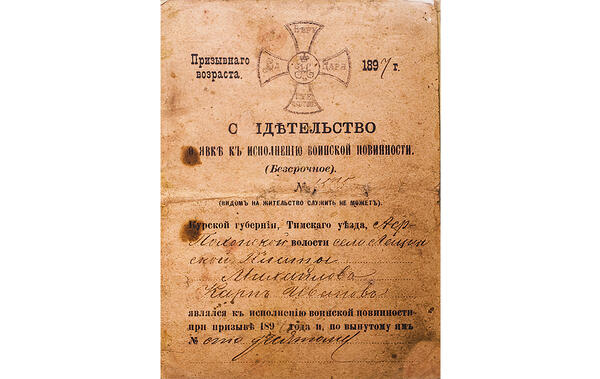
The collection of the Museum of Local History contains a military service completion certificate — such document was issued to conscripts who were not accepted for active military service. They were given a deferment because of their academic training or sent to the militia forces — the military reserve. The document from the exhibition belonged to Karp Mikhailov.
General mandatory military service had existed in the Russian Empire since 1874. All men had to serve in the army. The law provided for several exceptions — Muslims, Buddhists, and nomadic peoples, for example. Records show that as of 1895 there were 277,400 enlisted men from various regions of the empire.
Karp Mikhailov, a peasant, was called up for military service in 1897, in the village of Leshchinskaya Plata, the Kursk Governorate. According to the recruiting list, on November 5th he was enlisted in the militia forces — that was the name of those recruiters who were not chosen to take part in hostilities. Such soldiers were sent to the military reserve.
There were two classes of soldiers: the first category of ‘physically fit’ servicemen and the second — ‘physically unfit’, but able to carry weapons. If martial law was declared in the country and the militia forces were summoned, the soldiers of the first category had to come to the military registration and enlistment office at their place of residence within three days.
They were sent to training camps, and twice — in the first and third year of their service. The training camp lasted up to six weeks. Failure to appear was recognized as valid only in two cases: if a serviceman was sick or arrested (convicted). The first reserve training was held in 1890, and since then organized annually.
Karp Mikhailov attended the training camp in May 1898 and October 1900. On the tenth page of the certificate they put special marks about participation in military training. The document had no expiration date and had to be presented upon entering into marriage and upon entrance into state or public service.
Mikhailov later moved to Anzhero-Sudzhensk, where he worked as a miner at Mine No. 9/10. In 1924, he became a member of the All-Russian Central Executive Committee and participated in the All-Russian Congress of Soviets of Workers’, Peasants’, Red Army and Cossack Deputies.
General mandatory military service had existed in the Russian Empire since 1874. All men had to serve in the army. The law provided for several exceptions — Muslims, Buddhists, and nomadic peoples, for example. Records show that as of 1895 there were 277,400 enlisted men from various regions of the empire.
Karp Mikhailov, a peasant, was called up for military service in 1897, in the village of Leshchinskaya Plata, the Kursk Governorate. According to the recruiting list, on November 5th he was enlisted in the militia forces — that was the name of those recruiters who were not chosen to take part in hostilities. Such soldiers were sent to the military reserve.
There were two classes of soldiers: the first category of ‘physically fit’ servicemen and the second — ‘physically unfit’, but able to carry weapons. If martial law was declared in the country and the militia forces were summoned, the soldiers of the first category had to come to the military registration and enlistment office at their place of residence within three days.
They were sent to training camps, and twice — in the first and third year of their service. The training camp lasted up to six weeks. Failure to appear was recognized as valid only in two cases: if a serviceman was sick or arrested (convicted). The first reserve training was held in 1890, and since then organized annually.
Karp Mikhailov attended the training camp in May 1898 and October 1900. On the tenth page of the certificate they put special marks about participation in military training. The document had no expiration date and had to be presented upon entering into marriage and upon entrance into state or public service.
Mikhailov later moved to Anzhero-Sudzhensk, where he worked as a miner at Mine No. 9/10. In 1924, he became a member of the All-Russian Central Executive Committee and participated in the All-Russian Congress of Soviets of Workers’, Peasants’, Red Army and Cossack Deputies.