#8
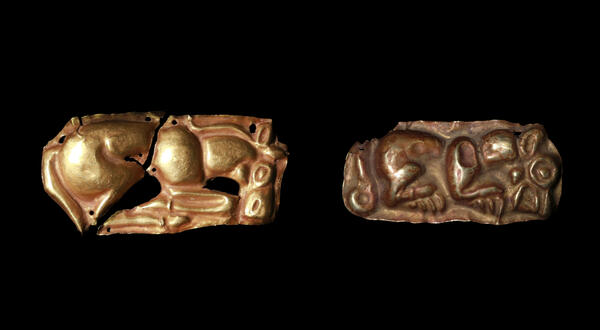
Plate with the image of a lying ungulate, Plaque with repoussé image of a beast of prey
#9
#11
#7
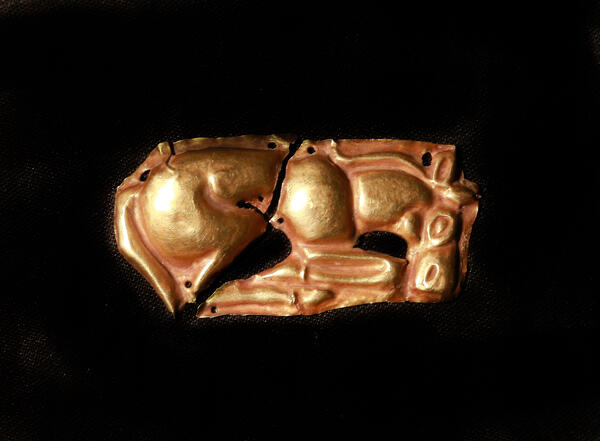
The plate portraying an Asiatic wild ass was found in the course of research activities near the KomsomOlsky village of the KrasnoYArsky District in the Astrakhan Region in 1987. This decoration - a gold sewn-on appliqué - was found on a woman’s chest. The head of the buried woman was adorned with a felt headdress (kalAf) with gold plates.
The plate with a wild ass is embossed. Embossing is a method of making repoussé images on metal plates.
An asiatic wild ass (kulan) is a hoofed animal from the equine family. His exterior resembles a donkey or a horse. Traditionally, ungulates were depicted standing or jumping, but our case is a clear deviation from the canon. At the same time, an ancient craftsman performed neat work: the bent limbs of the animal preserved their grace. The head and tail of the kulan are bent down.
Scientists have found out that the jewelry was made in the 6th-5th centuries BC, in the era of the SavromAts. The SavromAts (VII-IV centuries BC) were the first representatives of the common Sarmatian nomadic culture, which dominated the Eastern Europe for a thousand years. The area of the Savromat culture covers the Don, Volga and Ural steppes. The SavromAts led a nomadic lifestyle and were in constant motion. Men moved mainly on horseback, their households - women, children, old people - rode in carts pulled by bulls. Their carts were a kind of wheeled houses. They were covered with felt and leather. In addition to carts, people also had other dwellings that resembled yurts. However, sometimes they lived in a kind of not deep semi-dugouts in those places where they traditionally spent winter time: near the floodplain of the Volga River and near fresh lakes in the steppe. However, archaeologists have encountered very few such dwellings.
The main occupation of the Savromat tribes was nomadic cattle breeding. They left almost no structures behind, and scientists study the culture of the SavromAts mainly from burials, during archaeological excavations.
In 2005, the zoomorphic plate portraying an Asiatic wild ass and other archelogical finds were exhibited at the Astrakhan Steppe Treasures show at the National Museum of the Palazzo Venezia in Rome.
The plate with a wild ass is embossed. Embossing is a method of making repoussé images on metal plates.
An asiatic wild ass (kulan) is a hoofed animal from the equine family. His exterior resembles a donkey or a horse. Traditionally, ungulates were depicted standing or jumping, but our case is a clear deviation from the canon. At the same time, an ancient craftsman performed neat work: the bent limbs of the animal preserved their grace. The head and tail of the kulan are bent down.
Scientists have found out that the jewelry was made in the 6th-5th centuries BC, in the era of the SavromAts. The SavromAts (VII-IV centuries BC) were the first representatives of the common Sarmatian nomadic culture, which dominated the Eastern Europe for a thousand years. The area of the Savromat culture covers the Don, Volga and Ural steppes. The SavromAts led a nomadic lifestyle and were in constant motion. Men moved mainly on horseback, their households - women, children, old people - rode in carts pulled by bulls. Their carts were a kind of wheeled houses. They were covered with felt and leather. In addition to carts, people also had other dwellings that resembled yurts. However, sometimes they lived in a kind of not deep semi-dugouts in those places where they traditionally spent winter time: near the floodplain of the Volga River and near fresh lakes in the steppe. However, archaeologists have encountered very few such dwellings.
The main occupation of the Savromat tribes was nomadic cattle breeding. They left almost no structures behind, and scientists study the culture of the SavromAts mainly from burials, during archaeological excavations.
In 2005, the zoomorphic plate portraying an Asiatic wild ass and other archelogical finds were exhibited at the Astrakhan Steppe Treasures show at the National Museum of the Palazzo Venezia in Rome.
#14
Date: VI–V centuries BC
Technique: embossing
Dimensions: 0,2×3,0×4,9 cm
Collection: Precious metals
Copyright: State budgetary institution of culture of the Astrakhan region “Astrakhan Museum-Reserve”
Goskatalog Number: 17112906
Technique: embossing
Dimensions: 0,2×3,0×4,9 cm
Collection: Precious metals
Copyright: State budgetary institution of culture of the Astrakhan region “Astrakhan Museum-Reserve”
Goskatalog Number: 17112906
#12
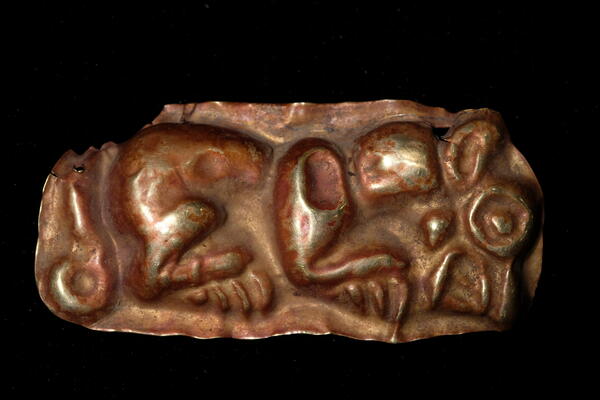
Plaque with repoussé image of a beast of prey
#13
#2
Archaeologists found the plaque with an image of a wild animal during the excavations in the KrivAya LUka area of the ChernoYArsky District in the Astrakhan region in 1976.
As scientists found out, the item was crafted in the 6th century BC. At that time, the so-called ‘animal style’ dominated the jewelry business. Craftsmen depicted animals on jewelry: women’s jewelry, fasteners, decorations of weapons and horse harnesses. Most often these were rams and deer, wild predatory cats and eagles. As a rule, animals were depicted in a styled manner: in general terms, they were either humble and calm, or, conversely, belligerent and attacking. The animal species can be guessed by the outlines of the muscles, teeth, muzzles and tails. In our case, the wild cat has fallen to the ground, its mouth is ajar, its long sharp claws are extended. However, the image of the beast is devoid of deliberate predation; the cat is depicted not furious, but rather frozen.
The Volga archaeological expedition has been working in the Volgograd and Astrakhan regions since the 1950s. The researchers studied the monuments of different eras - from ancient burial mounds to medieval fortefeid towns and cities of the XIV century with the remains of settlements.
And in the 1970s, the Volga archaeological expedition focused on those monuments that fell into the construction zones and were subject to destruction. For example, in the ChernoYArsky District of the Astrakhan Region, the construction of a huge Kalmyk-Astrakhan rice irrigation system was started, and there was a danger that many ancient mounds would be destroyed and flooded. Many of them were full of treasures that told researchers about the culture and life of long-disappeared peoples.
The excavations of the mounds were arranged along the dry bed of one of the ancient channels of the Volga delta. It was called KrivAya Luka. After the water that used to flood the delta during the so-called Novocaspian transgression of the Caspian Sea (approximately 6th – 5th millennium BC) left these area, some channels remained full-flowing for a long time. Later, they dried up, but the water sometimes broke out of the Volga or concentrated there after the rains. The tribes of the ancient Delta lived and buried their dead near such channels.
As scientists found out, the item was crafted in the 6th century BC. At that time, the so-called ‘animal style’ dominated the jewelry business. Craftsmen depicted animals on jewelry: women’s jewelry, fasteners, decorations of weapons and horse harnesses. Most often these were rams and deer, wild predatory cats and eagles. As a rule, animals were depicted in a styled manner: in general terms, they were either humble and calm, or, conversely, belligerent and attacking. The animal species can be guessed by the outlines of the muscles, teeth, muzzles and tails. In our case, the wild cat has fallen to the ground, its mouth is ajar, its long sharp claws are extended. However, the image of the beast is devoid of deliberate predation; the cat is depicted not furious, but rather frozen.
The Volga archaeological expedition has been working in the Volgograd and Astrakhan regions since the 1950s. The researchers studied the monuments of different eras - from ancient burial mounds to medieval fortefeid towns and cities of the XIV century with the remains of settlements.
And in the 1970s, the Volga archaeological expedition focused on those monuments that fell into the construction zones and were subject to destruction. For example, in the ChernoYArsky District of the Astrakhan Region, the construction of a huge Kalmyk-Astrakhan rice irrigation system was started, and there was a danger that many ancient mounds would be destroyed and flooded. Many of them were full of treasures that told researchers about the culture and life of long-disappeared peoples.
The excavations of the mounds were arranged along the dry bed of one of the ancient channels of the Volga delta. It was called KrivAya Luka. After the water that used to flood the delta during the so-called Novocaspian transgression of the Caspian Sea (approximately 6th – 5th millennium BC) left these area, some channels remained full-flowing for a long time. Later, they dried up, but the water sometimes broke out of the Volga or concentrated there after the rains. The tribes of the ancient Delta lived and buried their dead near such channels.
#15
Date:
VI century BC
Technique: embossing
Dimensions: 2,0×4,3 см
Collection: Precious metals
Copyright: State budgetary institution of culture of the Astrakhan region “Astrakhan Museum-Reserve”
Goskatalog Number: 17416747
Technique: embossing
Dimensions: 2,0×4,3 см
Collection: Precious metals
Copyright: State budgetary institution of culture of the Astrakhan region “Astrakhan Museum-Reserve”
Goskatalog Number: 17416747
read morehide
00:00
00:00
1x
1
 Point your smartphone camera to open in the app
Open in app
Share