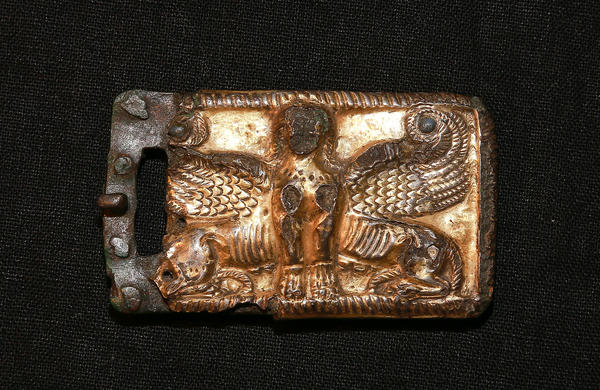
The rectangular belt buckle from our collection was crafted within the period from the 1st century BC to the 1st century AD. It is made of bronze and decorated with a repoussé image of a winged sphinx and a decorative frame in the form of a pseudo-string. The buckle has a belt slot and a protruding pin. An ancient craftsman carefully decorated the Sphinx with a pattern: the details of its wings are neatly worked out with a wavy ornament and small shading; the front legs are decorated with longitudinal stripes. There are traces of gilding on the belt buckle.
The lion personified the power of the Sun or one of the sun gods in most ancient eastern civilizations. The Great Sphinx was built for the pharaoh of the Khafre dynasty (literally ‘like the sun’), but the etymology of the word ‘sphinx’ is not Egyptian, but Greek. In Greece, this word — it translates as ‘strangler’ — was used to name a lion with a human head. This is connected with the legend about Oedipus, who freed the inhabitants of Thebes from the monster Sphinx who was a winged creature with the body of a lion and the head of a woman. The creature offered a riddle to passers-by and threw all those who could not solve it into the abyss. Only Oedipus solved the Sphinx’s riddle, and then the monster threw itself off the cliff.
Unlike the Egyptian Sphinx, the Greek one consisted of four animals: its body and legs were like a lion’s, a tail like a bull’s, wings like an eagle’s and a head like a man’s.
The buckle was considered not only an ornament in the ancient world, but also had a sacred function: it was assumed that it protects the owner from trouble. The object where the sphinx is depicted could be considered a very powerful amulet.
The belt buckle was found in 1972 during archaeological activities at the construction sites of the KalmYk-Astrakhan and NikOlsk rice irrigation systems, namely, in the BarAnovka village of the ChernoYArsk District of the Astrakhan Region. The excavations were led by V.V. DvornichEnko and G.A. FEdorov-DavYdov.
In 2005, this valuable find and other items were exhibited at the Astrakhan Steppe Treasures show at the National Museum of the Palazzo Venezia in Rome. In 2008, it was presented at the Gold of the Sarmatians show at the State Historical Museum in Moscow.
The lion personified the power of the Sun or one of the sun gods in most ancient eastern civilizations. The Great Sphinx was built for the pharaoh of the Khafre dynasty (literally ‘like the sun’), but the etymology of the word ‘sphinx’ is not Egyptian, but Greek. In Greece, this word — it translates as ‘strangler’ — was used to name a lion with a human head. This is connected with the legend about Oedipus, who freed the inhabitants of Thebes from the monster Sphinx who was a winged creature with the body of a lion and the head of a woman. The creature offered a riddle to passers-by and threw all those who could not solve it into the abyss. Only Oedipus solved the Sphinx’s riddle, and then the monster threw itself off the cliff.
Unlike the Egyptian Sphinx, the Greek one consisted of four animals: its body and legs were like a lion’s, a tail like a bull’s, wings like an eagle’s and a head like a man’s.
The buckle was considered not only an ornament in the ancient world, but also had a sacred function: it was assumed that it protects the owner from trouble. The object where the sphinx is depicted could be considered a very powerful amulet.
The belt buckle was found in 1972 during archaeological activities at the construction sites of the KalmYk-Astrakhan and NikOlsk rice irrigation systems, namely, in the BarAnovka village of the ChernoYArsk District of the Astrakhan Region. The excavations were led by V.V. DvornichEnko and G.A. FEdorov-DavYdov.
In 2005, this valuable find and other items were exhibited at the Astrakhan Steppe Treasures show at the National Museum of the Palazzo Venezia in Rome. In 2008, it was presented at the Gold of the Sarmatians show at the State Historical Museum in Moscow.