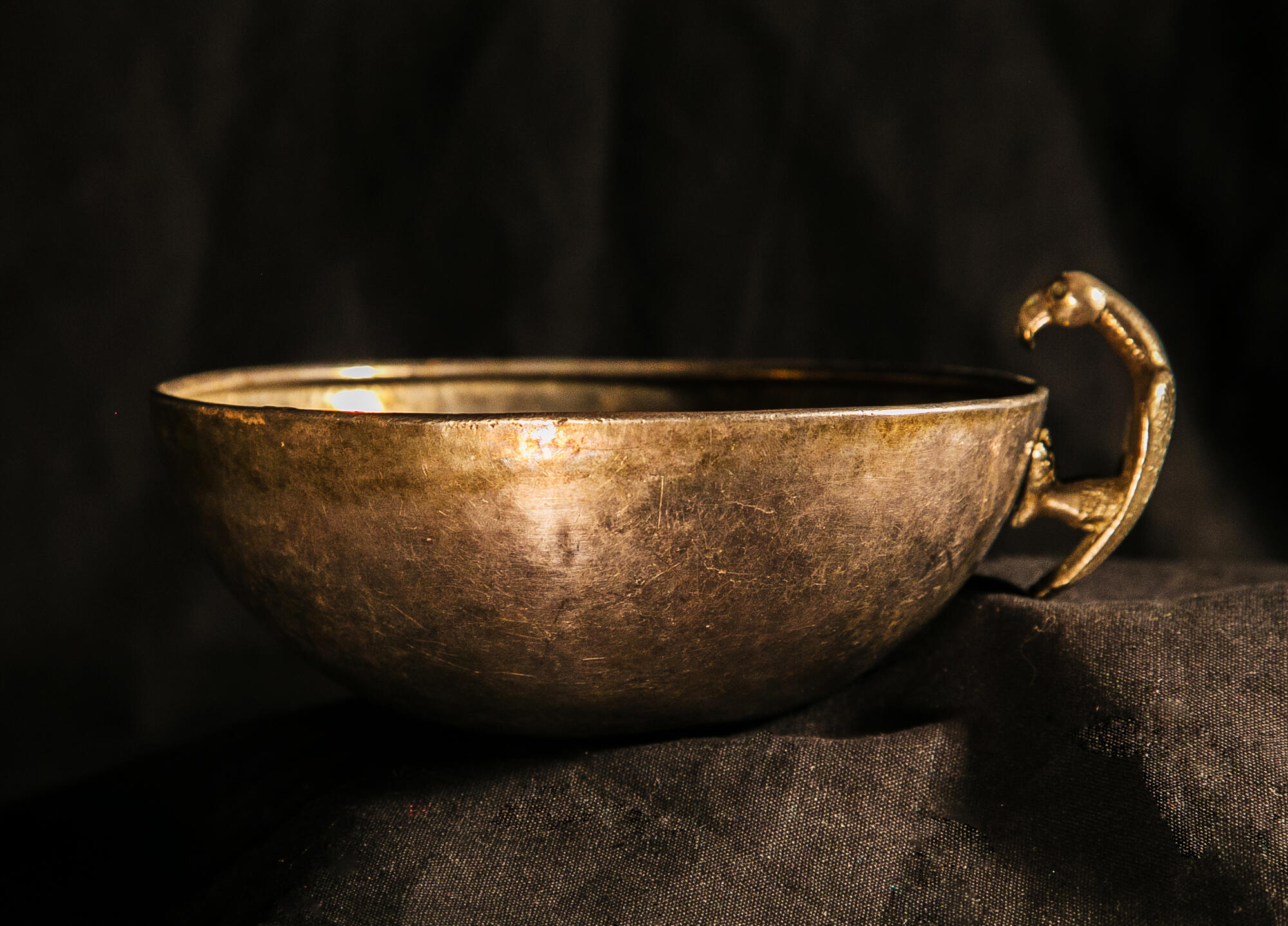


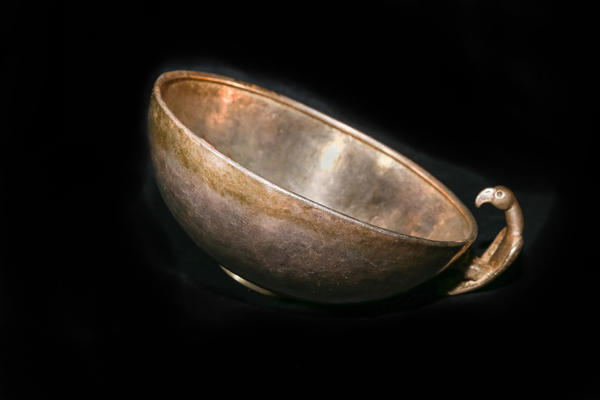
The silver bowl with a bird-shaped handle was found during excavations in the Volgograd Region in 1961. Scientists determined that the bowl had been crafted in the 1st century BC.
The bowl is made of a forged silver plate. The vessel surface has marks left by a lathe. A cast figurine of a bird of prey (eagle) is soldered to the bowl on the one side. The bird’s claws are on the edge of the vessel.
The hemispherical shape of the vessel is a point of interest. Scientists suggest that such bowls could be worn hanging from belts. Such a Scythian custom was mentioned by Herodotus in his records: the philosopher associated the custom with the legend about the people origin.
“Saying these words, Hercules stretched one of his bows (until then, Hercules had two bows). Then, having shown how to gird properly, he handed over the bow and belt (where a golden bowl was hanging at the end of the belt buckle) and left. When the children grew up, the mother gave them names. One was named as Agathirs, the other as Helon, and the younger as Scythes. Then, remembering Hercules” advice, she acted as Hercules instructed. Two sons, Agathirs and Helon, could not cope with the task (to draw a bow and also to gird as Hercules showed), and their mother expelled them from the country. The youngest, Scythes, managed to perform the task, and he remained in the country. All Scythian kings descended from Scythes, a son of Hercules. And, in memory of that gold bowl, the Scythians wear bowls attached to their belts to this day…’
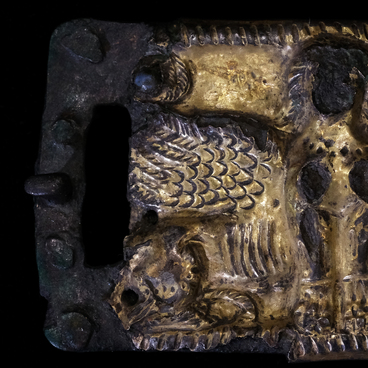
It is possible that the Sarmatians had a similar custom. In any case, precious bowls with a zoomorphic handles are often found in the burials of the Sarmatian nobility dated the 1st – 2nd centuries AD. The Sarmatians of that age decorated their jewelry, horse harness, precious dishes and even fasteners for clothes with symbolical images of animals. There was a polychrome Sarmatian style where parts of the body and head were emphasized with inserts made of coloured stones (usually turquoise) or of blue glass paste. They used large stones to bring focus on strong repoussé muscles, and small ones for emphasizing claws, teeth, eyes, ears, hooves, and bird feathers.
In 2005, the silver bowl and other archaeological values from the Astrakhan Museum Reserve were exhibited at the Astrakhan Steppe Treasures show in Rome.
The bowl is made of a forged silver plate. The vessel surface has marks left by a lathe. A cast figurine of a bird of prey (eagle) is soldered to the bowl on the one side. The bird’s claws are on the edge of the vessel.
The hemispherical shape of the vessel is a point of interest. Scientists suggest that such bowls could be worn hanging from belts. Such a Scythian custom was mentioned by Herodotus in his records: the philosopher associated the custom with the legend about the people origin.
“Saying these words, Hercules stretched one of his bows (until then, Hercules had two bows). Then, having shown how to gird properly, he handed over the bow and belt (where a golden bowl was hanging at the end of the belt buckle) and left. When the children grew up, the mother gave them names. One was named as Agathirs, the other as Helon, and the younger as Scythes. Then, remembering Hercules” advice, she acted as Hercules instructed. Two sons, Agathirs and Helon, could not cope with the task (to draw a bow and also to gird as Hercules showed), and their mother expelled them from the country. The youngest, Scythes, managed to perform the task, and he remained in the country. All Scythian kings descended from Scythes, a son of Hercules. And, in memory of that gold bowl, the Scythians wear bowls attached to their belts to this day…’
It is possible that the Sarmatians had a similar custom. In any case, precious bowls with a zoomorphic handles are often found in the burials of the Sarmatian nobility dated the 1st – 2nd centuries AD. The Sarmatians of that age decorated their jewelry, horse harness, precious dishes and even fasteners for clothes with symbolical images of animals. There was a polychrome Sarmatian style where parts of the body and head were emphasized with inserts made of coloured stones (usually turquoise) or of blue glass paste. They used large stones to bring focus on strong repoussé muscles, and small ones for emphasizing claws, teeth, eyes, ears, hooves, and bird feathers.
In 2005, the silver bowl and other archaeological values from the Astrakhan Museum Reserve were exhibited at the Astrakhan Steppe Treasures show in Rome.