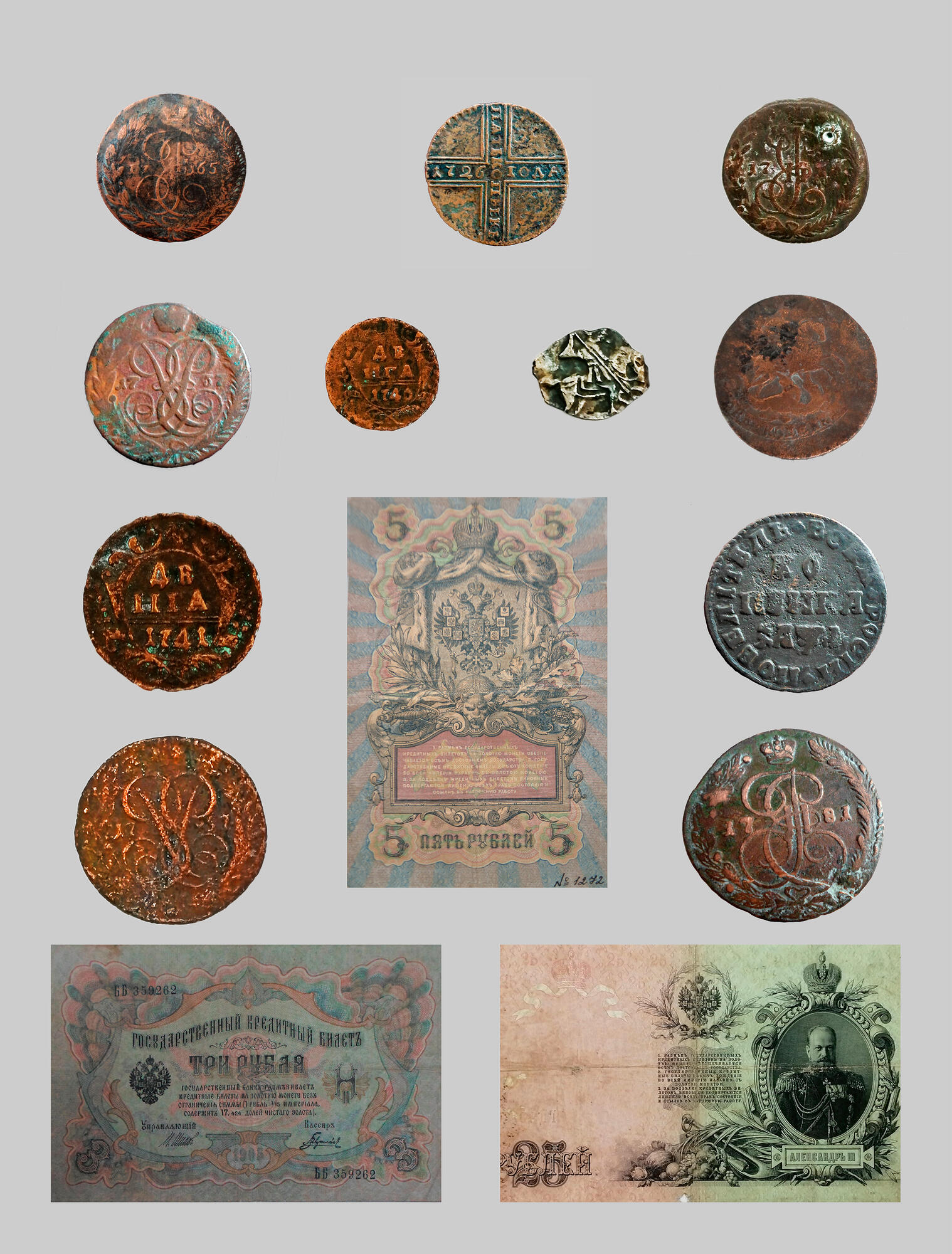


#1

Coin collection of 18c.-20c.
#2
#3

#4
The Karasuksky Regional Museum holds a copper denga coin in its collection. The coin was minted by the Yekaterinburg Mint in 1771. 2,910,000 of these coins were minted. The Moscow coat of arms is depicted on the obverse - the Great Martyr Saint George, without a mantle, gallops on horseback, striking a dragon with his spear. On the reverse, Catherine II’s cipher is positioned under the imperial crown. The cipher consists of the Russian letters ‘I’, for Empress, ‘E’ for ‘Catherine’ and the Roman numeral II for ‘the second’.
The cipher of ruler at the time was often embossed onto coins of different values. The first such symbols appeared on coins minted during Peter I’s reign. It was a cipher consisting of four interwoven letter P’s and four interwoven Roman numeral I’s.
A cipher is a design which combines initials. Most commonly, it takes the first letter of one’s forename and surname, and less commonly includes the first letter of one’s patronymic name. The letters were generally capital letters, combined using ornamental ligatured script. A ruler’s cipher would usually also contain a letter relating to their title and a number relating to their regnal number. Ciphers would occasionally be decorated with crowns or wreaths. Essentially, a cipher is a sophisticated monogram with the initials being more intricately interwoven and additional decorations and patterns. If the letters could only refer to one person, then the cipher will be simpler than if it is connected to a more than one person.
An important detail to note is the coin’s corded edge, or rim. It is covered in equally spaced vertical cuts. The peculiarity of the coin’s edge meant that it could be identified by Vladimir Bitkin’s ‘Composite Catalogue of Russian Coins’ as a denga - a coin with a value of half a kopek. Similar coins, such as kopeks, had a latticed edge - that is, with criss-crossed cuts, pointing in different directions. No other kopeks minted in 1771 were found to have this corded edge in other coin catalogues.
This type of denga was used during the reign of Empress Catherine II. At this time, copper coins used across the nation were minted at the Yekaterinburg (with the designation EM), Moscow Red (MM or without designation), Sestroretsky (SM or without designation), Saint Petersburg (SPM), Anninsky (AM and without designation), Suzunsky (km) and Tavrichesky ™ mints. Counterfeit five-kopek coins, with the EM cipher but without the Yekaterinburg mint designation, were minted at the Avesta mint in Sweden.
The cipher of ruler at the time was often embossed onto coins of different values. The first such symbols appeared on coins minted during Peter I’s reign. It was a cipher consisting of four interwoven letter P’s and four interwoven Roman numeral I’s.
A cipher is a design which combines initials. Most commonly, it takes the first letter of one’s forename and surname, and less commonly includes the first letter of one’s patronymic name. The letters were generally capital letters, combined using ornamental ligatured script. A ruler’s cipher would usually also contain a letter relating to their title and a number relating to their regnal number. Ciphers would occasionally be decorated with crowns or wreaths. Essentially, a cipher is a sophisticated monogram with the initials being more intricately interwoven and additional decorations and patterns. If the letters could only refer to one person, then the cipher will be simpler than if it is connected to a more than one person.
An important detail to note is the coin’s corded edge, or rim. It is covered in equally spaced vertical cuts. The peculiarity of the coin’s edge meant that it could be identified by Vladimir Bitkin’s ‘Composite Catalogue of Russian Coins’ as a denga - a coin with a value of half a kopek. Similar coins, such as kopeks, had a latticed edge - that is, with criss-crossed cuts, pointing in different directions. No other kopeks minted in 1771 were found to have this corded edge in other coin catalogues.
This type of denga was used during the reign of Empress Catherine II. At this time, copper coins used across the nation were minted at the Yekaterinburg (with the designation EM), Moscow Red (MM or without designation), Sestroretsky (SM or without designation), Saint Petersburg (SPM), Anninsky (AM and without designation), Suzunsky (km) and Tavrichesky ™ mints. Counterfeit five-kopek coins, with the EM cipher but without the Yekaterinburg mint designation, were minted at the Avesta mint in Sweden.
#5
Date: 1771
Place: Yekaterinburg Mint, Yekaterinburg
Technique: embossed
Dimensions: 21 mm in diameter
Copyright: Municipal Budgetary Institution ‘Karasuksky Regional Museum’
Collection: Numismatics
Place: Yekaterinburg Mint, Yekaterinburg
Technique: embossed
Dimensions: 21 mm in diameter
Copyright: Municipal Budgetary Institution ‘Karasuksky Regional Museum’
Collection: Numismatics
#6
Two Kopek Coin, 1757
#7

#8
The practice of re-coining or re-minting was widespread in 18th century Imperial Russia. This is where a new image is applied to old coins using various types of stamps. This solid copper coin, with a face value of two kopeks, from the Numismatic Collection of the Karasuksky Regional Museum, was re-minted in 1757 from a five-kopek coin issued between 1723 and 1730. Vladimir Bitkin’s catalog shows that it was minted by the Red Mint, Moscow.
The coin’s obverse depicts the Great Martyr, Saint George on horseback, striking a dragon with his spear. Elizabeth of Russia’s cipher is embossed in the center of the coin’s reverse. It is made up of the letter ‘E’ (for Elizabeth) and the letter ‘P’ (for Petrovna). The date of minting is stamped either side of the cipher. The cipher is surrounded by a wreath formed of laurels and palm branches, tied together at the bottom with a ribbon. The coin’s edge is latticed, with criss-crossed cuts. The coin doesn’t indicate its value.
Empress Elizabeth of Russia was part of the Romanov dynasty. She was the youngest daughter of Peter the Great and Catherine I, and ruled the Russian empire from 1741 until 1761. In the later years of her reign, the government decided to issue copper coins at a rate of sixteen rubles from sixteen kilograms of copper. This meant that 16.3 kilograms of copper had to mint exactly 16 rubles of coins, in one particular denomination, for example two-kopek coins. On 8 April, 1757, a decree specified that this should be extended to two-kopek, kopek, denga and quarter-kopek coins. A year later it was extended to five-kopek coins as well. The previous type of kopek-coins and five-kopek coins were re-minted into the new two-kopek coin. The decree concerning the ratio of 16 rubles to 16 kilograms of copper proved to be successful and lasted until 1810. In 1810, it was changed to a new ratio of 24 rubles from 16 kilograms of copper.
Copper coins from the reign of Elizabeth of Russia were minted at the following mints: Moscow Red (MM or without designation), Yekaterinburg (without designation), Saint Petersburg (without designation) and Sestroretsky.
A large proportion of the two-kopek coins reminted between 1757 and 1759 had previously been lightweight five-kopek coins issued between 1723 and 1730, and kopek coins issued between 1755 and 1757. Coins with an inscription on the rim had the coin’s value stamped above the Moscow coat of arms. Copies with a simple lattice edge had the value stamped under the coat of arms.
The coin’s obverse depicts the Great Martyr, Saint George on horseback, striking a dragon with his spear. Elizabeth of Russia’s cipher is embossed in the center of the coin’s reverse. It is made up of the letter ‘E’ (for Elizabeth) and the letter ‘P’ (for Petrovna). The date of minting is stamped either side of the cipher. The cipher is surrounded by a wreath formed of laurels and palm branches, tied together at the bottom with a ribbon. The coin’s edge is latticed, with criss-crossed cuts. The coin doesn’t indicate its value.
Empress Elizabeth of Russia was part of the Romanov dynasty. She was the youngest daughter of Peter the Great and Catherine I, and ruled the Russian empire from 1741 until 1761. In the later years of her reign, the government decided to issue copper coins at a rate of sixteen rubles from sixteen kilograms of copper. This meant that 16.3 kilograms of copper had to mint exactly 16 rubles of coins, in one particular denomination, for example two-kopek coins. On 8 April, 1757, a decree specified that this should be extended to two-kopek, kopek, denga and quarter-kopek coins. A year later it was extended to five-kopek coins as well. The previous type of kopek-coins and five-kopek coins were re-minted into the new two-kopek coin. The decree concerning the ratio of 16 rubles to 16 kilograms of copper proved to be successful and lasted until 1810. In 1810, it was changed to a new ratio of 24 rubles from 16 kilograms of copper.
Copper coins from the reign of Elizabeth of Russia were minted at the following mints: Moscow Red (MM or without designation), Yekaterinburg (without designation), Saint Petersburg (without designation) and Sestroretsky.
A large proportion of the two-kopek coins reminted between 1757 and 1759 had previously been lightweight five-kopek coins issued between 1723 and 1730, and kopek coins issued between 1755 and 1757. Coins with an inscription on the rim had the coin’s value stamped above the Moscow coat of arms. Copies with a simple lattice edge had the value stamped under the coat of arms.
#9
Date: 1757
Technique: embossed
Place: Red Mint, Moscow
Dimensions: 30 mm in diameter
Copyright: Municipal Budgetary Institution ‘Karasuksky Regional Museum’
Collection: Numismatics
Technique: embossed
Place: Red Mint, Moscow
Dimensions: 30 mm in diameter
Copyright: Municipal Budgetary Institution ‘Karasuksky Regional Museum’
Collection: Numismatics
#10
Two-Kopek Coin, 1765
#11

#12
This solid round copper coin with a face value of two kopeks, from the Numismatic collection of the Karasuksky Regional Museum, is poorly preserved, so it is quite difficult to determine exactly where it was minted.
From the information which has been preserved, researchers have ascertained that this coin was in circulation during the reign of Catherine II, as the royal cipher (formed of two letters) is embossed in the center of the coin’s reverse. The numbers ‘17’ and ‘65’ have been preserved on either side of the cipher. This means that the coin was issued in 1765, three years after Catherine took to the throne. The cipher is surrounded by a wreath made of laurels and palm branches, tied together by a ribbon at the bottom. This is shifted up and to the right of the coin, meaning that there wasn’t space for the crown on the coin. The design on the coin’s rim cannot be distinguished.
The Moscow coat of arms is depicted on the obverse of the coin- the Great Martyr Saint George, without a mantle, gallops on horseback, striking a dragon with his spear. Beneath this there is an inscription: ‘TWO • KOPEKS’. Beneath the horse’s left leg, it is possible to see the coin’s previous value. The practice of re-coining or re-minting was widespread in 18th century Imperial Russia. This is where a new image is applied to old coins using newer stamps.
1765 two kopek-coins were minted in three different mints: Yekaterinburg (with the designation EM), Moscow Red (with the designation MM) and Saint Petersburg (with the designation SPM). Later, the so-called re-minted coins were released with the EM stamp, but without the mint designation. These re-minted coins are essentially fake coins. However, there is a crucial difference between fake coins and re-minted coins, which is that the re-minted coins are produced at a State Mint. To re-mint the coins, they would either use the original tools and stamps or specially-made tools for a specific order. These types of re-minted coins were made at a later date than the one indicated on the coin.
There are two theories as to what exactly this coin is. Vladimir Bitkin’s two-volume ‘Composite Catalogue of Russian Coins’ suggests that it could be a re-minted coin, but without a mint designation. At this time re-minting took place at the Yekaterinburg mint. This mint produced coins with a smooth or cord-like rim - that is, the cuts are located at an equal distance from each other and are tilted to the right. According to Bitkin, the rarity of a coin like this is rated as R2 - Very Rare. There are only between nine to twenty examples of such a coin.
The second theory suggests that this re-minted coin was fairly common. Catherine II came to the throne as a result of a coup d’état after the death of her husband, Peter III. At the beginning of her reign, a significant proportion of coins were repurposed. Almost all of the two-kopek coins minted between 1763 and 1767 at the Yekaterinburg Mint, all the two-kopek coins minted at the Saint Petersburg and Moscow Red Mint and coins without designations were re-minted from four-kopek coins issued in 1762, which had the cipher of Peter III. In this case, it is a fairly common coin.
From the information which has been preserved, researchers have ascertained that this coin was in circulation during the reign of Catherine II, as the royal cipher (formed of two letters) is embossed in the center of the coin’s reverse. The numbers ‘17’ and ‘65’ have been preserved on either side of the cipher. This means that the coin was issued in 1765, three years after Catherine took to the throne. The cipher is surrounded by a wreath made of laurels and palm branches, tied together by a ribbon at the bottom. This is shifted up and to the right of the coin, meaning that there wasn’t space for the crown on the coin. The design on the coin’s rim cannot be distinguished.
The Moscow coat of arms is depicted on the obverse of the coin- the Great Martyr Saint George, without a mantle, gallops on horseback, striking a dragon with his spear. Beneath this there is an inscription: ‘TWO • KOPEKS’. Beneath the horse’s left leg, it is possible to see the coin’s previous value. The practice of re-coining or re-minting was widespread in 18th century Imperial Russia. This is where a new image is applied to old coins using newer stamps.
1765 two kopek-coins were minted in three different mints: Yekaterinburg (with the designation EM), Moscow Red (with the designation MM) and Saint Petersburg (with the designation SPM). Later, the so-called re-minted coins were released with the EM stamp, but without the mint designation. These re-minted coins are essentially fake coins. However, there is a crucial difference between fake coins and re-minted coins, which is that the re-minted coins are produced at a State Mint. To re-mint the coins, they would either use the original tools and stamps or specially-made tools for a specific order. These types of re-minted coins were made at a later date than the one indicated on the coin.
There are two theories as to what exactly this coin is. Vladimir Bitkin’s two-volume ‘Composite Catalogue of Russian Coins’ suggests that it could be a re-minted coin, but without a mint designation. At this time re-minting took place at the Yekaterinburg mint. This mint produced coins with a smooth or cord-like rim - that is, the cuts are located at an equal distance from each other and are tilted to the right. According to Bitkin, the rarity of a coin like this is rated as R2 - Very Rare. There are only between nine to twenty examples of such a coin.
The second theory suggests that this re-minted coin was fairly common. Catherine II came to the throne as a result of a coup d’état after the death of her husband, Peter III. At the beginning of her reign, a significant proportion of coins were repurposed. Almost all of the two-kopek coins minted between 1763 and 1767 at the Yekaterinburg Mint, all the two-kopek coins minted at the Saint Petersburg and Moscow Red Mint and coins without designations were re-minted from four-kopek coins issued in 1762, which had the cipher of Peter III. In this case, it is a fairly common coin.
#13
Date: 1765
Technique: embossed
Place: Yekaterinburg or Saint Petersburg Mint
Dimensions: 32 mm in diameter
Copyright: Municipal Budgetary Institution ‘Karasuksky Regional Museum’
Collection: Numismatics
Technique: embossed
Place: Yekaterinburg or Saint Petersburg Mint
Dimensions: 32 mm in diameter
Copyright: Municipal Budgetary Institution ‘Karasuksky Regional Museum’
Collection: Numismatics
#14
Three Rubles, 1905
#15

#16
The Karasuksky Regional Museum holds a three-ruble paper banknote, issued in 1905, in its collection. This credit note was printed between 1905 and 1912 as part of a total circulation of 98 million notes. In 1909, in Tomsk, three-rubles would buy you around 16 kilograms of fresh pike or around 48 kilograms of wheat flour.
Banknotes with the new design were introduced in 1905, as printing facilities became more advanced. From 1907, the new banknotes were gradually introduced. 3, 10 and 25-ruble notes were issued until 1919, whilst 100 and 500-ruble notes appeared after 1921. This three-ruble note is printed on white paper with water marks in both usually typography as well as metallographic printing. This technique uses a fairly thick layer of paint on the paper, which, when dry, means you can feel slightly raised elements of the drawing with your fingertips.
They used ‘Orlov printing’ for these banknotes - a method which made it possible to print several different colors from the same printing plate. It was invented by an expert in weaving mills, Ivan Orlov, when he was invited to the Expedition of Storing State Papers to develop silk banknotes. The method worked by ensuring that the paint from each template was transferred to the combined shaft, from which it was then transferred to the printing plate, and then printed onto the paper. This made a perfectly fitted multi-color impression. These printers could use up to five colors on each side, without leaving any gaps or overlays in the drawing. The multicolored notes printed with the Orlov method created banknotes which could not be forged by usual typographic methods.
On the obverse of the three-ruble note, there is a multicolored background and a design, above which the inscription ‘State Bank Note’ is printed. Beneath it the year of issuance - 1905 - is printed. The small state coat of arms is positioned in the center of the note, as well as Tsar Nicholas II’s cipher, the note’s value (‘THREE RUBLES’) and a small four-line inscription: ‘The State Bank exchanges credit notes for gold coins without restrictions for the amount exchanged. One ruble = 1/15 imperial, containing 17.424 shares of pure gold.’ This means that the banknote’s value was equivalent to three minted gold rubles and could be exchanged for them. The note’s reverse, along with its multicolored background and design, also has an inscription taken from the passages of the law referring to the forgery of money. The designer has also positioned a watermark on the reverse, formed of the number three repeated many times in wavy lines.
Banknotes with the new design were introduced in 1905, as printing facilities became more advanced. From 1907, the new banknotes were gradually introduced. 3, 10 and 25-ruble notes were issued until 1919, whilst 100 and 500-ruble notes appeared after 1921. This three-ruble note is printed on white paper with water marks in both usually typography as well as metallographic printing. This technique uses a fairly thick layer of paint on the paper, which, when dry, means you can feel slightly raised elements of the drawing with your fingertips.
They used ‘Orlov printing’ for these banknotes - a method which made it possible to print several different colors from the same printing plate. It was invented by an expert in weaving mills, Ivan Orlov, when he was invited to the Expedition of Storing State Papers to develop silk banknotes. The method worked by ensuring that the paint from each template was transferred to the combined shaft, from which it was then transferred to the printing plate, and then printed onto the paper. This made a perfectly fitted multi-color impression. These printers could use up to five colors on each side, without leaving any gaps or overlays in the drawing. The multicolored notes printed with the Orlov method created banknotes which could not be forged by usual typographic methods.
On the obverse of the three-ruble note, there is a multicolored background and a design, above which the inscription ‘State Bank Note’ is printed. Beneath it the year of issuance - 1905 - is printed. The small state coat of arms is positioned in the center of the note, as well as Tsar Nicholas II’s cipher, the note’s value (‘THREE RUBLES’) and a small four-line inscription: ‘The State Bank exchanges credit notes for gold coins without restrictions for the amount exchanged. One ruble = 1/15 imperial, containing 17.424 shares of pure gold.’ This means that the banknote’s value was equivalent to three minted gold rubles and could be exchanged for them. The note’s reverse, along with its multicolored background and design, also has an inscription taken from the passages of the law referring to the forgery of money. The designer has also positioned a watermark on the reverse, formed of the number three repeated many times in wavy lines.
#17
Date: 1905
Technique: metallographic printing
Place: The Expedition of Storing State Papers, Saint Petersburg
Dimensions: 15,4×9,9 cm
Collection: Numismatics
Copyright: Municipal Budgetary Institution ‘Karasuksky Regional Museum’
Technique: metallographic printing
Place: The Expedition of Storing State Papers, Saint Petersburg
Dimensions: 15,4×9,9 cm
Collection: Numismatics
Copyright: Municipal Budgetary Institution ‘Karasuksky Regional Museum’
#18
Five Kopeks, 1726
#19

#20
The numismatic collection of the Karasuksky Regional Museum includes a round, solid copper coin, with a face value of five kopeks. It was issued in 1726, and the coin was in circulation during Catherine I’s reign. Catherine I was the second wife of Peter the Great, and came to the throne after his death in 1725. This coin was the only copper coin minted during Catherine I’s reign.
The coin has a patterned rim. The small State coat of arms is positioned in the center of the coin’s obverse, surrounded by five small raised dots. The coat of arms depicts a two-headed eagle under three crowns, with an orb and scepter in its talons. These dots allowed illiterate members of the population to determine the coin’s value. Under the eagle, the letters ‘Н’ and ‘Д’ (N and D) identify that the coin was minted at the Copper Embankment Mint. The coin’s reverse also has a patterned rim. The coin’s face is divided into four parts by a cross, which is bordered by another set of parallel raised lines. A horizontal inscription shows the coin’s value, whilst a vertical inscription shows the year of issuance. The coin’s edge or rim is latticed, meaning that it is covered by smooth cuts pointing in different directions. This edge strengthened the metal and made forgery more difficult.
Between 1723 and 1730, lightweight copper coins were minted at the Moscow Red Mint (with the designation KD), the Kadashyovsky Mint (with the designations MOSCOW, MD, DM, MM or without any designation) and the Copper Embankment Mint (ND or without designation). A 40-ruble ratio was established for these mints, meaning that 16.3 kilograms of copper would be made into exactly 40 rubles of a particular type of coin. Coin ratios allowed the mints to control the number of coins issued and the mass of each coin.
Most of the coins of this type were made with an unusual method for Russian coins - the reverse faces the opposite direction from the obverse. Some of the coins, however, were produced with the usual arrangement of faces. Most of the lightweight kopeks were later re-minted as quarter-kopeks between 1730 and 1735, whilst the five-kopek coins were re-minted as kopeks and other coins between 1755 and 1757. These kopeks were used until February 1731, after which they were accepted according to their weight in copper.
The coin has a patterned rim. The small State coat of arms is positioned in the center of the coin’s obverse, surrounded by five small raised dots. The coat of arms depicts a two-headed eagle under three crowns, with an orb and scepter in its talons. These dots allowed illiterate members of the population to determine the coin’s value. Under the eagle, the letters ‘Н’ and ‘Д’ (N and D) identify that the coin was minted at the Copper Embankment Mint. The coin’s reverse also has a patterned rim. The coin’s face is divided into four parts by a cross, which is bordered by another set of parallel raised lines. A horizontal inscription shows the coin’s value, whilst a vertical inscription shows the year of issuance. The coin’s edge or rim is latticed, meaning that it is covered by smooth cuts pointing in different directions. This edge strengthened the metal and made forgery more difficult.
Between 1723 and 1730, lightweight copper coins were minted at the Moscow Red Mint (with the designation KD), the Kadashyovsky Mint (with the designations MOSCOW, MD, DM, MM or without any designation) and the Copper Embankment Mint (ND or without designation). A 40-ruble ratio was established for these mints, meaning that 16.3 kilograms of copper would be made into exactly 40 rubles of a particular type of coin. Coin ratios allowed the mints to control the number of coins issued and the mass of each coin.
Most of the coins of this type were made with an unusual method for Russian coins - the reverse faces the opposite direction from the obverse. Some of the coins, however, were produced with the usual arrangement of faces. Most of the lightweight kopeks were later re-minted as quarter-kopeks between 1730 and 1735, whilst the five-kopek coins were re-minted as kopeks and other coins between 1755 and 1757. These kopeks were used until February 1731, after which they were accepted according to their weight in copper.
#21
Date: 1726
Technique: embossed
Place: Copper Embankment Mint at the Kremlin, Moscow
Dimensions: 31 mm in diameter
Copyright: Municipal Budgetary Institution ‘Karasuksky Regional Museum’
Collection: Numismatics
Technique: embossed
Place: Copper Embankment Mint at the Kremlin, Moscow
Dimensions: 31 mm in diameter
Copyright: Municipal Budgetary Institution ‘Karasuksky Regional Museum’
Collection: Numismatics
#22
Five Kopeks, 1765
#23

#24
The numismatic collection of the Karasuksky Regional Museum includes a round, solid copper coin, with a face value of five kopeks. The design is from 1765, minted under Catherine II. Despite the striking diameter - 42 millimeters - it is not the largest five-kopek coin in the history of Russian numismatics. A square coin measuring 45×45 millimeters, with a weight of 81.9 grams was minted under Catherine I in 1726. The 1765 model of the five-kopek coin was solid, meaning that the coin could not be divided into parts with purchasing power.
In January 1762, as a result of the dire economic situation in Russia stemming from the Seven Years’ war, Tsar Peter III ordered that all current five-kopek coins should be re-minted into ten-kopek coins, and that the coin to metal ratio for them should change. The ratio determines the exact quantity of coins, of one face value, which could be printed from a pre-determined amount of metal. The copper to coin ratio changed from 16 rubles from 16.3 kilograms of copper, to 32 rubles from the same weight of copper. That meant that the weight of one coin now was the combined weight of two, and a theoretical million rubles morphed into two million. In December of the same year, Catherine II came to the throne and established the minting of five-kopek coins, as well as bringing back the 16 rubles copper to coin ratio. In 1766, this coin would pay for a five verst journey - around five kilometers - on a stage-coach.
A two-headed eagle with three crowns, an orb and scepter is depicted on the five kopek’s obverse. A shield on the eagle’s chest bears the Moscow coat of arms: Saint George in armor, on a galloping horse, striking a dragon with his spear. Despite the far from perfect state of the exhibit, it is still possible to see the chain of the order of Andrew the Apostle surrounding the shield. The letters ‘E M’ are displayed down the sides of the eagle. This is the designation of the Yekaterinburg Mint. A ribbon and the coin’s face value are displayed above the eagle. The reverse is in a better state. Catherine II’s royal cipher is positioned in the center of the reverse, formed of the Russian letters ‘I’ for Empress and ‘E’ for Catherine and the numbers ‘II’ for ‘The Second’. The date of issuance, 1765, is written on the side of the cipher. The coin’s rim is latticed, meaning that it is formed of little cuts pointing in different directions.
Under Catherine II, copper coins used across the nation were minted at the Yekaterinburg (with the designation EM), Moscow Red (MM or without designation), Sestroretsky (SM or without designation), Saint Petersburg (SPM), Anninsky (AM and without designation), Suzunsky (KM) and Tavrichesky ™ mints.
In January 1762, as a result of the dire economic situation in Russia stemming from the Seven Years’ war, Tsar Peter III ordered that all current five-kopek coins should be re-minted into ten-kopek coins, and that the coin to metal ratio for them should change. The ratio determines the exact quantity of coins, of one face value, which could be printed from a pre-determined amount of metal. The copper to coin ratio changed from 16 rubles from 16.3 kilograms of copper, to 32 rubles from the same weight of copper. That meant that the weight of one coin now was the combined weight of two, and a theoretical million rubles morphed into two million. In December of the same year, Catherine II came to the throne and established the minting of five-kopek coins, as well as bringing back the 16 rubles copper to coin ratio. In 1766, this coin would pay for a five verst journey - around five kilometers - on a stage-coach.
A two-headed eagle with three crowns, an orb and scepter is depicted on the five kopek’s obverse. A shield on the eagle’s chest bears the Moscow coat of arms: Saint George in armor, on a galloping horse, striking a dragon with his spear. Despite the far from perfect state of the exhibit, it is still possible to see the chain of the order of Andrew the Apostle surrounding the shield. The letters ‘E M’ are displayed down the sides of the eagle. This is the designation of the Yekaterinburg Mint. A ribbon and the coin’s face value are displayed above the eagle. The reverse is in a better state. Catherine II’s royal cipher is positioned in the center of the reverse, formed of the Russian letters ‘I’ for Empress and ‘E’ for Catherine and the numbers ‘II’ for ‘The Second’. The date of issuance, 1765, is written on the side of the cipher. The coin’s rim is latticed, meaning that it is formed of little cuts pointing in different directions.
Under Catherine II, copper coins used across the nation were minted at the Yekaterinburg (with the designation EM), Moscow Red (MM or without designation), Sestroretsky (SM or without designation), Saint Petersburg (SPM), Anninsky (AM and without designation), Suzunsky (KM) and Tavrichesky ™ mints.
#25
Date: 1765
Technique: embossed
Place: Yekaterinburg Mint, Yekaterinburg
Dimensions: 42mm in diameter
Copyright: Municipal Budgetary Institution ‘Karasuksky Regional Museum’
Collection: Numismatics
Technique: embossed
Place: Yekaterinburg Mint, Yekaterinburg
Dimensions: 42mm in diameter
Copyright: Municipal Budgetary Institution ‘Karasuksky Regional Museum’
Collection: Numismatics
#26
Five Kopeks, 1781
#27

#28
The Numismatic Collection at the Karasuksky Regional Museum includes a five-kopek coin from the time of Catherine II, minted in 1781. It is a round, solid copper coin with a diameter of 40 millimeters. That makes it two millimeters smaller than the five-kopek coins produced in 1765. The coin to copper ratio for this coin - the number of coins of one particular type made from a pood (or 16.3 kilograms) of copper - remained the same as before. 16.3 kilograms of copper was turned into 16 rubles of five-kopek coins.
On the obverse face of this Catherine-era five-kopek coin is a two-headed eagle with three crowns, an orb and scepter. A shield on the eagle’s chest bears the Moscow coat of arms: The Great Martyr of Saint George in armor, without a mantle, gallops on horseback, striking a dragon with his spear. The chain of the order of Saint Andrew the Apostle is positioned around the shield. This order was established by Peter the Great in 1698, “In the name of Saint Andrew the Apostle, the First-Called, by Holy baptism, our limits were first enlightened.” This Imperial order only had one level and until 1714, it was the only award in the Russian Empire.
The symbols of the Order of Saint Andrew are a cross, an eight-pointed silver star with the inscription “For Faith and Loyalty” and a gold figured chain, covered in multicolored enamels. It was only worn on the most solemn of occasions. This is the chain depicted on the five-kopek coin. Because these coins were in high demand, their designs gradually wore away and therefore now only the slightest details can be deduced as to where the coin was minted.
The letters “E M” are positioned beneath the eagle’s talons, signifying that the five-kopek coin was minted at the Yekaterinburg Mint. This is the most widely produced coin from the whole circulation. Five-kopek coins were also minted at the Suzunsky Mint, and there are records of three designs of official re-mints - one from the Suzunsky Mint and two from the Saint Petersburg Mint. Official re-mints are coins minted later and following the design of the original. They are exactly the same except for an updated date of issuance. These re-minted coins differ from forged coins as they were issued officially, using the original or specially recreated coin stamps.
Catherine II’s royal cipher is depicted on the coin’s reverse. The cipher is formed of the letters ‘I’, ‘E’ and the number ‘II’. The date of issuance is stamped either side of the cipher. The crown, slightly titled to the right, sits above the cipher. The coin’s rim or edge is latticed, meaning that it is formed of little cuts pointing in different directions. On rarer five-kopek coins minted at the Suzunsky Mint, the edge’s cuts all point in one direction.
On the obverse face of this Catherine-era five-kopek coin is a two-headed eagle with three crowns, an orb and scepter. A shield on the eagle’s chest bears the Moscow coat of arms: The Great Martyr of Saint George in armor, without a mantle, gallops on horseback, striking a dragon with his spear. The chain of the order of Saint Andrew the Apostle is positioned around the shield. This order was established by Peter the Great in 1698, “In the name of Saint Andrew the Apostle, the First-Called, by Holy baptism, our limits were first enlightened.” This Imperial order only had one level and until 1714, it was the only award in the Russian Empire.
The symbols of the Order of Saint Andrew are a cross, an eight-pointed silver star with the inscription “For Faith and Loyalty” and a gold figured chain, covered in multicolored enamels. It was only worn on the most solemn of occasions. This is the chain depicted on the five-kopek coin. Because these coins were in high demand, their designs gradually wore away and therefore now only the slightest details can be deduced as to where the coin was minted.
The letters “E M” are positioned beneath the eagle’s talons, signifying that the five-kopek coin was minted at the Yekaterinburg Mint. This is the most widely produced coin from the whole circulation. Five-kopek coins were also minted at the Suzunsky Mint, and there are records of three designs of official re-mints - one from the Suzunsky Mint and two from the Saint Petersburg Mint. Official re-mints are coins minted later and following the design of the original. They are exactly the same except for an updated date of issuance. These re-minted coins differ from forged coins as they were issued officially, using the original or specially recreated coin stamps.
Catherine II’s royal cipher is depicted on the coin’s reverse. The cipher is formed of the letters ‘I’, ‘E’ and the number ‘II’. The date of issuance is stamped either side of the cipher. The crown, slightly titled to the right, sits above the cipher. The coin’s rim or edge is latticed, meaning that it is formed of little cuts pointing in different directions. On rarer five-kopek coins minted at the Suzunsky Mint, the edge’s cuts all point in one direction.
#29
Date: 1781
Technique: embossed
Place: Yekaterinburg Mint, Yekaterinburg
Dimensions: 40mm in diameter
Copyright: Municipal Budgetary Institution ‘Karasuksky Regional Museum’
Collection: Numismatics
Technique: embossed
Place: Yekaterinburg Mint, Yekaterinburg
Dimensions: 40mm in diameter
Copyright: Municipal Budgetary Institution ‘Karasuksky Regional Museum’
Collection: Numismatics
#30
5 Rubles, 1909
#31

#32
The Karasuksky Regional Museum’s collection includes a State Credit note, with a face value of five rubles, issued in 1909, signed by Russian financier, Ivan Shipov, who led the Russian Empire’s State Bank.
The 1909 five ruble banknote is the most frequently seen banknote of all pre-revolutionary Russian money. They are found in old books, in secret hiding spots in pre-revolutionary buildings and buried with other possessions and many other places besides. This banknote was printed between 1909 and 1917, and it is possible to determine a more specific date thanks to the serial letters, numbers and signatures of the bank managers and clerks. For example, the first batch was issued in 1909 and 1910 and was not signed. They have horizontal or diagonal perforations. Some notes were printed on both sides, whilst others were printed on just one side, with a white background on the back. There are no numbers on the double-sided banknotes, however they do have the signature of the Manager of the state Bank, Alexey Konshin.
From 1910, the proper five-ruble notes were issued. These banknotes have a watermark - the number 5 is repeated in the wavy lines on the reverse - and were numbered and signed by Alexey Konshin and the clerk. Banknotes with Konshin’s signature were issued until 1914, with a total circulation of 194 million notes.
Ivan Shipov was appointed Manager of the State Bank on 22 April 1914. From 1914 until 1916, the five ruble note was issued with his signature, and this is the signature on the museum’s note. The circulation of these banknotes amounted to 127 million. There was a so-called ‘Soviet Issue’ of five-ruble credit notes with the 1909 design and Shipov’s signature. These notes used the old stamps after Shipov was dismissed from his position for sabotage. In 1917, he refused to comply with the orders made by the Council of People’s Commissars and the State Bank’s operations were halted.
The 1909 design of vertical five ruble banknotes were printed in a few colors on white paper and were fairly large - almost 16 centimeters in length. On the obverse, apart from the small State coat of arms and the year of issuance, there is an inscription explaining that the banknote can be exchanged for five rubles of gold. The signature of the clerk, Ovchinnikov, is next to Shipov’s signature. There are sixteen different signatures of clerks on Shipov-era five-ruble notes. Lower down, the serial number: OK 122576 is displayed.
The 1909 five ruble banknote is the most frequently seen banknote of all pre-revolutionary Russian money. They are found in old books, in secret hiding spots in pre-revolutionary buildings and buried with other possessions and many other places besides. This banknote was printed between 1909 and 1917, and it is possible to determine a more specific date thanks to the serial letters, numbers and signatures of the bank managers and clerks. For example, the first batch was issued in 1909 and 1910 and was not signed. They have horizontal or diagonal perforations. Some notes were printed on both sides, whilst others were printed on just one side, with a white background on the back. There are no numbers on the double-sided banknotes, however they do have the signature of the Manager of the state Bank, Alexey Konshin.
From 1910, the proper five-ruble notes were issued. These banknotes have a watermark - the number 5 is repeated in the wavy lines on the reverse - and were numbered and signed by Alexey Konshin and the clerk. Banknotes with Konshin’s signature were issued until 1914, with a total circulation of 194 million notes.
Ivan Shipov was appointed Manager of the State Bank on 22 April 1914. From 1914 until 1916, the five ruble note was issued with his signature, and this is the signature on the museum’s note. The circulation of these banknotes amounted to 127 million. There was a so-called ‘Soviet Issue’ of five-ruble credit notes with the 1909 design and Shipov’s signature. These notes used the old stamps after Shipov was dismissed from his position for sabotage. In 1917, he refused to comply with the orders made by the Council of People’s Commissars and the State Bank’s operations were halted.
The 1909 design of vertical five ruble banknotes were printed in a few colors on white paper and were fairly large - almost 16 centimeters in length. On the obverse, apart from the small State coat of arms and the year of issuance, there is an inscription explaining that the banknote can be exchanged for five rubles of gold. The signature of the clerk, Ovchinnikov, is next to Shipov’s signature. There are sixteen different signatures of clerks on Shipov-era five-ruble notes. Lower down, the serial number: OK 122576 is displayed.
#33
Date: 1909
Place: The Expedition of Storing State Papers, Saint Petersburg
Technique: typographic printing
Dimensions: 9,8×15,8 cm
Copyright: Municipal Budgetary Institution ‘Karasuksky Regional Museum’
Collection: Numismatics
Place: The Expedition of Storing State Papers, Saint Petersburg
Technique: typographic printing
Dimensions: 9,8×15,8 cm
Copyright: Municipal Budgetary Institution ‘Karasuksky Regional Museum’
Collection: Numismatics
#34
25 Rubles, 1909
#35

#36
The numismatic collection of the Karasuksky Regional Museum includes a paper banknote, with a face value of 25 rubles, issued in 1909. This credit note was issued some time after April 1914, since at this time, Ivan Shipov, whose signature is on the banknote, was the manager of the Russian Empire’s State Bank. This design of banknote was issued right up until 1918, with a total circulation of 53 million notes. In 1912, in Tomsk, this note would buy you five poods (or around 80 kilograms) of high-quality beef, or three pairs of excellent boots.
This was the second issuance of 25-ruble banknotes under Tsar Nicholas II. The first took place in 1898, four years after Nicholas took the throne, whilst the second took place in 1909. The reason for the introduction of these new paper banknotes was to improve the printing techniques of the banknotes. The credit notes produced between 1905 and 1912 were printed on white paper (apart from the 100 ruble notes, which were printed on a yellowy paper), and had watermarks. Printing with usual and metallographic printing techniques made the text and the colorful design slightly raised off the surface of the note. Printers could utilize five different colors on one side of the banknote. Money printed with this technique was very hard to forge. These banknotes remained in circulation until October 1922.
The 25-ruble note’s obverse is made up of two different halves. The left half is printed in lilac, whilst the right one is bluey-green in color, with black text. The main design on the right-hand side is a portrait of Alexander III, surrounded by a decorated oval frame, with a crown at the top. The 1883 State coat of arms is depicted in the center of the note. Beneath it, an extract of the 14 November 1897 law is inscribed, warning about the punishment of hard labor for anyone found forging money.
The reverse’s background is dark purple, with a multicolored design and black text. The 1883 small State coat of arms is printed on this side of the note, as well as the face value and a five-line inscription about the gold collateral held for this credit note. The banknote was signed by the manger of the State Bank, Ivan Shipov, and its clerk, Gusev. There are more complex water marks on this banknote than on the five ruble note. The number 25 is repeated with the shortened word ‘RUB’ perpendicular to each other, tilted diagonally. There is also a local watermark, duplicating the portrait of Alexander III.
This was the second issuance of 25-ruble banknotes under Tsar Nicholas II. The first took place in 1898, four years after Nicholas took the throne, whilst the second took place in 1909. The reason for the introduction of these new paper banknotes was to improve the printing techniques of the banknotes. The credit notes produced between 1905 and 1912 were printed on white paper (apart from the 100 ruble notes, which were printed on a yellowy paper), and had watermarks. Printing with usual and metallographic printing techniques made the text and the colorful design slightly raised off the surface of the note. Printers could utilize five different colors on one side of the banknote. Money printed with this technique was very hard to forge. These banknotes remained in circulation until October 1922.
The 25-ruble note’s obverse is made up of two different halves. The left half is printed in lilac, whilst the right one is bluey-green in color, with black text. The main design on the right-hand side is a portrait of Alexander III, surrounded by a decorated oval frame, with a crown at the top. The 1883 State coat of arms is depicted in the center of the note. Beneath it, an extract of the 14 November 1897 law is inscribed, warning about the punishment of hard labor for anyone found forging money.
The reverse’s background is dark purple, with a multicolored design and black text. The 1883 small State coat of arms is printed on this side of the note, as well as the face value and a five-line inscription about the gold collateral held for this credit note. The banknote was signed by the manger of the State Bank, Ivan Shipov, and its clerk, Gusev. There are more complex water marks on this banknote than on the five ruble note. The number 25 is repeated with the shortened word ‘RUB’ perpendicular to each other, tilted diagonally. There is also a local watermark, duplicating the portrait of Alexander III.
#37
Date: 1909
Place: The Expedition of Storing State Papers, Saint Petersburg
Technique: metallographic and typographic printing
Dimensions: 17,8×10,8 cm
Collection: Numismatics
Copyright: Municipal Budgetary Institution ‘Karasuksky Regional Museum’
Place: The Expedition of Storing State Papers, Saint Petersburg
Technique: metallographic and typographic printing
Dimensions: 17,8×10,8 cm
Collection: Numismatics
Copyright: Municipal Budgetary Institution ‘Karasuksky Regional Museum’
#38
Denga, 1740
#39

#40
The numismatic collection of the Karasuksky Regional Museum includes a round, solid copper coin, with a face value of a denga, issued in 1740. Coins such as these were in circulation under Anna Ivanovna, the fourth daughter of Ivan V, who was a brother and co-regent to Peter I. They continued to be used under Elizabeth of Russia.
The denga’s obverse shows the simple State coat of arms used by the Russian Empire in the first half of the 18th century. The eagle doesn’t have a shield on its chest or the ribbon of the order of Saint Andrew. Three crowns rest on top of it, whilst it holds an orb and scepter in its talons. The central imperial crown is large and covered, that is, it has a cap within it. The coin’s reverse has the face value displayed over two lines and the date of issuance - 1740. Two lines separate the two pieces of text. As for framing, there are branches on the side and crossed branches at the bottom. Due to the exhibit’s condition, it is not possible to see what type of branches these are, but on other coins from the same production run, it is possible to say that it is a leafy branch. On both sides of the denga coin, the image has shifted to one direction or another during production. On the reverse it is shifted to the right, whilst on the obverse - to the left.
The coin’s edge, or rim, is latticed, made up of criss-crossed cuts. This type of edge design makes forgery significantly more difficult. Usually the design on the edge was made with a specialist milling machine - the coin was rolled with a lot of strength between two steel rails with notches sticking out of them.
The denga is considered to be one of the most common coins of the imperial era, as it was regularly issued between 1730 and 1754. During that time, only the two-headed eagle would change between different versions. This coin has the so-called ‘Yekaterinburgski’ eagle, which was stamped onto coins between 1737 and 1741. The ‘Yekaterinburgski’ eagle differentiates itself from other eagles on the State coat of arms due to its large and wide crown, and triangular body shape. The feathers down the eagle’s side are long and straight. Throughout the whole production run, a total of 17,065,800 coins like this were minted at the Yekaterinburg Mint.
Russian Imperial copper coins between 1730 and 1754 were minted at the Yekaterinburg, Moscow Red and Kadashyovsky mints, and also at the Plaschilnaya mill, a temporary mint on the river Yauza. A ten-ruble copper to coin ratio was used for these coins, meaning that one pood (16.3 kilograms) of copper would be turned into exactly ten rubles of one particular coin type.
The denga’s obverse shows the simple State coat of arms used by the Russian Empire in the first half of the 18th century. The eagle doesn’t have a shield on its chest or the ribbon of the order of Saint Andrew. Three crowns rest on top of it, whilst it holds an orb and scepter in its talons. The central imperial crown is large and covered, that is, it has a cap within it. The coin’s reverse has the face value displayed over two lines and the date of issuance - 1740. Two lines separate the two pieces of text. As for framing, there are branches on the side and crossed branches at the bottom. Due to the exhibit’s condition, it is not possible to see what type of branches these are, but on other coins from the same production run, it is possible to say that it is a leafy branch. On both sides of the denga coin, the image has shifted to one direction or another during production. On the reverse it is shifted to the right, whilst on the obverse - to the left.
The coin’s edge, or rim, is latticed, made up of criss-crossed cuts. This type of edge design makes forgery significantly more difficult. Usually the design on the edge was made with a specialist milling machine - the coin was rolled with a lot of strength between two steel rails with notches sticking out of them.
The denga is considered to be one of the most common coins of the imperial era, as it was regularly issued between 1730 and 1754. During that time, only the two-headed eagle would change between different versions. This coin has the so-called ‘Yekaterinburgski’ eagle, which was stamped onto coins between 1737 and 1741. The ‘Yekaterinburgski’ eagle differentiates itself from other eagles on the State coat of arms due to its large and wide crown, and triangular body shape. The feathers down the eagle’s side are long and straight. Throughout the whole production run, a total of 17,065,800 coins like this were minted at the Yekaterinburg Mint.
Russian Imperial copper coins between 1730 and 1754 were minted at the Yekaterinburg, Moscow Red and Kadashyovsky mints, and also at the Plaschilnaya mill, a temporary mint on the river Yauza. A ten-ruble copper to coin ratio was used for these coins, meaning that one pood (16.3 kilograms) of copper would be turned into exactly ten rubles of one particular coin type.
#41
Date: 1740
Place: Yekaterinburg Mint, Yekaterinburg
Technique: embossed
Dimensions: 25 mm in diameter
Collection: Numismatics
Copyright: Municipal Budgetary Institution ‘Karasuksky Regional Museum’
Place: Yekaterinburg Mint, Yekaterinburg
Technique: embossed
Dimensions: 25 mm in diameter
Collection: Numismatics
Copyright: Municipal Budgetary Institution ‘Karasuksky Regional Museum’
#42
Denga, 1741
#43

#44
The numismatic collection of the Karasuksky Regional Museum includes a round copper coin, with a face value of a denga, issued in 1741. At this time, the infant Ivan Antonovich Romanov, or Ivan VI, was ruling, although he had not yet been crowned. He was the son of Duke Anthony Ulrich of Brunswick and Anna Leopoldovna. He was part of the Brunswick branch of the Romanov dynasty and was the great-grandson Ivan V, who was Peter the Great’s brother. This had put him in line to the throne.
At the beginning, the boy’s regent was Ernst Biron, a favorite of Anna Ivanovna’s, whilst later on it was his mother, Anna Leopoldovna. Ivan Antonovich was deposed by Elizabeth Petrovna, and spent the first half of his life locked in a small cell in the northern village of Kholmogory. When he was sixteen, he was moved to a solitary cell in the Shlisselburg fortress. Eight years later, Ivan’s own armed guards killed him, following another attempt to free the deposed tsar.
Until roughly the end of January 1741, when a new coin design with Ivan VI’s portrait were approved, rubles and fifty-kopek coins continued to be minted with Anna Ivanovna’s portrait, dated with the year 1740. The reason behind this was due to the difficulty in creating a suitable portrait for the two-month old tsar for the new coin design.
Ivan VI’s silver coins were minted with face values of 1 ruble, 50, 25 and 10 kopeks. Furthermore, the silver type used for ten-kopek coins was reduced from 802 to 750. Copper coins remained unchanged from the previous ruler, and were minted with a copper to coin ratio of ten rubles per pood (16.3 kilograms) of copper. Under Ivan VI, the mints in Saint Petersburg, Moscow and Yekaterinburg were all operational. The mint in Yekaterinburg only minted copper coins, whilst Moscow and Saint Petersburg minted exclusively in silver.
After Elizabeth I’s accession to the throne, coins with Ivan VI’s portrait were withdrawn from circulation and re-minted into equivalent coins with Elizabeth’s portrait. Following a decree from 31 December 1741, all Russian subjects had to exchange (for their full value) their coins with Ivan VI’s portrait within a year. After this deadline, the exchange rate fell so that Russians could only get 92.5 kopeks per ruble. The rate fell once again, and after June 1745, the coins were withdrawn with nothing in return, and anyone in possession of such a coin could be sent to hard labor as conspirators against the state. It was not at all difficult to exchange coins, as around 60% of the produced coins were still in storage with the treasury, so they were sent immediately to be re-minted.
At the beginning, the boy’s regent was Ernst Biron, a favorite of Anna Ivanovna’s, whilst later on it was his mother, Anna Leopoldovna. Ivan Antonovich was deposed by Elizabeth Petrovna, and spent the first half of his life locked in a small cell in the northern village of Kholmogory. When he was sixteen, he was moved to a solitary cell in the Shlisselburg fortress. Eight years later, Ivan’s own armed guards killed him, following another attempt to free the deposed tsar.
Until roughly the end of January 1741, when a new coin design with Ivan VI’s portrait were approved, rubles and fifty-kopek coins continued to be minted with Anna Ivanovna’s portrait, dated with the year 1740. The reason behind this was due to the difficulty in creating a suitable portrait for the two-month old tsar for the new coin design.
Ivan VI’s silver coins were minted with face values of 1 ruble, 50, 25 and 10 kopeks. Furthermore, the silver type used for ten-kopek coins was reduced from 802 to 750. Copper coins remained unchanged from the previous ruler, and were minted with a copper to coin ratio of ten rubles per pood (16.3 kilograms) of copper. Under Ivan VI, the mints in Saint Petersburg, Moscow and Yekaterinburg were all operational. The mint in Yekaterinburg only minted copper coins, whilst Moscow and Saint Petersburg minted exclusively in silver.
After Elizabeth I’s accession to the throne, coins with Ivan VI’s portrait were withdrawn from circulation and re-minted into equivalent coins with Elizabeth’s portrait. Following a decree from 31 December 1741, all Russian subjects had to exchange (for their full value) their coins with Ivan VI’s portrait within a year. After this deadline, the exchange rate fell so that Russians could only get 92.5 kopeks per ruble. The rate fell once again, and after June 1745, the coins were withdrawn with nothing in return, and anyone in possession of such a coin could be sent to hard labor as conspirators against the state. It was not at all difficult to exchange coins, as around 60% of the produced coins were still in storage with the treasury, so they were sent immediately to be re-minted.
#45
Date: 1741
Place: Yekaterinburg Mint, Yekaterinburg
Technique: embossed
Dimensions: 25 mm in diameter
Copyright: Municipal Budgetary Institution ‘Karasuksky Regional Museum’
Collection: Numismatics
Place: Yekaterinburg Mint, Yekaterinburg
Technique: embossed
Dimensions: 25 mm in diameter
Copyright: Municipal Budgetary Institution ‘Karasuksky Regional Museum’
Collection: Numismatics
#46
Denga, 1757
#47

#48
Among the other denga coins held in the Karasuksky Regional Museum’s Numismatics collection, this denga was issued in 1757, entering into circulation towards the end of Elizabeth I’s reign. The denga is a solid copper coin, with a value of half a kopek. The system of monetary circulation in Russia became more standardized and well-defined under Peter the Great. Over a number of years, he gradually introduced new face values of copper coins and normalized the guidelines around minting.
In 1700, the following copper coins appeared: denga, polushka (a half denga) and a polupolushka (a quarter denga). The population became accustomed to the fact that copper coins should be trusted just as much as silver coins. A year later, silver half-rubles (50 kopeks), half-poltinas (25 kopeks), grivenniki (10 kopeks) and five-kopek coins were minted in Russia. The silver ruble and the copper kopek only appeared in 1704.
In the later years of Elizabeth I’s reign, the government decided to change the copper to metal ratio for the most popular coins. In other words, they changed the number of coins made from a defined amount of a precious metal. Now, from one pood of copper (16.3 kilograms), 16 rubles of a particular face value needed to be made. The previous ratio had been 10 rubles to a pood of copper, meaning that they were heavier and therefore contained more of the precious metal. A decree on 8 April 1757 introduced this new ratio for two-kopek, kopek, denga and polushka (half-denga) coins. Five-kopek coins were added to this, following a decree on 14 January 1758. The previous kopeks along with the remaining crossed five-kopek coins were re-minted into the new design of two-kopek coins, which had twice the face value. This scheme, proposed by the head of the Russian government, Pyotr Shuvalov, proved to be effective, with the 16-ruble copper to ruble ratio remaining in force until 1810.
The denga’s obverse shows a rider with a spear, If one compares it with coins in a better condition, you can see that this depicts the Moscow coat of arms: Great Martyr Saint George the Victorious, in armor, on a galloping horse, strikes a serpent with a spear. The face value is positioned under the image - denga. Elizabeth I’s cipher is positioned on the coin’s reverse, with the imperial crown above it. This coin was minted between 1757 and 1760. Throughout these years, there are many different variations in the shape, size and position of the date, the cipher design and other smaller details.
In 1700, the following copper coins appeared: denga, polushka (a half denga) and a polupolushka (a quarter denga). The population became accustomed to the fact that copper coins should be trusted just as much as silver coins. A year later, silver half-rubles (50 kopeks), half-poltinas (25 kopeks), grivenniki (10 kopeks) and five-kopek coins were minted in Russia. The silver ruble and the copper kopek only appeared in 1704.
In the later years of Elizabeth I’s reign, the government decided to change the copper to metal ratio for the most popular coins. In other words, they changed the number of coins made from a defined amount of a precious metal. Now, from one pood of copper (16.3 kilograms), 16 rubles of a particular face value needed to be made. The previous ratio had been 10 rubles to a pood of copper, meaning that they were heavier and therefore contained more of the precious metal. A decree on 8 April 1757 introduced this new ratio for two-kopek, kopek, denga and polushka (half-denga) coins. Five-kopek coins were added to this, following a decree on 14 January 1758. The previous kopeks along with the remaining crossed five-kopek coins were re-minted into the new design of two-kopek coins, which had twice the face value. This scheme, proposed by the head of the Russian government, Pyotr Shuvalov, proved to be effective, with the 16-ruble copper to ruble ratio remaining in force until 1810.
The denga’s obverse shows a rider with a spear, If one compares it with coins in a better condition, you can see that this depicts the Moscow coat of arms: Great Martyr Saint George the Victorious, in armor, on a galloping horse, strikes a serpent with a spear. The face value is positioned under the image - denga. Elizabeth I’s cipher is positioned on the coin’s reverse, with the imperial crown above it. This coin was minted between 1757 and 1760. Throughout these years, there are many different variations in the shape, size and position of the date, the cipher design and other smaller details.
#49
Date: 1757
Technique: embossed
Place: Yekaterinburg Mint, Yekaterinburg
Dimensions: 22 mm in diameter
Copyright: Municipal Budgetary Institution ‘Karasuksky Regional Museum’
Collection: Numismatics
Technique: embossed
Place: Yekaterinburg Mint, Yekaterinburg
Dimensions: 22 mm in diameter
Copyright: Municipal Budgetary Institution ‘Karasuksky Regional Museum’
Collection: Numismatics
#50
Kopek Coin, 1706
#51

#52
The numismatic collection of the Karasuksky Regional Museum includes an oval-shaped solid silver wire coin, with a face value of a kopek. The coin weighs around 0.25 g, with 0.24 g of that being pure silver. The silver itself is 960 silver. The silver type refers to the number of milligrams of pure metal in one gram of the alloy.
A rider without a greatcoat, but with a spear in his right hand is depicted on the coin’s obverse. Three letters are written under the horse’s legs, indicating the coin’s year of issuance. A three-line inscription containing the name and title of the ruler is displayed on the coin’s reverse: ‘ПTРЪ ЕЗИЕ O/BИЧЪ’ (Tsar Peter Alyozievich, or Tsar Peter Alekseyevich).
The one-man rule of Peter the Great started after the death of his older brother, Ivan Alekseyevich, in 1696. This was the year that Russia started to date ‘wire kopeks’ - coins minted on flattened pieces of silver wire. The ‘Chinese Mint’ became the first Russian mint to start issuing dated silver kopeks. In 1700, the second mint was establish in the building of the former Zemsky Prikaz (department of urban issues and police) on Red Square. The Chinese Mint was named ‘The Old Mint’ in documents. In 1701, two further mints were set up, including the Kadashyovsky Mint. Yuri Frobus was the designer of coin stamps at this Mint between 1701 and 1708.
Production of ‘wire kopeks’ was halted at every mint in January 1718. A unique trait of kopeks produced between 1701 and 1709 at the Kadashyovsky Mint is that the design and inscriptions are raised significantly. The rider on the coin’s obverse was always depicted without a greatcoat. The inscriptions on the reverse are a shortened version of ‘Tsar Peter Alekseyevich’. All of the reverse stamps are characterized by noticeably raised large letters and the use of the letter ξ (pronounced ‘ksi’) in the patronymic name. The carefully cut letter is slightly different on each stamp. Dots have been added around the edges of the inscription, rendering it circular in shape.
The museum’s coin, according to Grishin and Kleschinov’s ‘Catalogue of Russian Medieval Coins 1533-1717’ was embossed by stamp No. 96. The obverse sides of these coins were embossed by stamps No. 42, 43, 44, and 45. However, the number of lines on the rider’s costume and the shape of the horse’s tail indicate that it could only have been embossed by stamp No. 42. This means that this coin’s number is No. 2062. These coins were produced in large quantities at the Kadashyovsky Mint in 1706.
A rider without a greatcoat, but with a spear in his right hand is depicted on the coin’s obverse. Three letters are written under the horse’s legs, indicating the coin’s year of issuance. A three-line inscription containing the name and title of the ruler is displayed on the coin’s reverse: ‘ПTРЪ ЕЗИЕ O/BИЧЪ’ (Tsar Peter Alyozievich, or Tsar Peter Alekseyevich).
The one-man rule of Peter the Great started after the death of his older brother, Ivan Alekseyevich, in 1696. This was the year that Russia started to date ‘wire kopeks’ - coins minted on flattened pieces of silver wire. The ‘Chinese Mint’ became the first Russian mint to start issuing dated silver kopeks. In 1700, the second mint was establish in the building of the former Zemsky Prikaz (department of urban issues and police) on Red Square. The Chinese Mint was named ‘The Old Mint’ in documents. In 1701, two further mints were set up, including the Kadashyovsky Mint. Yuri Frobus was the designer of coin stamps at this Mint between 1701 and 1708.
Production of ‘wire kopeks’ was halted at every mint in January 1718. A unique trait of kopeks produced between 1701 and 1709 at the Kadashyovsky Mint is that the design and inscriptions are raised significantly. The rider on the coin’s obverse was always depicted without a greatcoat. The inscriptions on the reverse are a shortened version of ‘Tsar Peter Alekseyevich’. All of the reverse stamps are characterized by noticeably raised large letters and the use of the letter ξ (pronounced ‘ksi’) in the patronymic name. The carefully cut letter is slightly different on each stamp. Dots have been added around the edges of the inscription, rendering it circular in shape.
The museum’s coin, according to Grishin and Kleschinov’s ‘Catalogue of Russian Medieval Coins 1533-1717’ was embossed by stamp No. 96. The obverse sides of these coins were embossed by stamps No. 42, 43, 44, and 45. However, the number of lines on the rider’s costume and the shape of the horse’s tail indicate that it could only have been embossed by stamp No. 42. This means that this coin’s number is No. 2062. These coins were produced in large quantities at the Kadashyovsky Mint in 1706.
#53
Date: 1706
Place: Kadashyovsky Mint, Moscow
Technique: embossed
Dimensions: 1×0,8 cm
Copyright: Municipal Budgetary Institution ‘Karasuksky Regional Museum’
Collection: Numismatics
Place: Kadashyovsky Mint, Moscow
Technique: embossed
Dimensions: 1×0,8 cm
Copyright: Municipal Budgetary Institution ‘Karasuksky Regional Museum’
Collection: Numismatics
#54
Kopek Coin, 1710
#55

#56
The Karasuksky Regional Museum’s Numismatics collection includes two-kopek coins minted under Peter the Great. One is a pre-reform stretched ‘cheshuyka’ (fish-scale), made from silver wire, whilst the other is a traditional, round, solid copper coin. It was minted in 1710.
The reforms carried out between 1698 and 1704 were some of the first measures undertaken by Peter the Great in order to regulate the country’s economy. The overall goal was to increase revenue from monetary regalia. Furthermore it was necessary to standardize and unify the system of the internal circulation of money.
Until the end of the 17th century, the Moscow mint (the only mint in the country), continued to mint silver kopeks, dengas and polushkas. Face values of less than a kopek were expensive to produce, and so on the whole they were in demand. By the end of the 17th century, the kopek had become very small indeed, but it remained a heavily used coin.
That coin production was greatly reduced and local initiatives received compensation accounts for the fact that they didn’t change the coin. People would either cut kopeks into smaller pieces or created local money from other materials, such as ‘leather lots’, which were stamped square pieces of hard leather. In these circumstances, the only way forward was to create a new monetary system. It was based on a silver ruble with a reduced weight, which corresponded to the European thaler, and also a copper kopek and its derivatives.
There were thorough preparations ahead of the reforms. Several minting machines were purchased from abroad. From 1696, dated kopeks started to be issued. These dates would have sent a message to the population about the forthcoming changes to the monetary system.
The reforms took six years. In 1698, the weight of the silver kopek was reduced to 0.28 grams, due to the weight of the ruble being equal to the weight of a thaler - 28 grams. From this scheme, the government received 35 kopeks in profit for every ruble. At the same time, new mints were being built and existing mints were being refurbished, where coins could be minted on round blanks.
On 11 March 1700, a decree was issued ‘About the introduction of copper coins’. Copper coins were necessary due to a lack of coins being available in cities. Copper coins were initially issued with face values of a denga (½ kopek), polushka (¼ kopek) and polupolushka (1/8 kopek). The government recognized that they were directly equivalent to the silver wire kopeks. When there was a critical lack of coins, they were fairly easily introduced into circulation. Coins were minted from imported copper, which came in ingots or plates.
In 1701, the following new silver coins were minted: poltinas, polupoltinniks, grivenniks (10 kopeks) and five kopeks (10 dengas). At the same time, up until 1718, the previous style of silver wire kopeks were made as collateral for the solid copper kopeks and their derivatives. In 1701, gold coins started to be produced, with a weight of 3.47 grams. They were equivalent to the Western European Ducat. The final stage of the reforms took place in 1704, with the silver ruble and copper kopek entering into circulation.
The reforms carried out between 1698 and 1704 were some of the first measures undertaken by Peter the Great in order to regulate the country’s economy. The overall goal was to increase revenue from monetary regalia. Furthermore it was necessary to standardize and unify the system of the internal circulation of money.
Until the end of the 17th century, the Moscow mint (the only mint in the country), continued to mint silver kopeks, dengas and polushkas. Face values of less than a kopek were expensive to produce, and so on the whole they were in demand. By the end of the 17th century, the kopek had become very small indeed, but it remained a heavily used coin.
That coin production was greatly reduced and local initiatives received compensation accounts for the fact that they didn’t change the coin. People would either cut kopeks into smaller pieces or created local money from other materials, such as ‘leather lots’, which were stamped square pieces of hard leather. In these circumstances, the only way forward was to create a new monetary system. It was based on a silver ruble with a reduced weight, which corresponded to the European thaler, and also a copper kopek and its derivatives.
There were thorough preparations ahead of the reforms. Several minting machines were purchased from abroad. From 1696, dated kopeks started to be issued. These dates would have sent a message to the population about the forthcoming changes to the monetary system.
The reforms took six years. In 1698, the weight of the silver kopek was reduced to 0.28 grams, due to the weight of the ruble being equal to the weight of a thaler - 28 grams. From this scheme, the government received 35 kopeks in profit for every ruble. At the same time, new mints were being built and existing mints were being refurbished, where coins could be minted on round blanks.
On 11 March 1700, a decree was issued ‘About the introduction of copper coins’. Copper coins were necessary due to a lack of coins being available in cities. Copper coins were initially issued with face values of a denga (½ kopek), polushka (¼ kopek) and polupolushka (1/8 kopek). The government recognized that they were directly equivalent to the silver wire kopeks. When there was a critical lack of coins, they were fairly easily introduced into circulation. Coins were minted from imported copper, which came in ingots or plates.
In 1701, the following new silver coins were minted: poltinas, polupoltinniks, grivenniks (10 kopeks) and five kopeks (10 dengas). At the same time, up until 1718, the previous style of silver wire kopeks were made as collateral for the solid copper kopeks and their derivatives. In 1701, gold coins started to be produced, with a weight of 3.47 grams. They were equivalent to the Western European Ducat. The final stage of the reforms took place in 1704, with the silver ruble and copper kopek entering into circulation.
#57
Date: 1710
Technique: embossed
Place: Moscow Mint, Moscow
Dimensions: 25 mm in diameter
Collection: Numismatics
Copyright: Municipal Budgetary Institution ‘Karasuksky Regional Museum’
Technique: embossed
Place: Moscow Mint, Moscow
Dimensions: 25 mm in diameter
Collection: Numismatics
Copyright: Municipal Budgetary Institution ‘Karasuksky Regional Museum’
read morehide
00:00
00:00
1x
Coin collection of 18c.-20c.
Collection
Exhibition
0
 Point your smartphone camera to open in the app
Open in app
Share
