Font
Color
Graphics
Изображение точки

To see AR mode in action:

1. Install ARTEFACT app for iOS or Android;

2. Find the exhibition «The World of the Streltsy»

3. Push the «Augmented reality» button and point your phone's camera at the exhibit;

Скрыть точки интересаПоказать точки интереса
Показать в высоком качестве

Earrings

Collection
Collection of Sergei Afonin, Moscow
0
Open in app
#1
Two-piece earrings
#2
The essential spirit of Russian traditional costume is expressed in its elegance and splendor. To create it, expensive fabrics were used: samite, satin, brocade, and velvet. Needlewomen used bright colors — red, azure, and green. Even the clergy wore red cassocks.

Fabrics were usually decorated with a pattern. In addition to trimming, costumes feature many overlay elements, such as collar-necklaces or “zapony”. Even ordinary townspeople strove to have a set of good and bright festive costumes, which were often inherited.

The costume also included jewelry. Historians and archaeologists claim that earrings were very popular. As soon as the girl began to walk, her mother pierced her ears and inserted earrings. Both noble and ordinary people preserved this custom, only the metal and stones used to create jewelry differed.

The Englishman Giles Fletcher, who visited Russia in the 16th century, described Russian noble women who wore large gold earrings decorated with rubies or sapphires. Jewelers made such jewelry in the form of pendants. They were one-piece, two-piece, and three-piece earrings.

Such earrings were made according to one design. The suspension had a rod with one or several stones. The stones were secured with the help of a granulation knot or a bead.

Stones played the main role, since there were few ways to decorate earrings. The gem was usually given an oval shape, so the beauty of many stones could be lost.

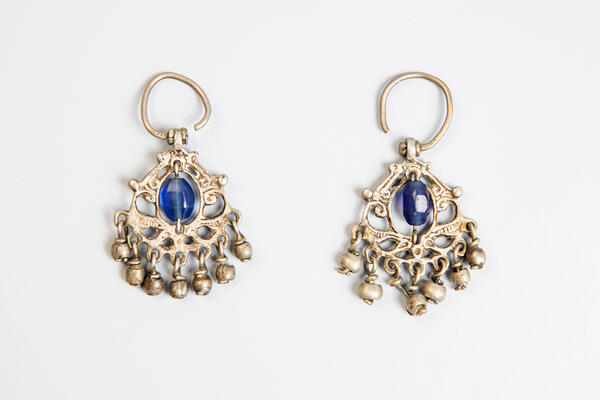
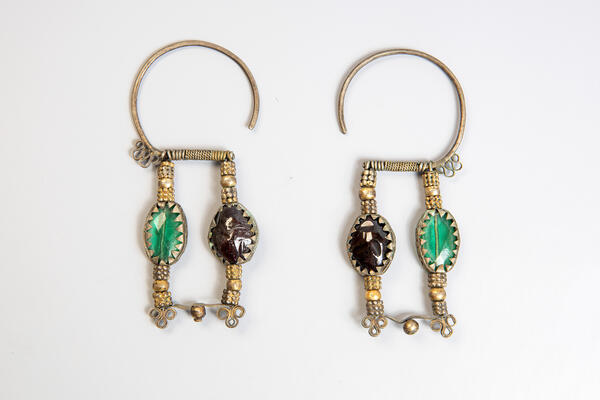
In the 16th and 17th centuries, the skill of processing precious and semi-precious stones remained insufficiently developed. Stones were slightly ground to obtain the shiny finish, but the shape often remained crude. The stone was then planted in a fairly deep setting. Instead of stones, colored cut glass was often used. The collection of the Museum “The Smolensk Fortress” contains exactly this type of accessories — a pair of two-piece earrings.
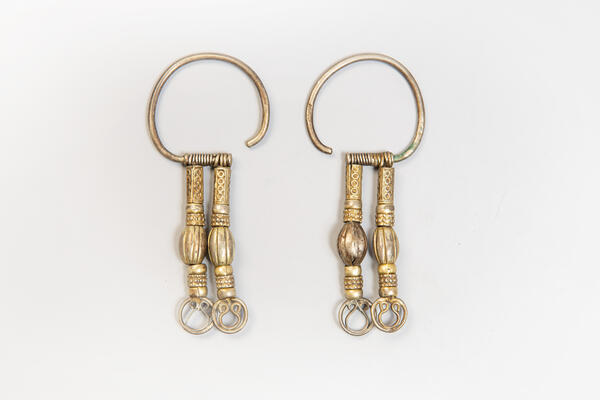
#3
Наименование: Two-piece earrings
Размеры: 9×4,5×0,5 cm
Коллекция: The Smolensk Fortress
Правообладатель изображений: The Smolensk Fortress
#4
Two-piece earrings
#5
Many jewelry pieces of the 17th century were made using such jewelry techniques as filigree and granulation. Artisans used them to create rings, buttons, and earrings.

Filigree was a technique that involved arranging smooth or twisted silver, copper or gold threads into intricate lace-like patterns and sprinkling them with a powdered alloy. Then the entire product was heated to the melting point of the material to solder all the elements together.

If the artisan used this method to decorate some other object, then the filigree was called “overlay”. If the technique was used to create a separate item, for example, a brooch, then it was called “openwork”. Such decorations were distinguished by their lightness, as they resembled fine lace.

Filigree was often combined with granulation, when silver or gold balls were soldered onto a filigree ornament, so that a special texture was created and the product looked richer and more elegant.

The granulation technique was used to make bracelets, earrings, rings and pendants. Craftsmen often completed earrings with a pyramid of granulation balls, which were soldered together.

In Russia, there were several centers for the production of jewelry, in particular earrings, which actively used granulation and filigree techniques. For example, filigree was used in Kazan for a long time. Other Russian masters subsequently adopted many jewelry motifs from this region. There was a tradition in Vologda to make patterns from small filigree rings. In Veliky Ustyug, jewelers used the motif of a rolled leaf in an effort to achieve a rounded shape.

Craftsmen used wire of different thickness to convey the play of light and shadow. Solvychegodsk products were characterized by the image of stylized herbs and enamel coating. In this case, filigree elements played a secondary role.

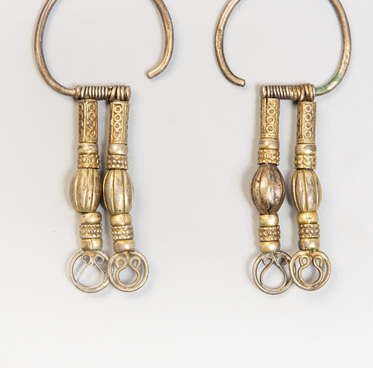
The exhibit from the museum’s collection is the so-called two-piece earrings. They are made of gilded silver using the overlay filigree technique and additional decoration with granulation.
#6
Наименование: Two-piece earrings
Размеры: 7,5×4,2×0,4 cm
Коллекция: The Smolensk Fortress
Правообладатель изображений: The Smolensk Fortress
#7
“Dove” earrings
#8
The Museum “The Smolensk Fortress” houses several types of women’s earrings, including the so-called “dove” earrings, which were made in the 17th century from silver.

“Dove” earrings were made in the following way: first, a base plate was formed, and then small pendants were attached — they formed a bird’s silhouette. Some similar earrings from the collections of other museums feature paired silhouettes of birds, which seem to be facing each other.

Researchers emphasize the special three-dimensional structure of “dove” earrings that creates the decorative effect. Many “dove” earrings were quite thick. Often, such earrings had inserts made of stones or colored glasses on both sides.

Jewelers made such pendants from mother-of-pearl, pearls, beads, and metal. The bird motif in women’s jewelry was quite common. In addition to “dove” earrings, there is also such a type of earrings as “eagle” earrings (“orliki” in Russian). They had a pendant in the form of an eagle figurine at the end.

In Rus, the bird could symbolize light and warmth, love and marriage, femininity and motherhood. It was also a solar symbol and frequently became part of Russian embroidery designs. Traditional women’s headdresses were decorated with motifs of birds, and the very image of a girl was likened to a swan or a peacock.

This motif in women’s jewelry was gradually transformed, and the figure increasingly resembled a floral pattern. Researchers believe that the origin of bird-shaped earrings is associated with the transformation of pendants known as “ryasna”.

Richly decorated earrings were a luxury item, and women often passed them down as heirlooms in their wills. Earrings, even if they were damaged, were not thrown away, but carefully dismantled. Then, the stones and pearls were used to trim collars and to decorate clothes. In the 16th and 17th centuries, even men followed the fashion and wore one earring. Earrings could be also fastened to ribbons or headdress fabric.
#9
Наименование: “Dove” earrings
Размеры: 5,2×3 cm
Коллекция: The Smolensk Fortress
Правообладатель изображений: The Smolensk Fortress
#10
One-piece earrings
#11
Earrings were one of the most popular types of jewelry in the 16th and 17th centuries. To make them craftsmen used a variety of materials, as well as natural and artificial inlays. Earrings made women look especially stately and noble.

Earrings were part of women’s clothing, they made the whole outfit look elegant and splendid. Artisans chose bright precious stones: emeralds, sapphires, and dark red rubies. The elegance of women’s and men’s costumes in the 17th century was well combined with the patterned decoration of the chambers.

Earrings with one pendant were called one-piece earrings, with two and three pendants — two-piece and three-piece earrings. They could be decorated with smoky quartz, pearls, corals, precious and semi-precious stones, as well as metal beads.

The jewelry making technique and the set of materials depended on the region and the client’s budget. In the 17th century, there was a fashion for long earlobes, which determined the massiveness of many products. The girl’s ears were pierced early enough, and small hoop earrings were inserted. Only when she entered the time of her youth did she start wearing massive and expensive jewelry.

Earrings made of gold and silver with precious stones have been passed down from generation to generation. Sometimes the photographs that were made in the late 19th century feature one-piece earrings typical of the 17th century. Earrings did not remain unchanged in shape: time passed, styles and taste preferences changed. One-piece, two-piece and three-piece earrings were replaced by earrings in the shape of boats and birds.

In the 18th century, earrings in the form of a bunch of grapes made of pearls came into fashion, as well as bow-shaped earrings, for which Tula artisans became famous. To decorate their products, they used faceted metal balls, which, under certain lighting, looked like diamonds.

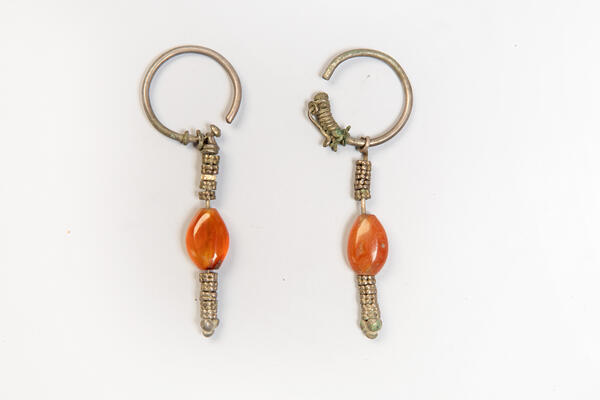
One-piece earrings from the collection of the Museum “The Smolensk Fortress” were created by a jeweler from silver, and carnelian, a type of quartz, was used as a central element. It is known that one of the rings of Alexander Sergeevich Pushkin was decorated with this stone.
#12
Наименование: One-piece earrings
Размеры: 7,3×2,5 cm
Коллекция: The Smolensk Fortress
Правообладатель изображений: The Smolensk Fortress
#13
read morehide
00:00
00:00
1x

Earrings

Collection
Collection of Sergei Afonin, Moscow
0
Point your smartphone camera to open in the app
Share
VkontakteOdnoklassnikiTelegram
Share on my website
Copy linkCopied
Copy
Open in app
To see AR mode in action:
  1. Install ARTEFACT app for 
  2. iOS or Android;
  3. Find and download the «Paintings in Details» exhibition
  4. Push the «Augmented reality» button and point your phone's camera at the painting;
  5. Watch what happens on your phone screen whilst you flip through the pictures.
 
We use Cookies
Cookies on the Artefact Website. We use cookies to ensure that we give you the best experience on our website. If you continue without changing your settings, we'll assume that you are happy to receive all cookies on the Artefact website. However, if you would like to, you can change your cookie settings at any time.
Learn more about useHide
Content is available only in Russian

X

Нашли опечатку?...

%title%%type%