

Many jewelry pieces of the 17th century were made using such jewelry techniques as filigree and granulation. Artisans used them to create rings, buttons, and earrings.
Filigree was a technique that involved arranging smooth or twisted silver, copper or gold threads into intricate lace-like patterns and sprinkling them with a powdered alloy. Then the entire product was heated to the melting point of the material to solder all the elements together.
If the artisan used this method to decorate some other object, then the filigree was called “overlay”. If the technique was used to create a separate item, for example, a brooch, then it was called “openwork”. Such decorations were distinguished by their lightness, as they resembled fine lace.
Filigree was often combined with granulation, when silver or gold balls were soldered onto a filigree ornament, so that a special texture was created and the product looked richer and more elegant.
The granulation technique was used to make bracelets, earrings, rings and pendants. Craftsmen often completed earrings with a pyramid of granulation balls, which were soldered together.
In Russia, there were several centers for the production of jewelry, in particular earrings, which actively used granulation and filigree techniques. For example, filigree was used in Kazan for a long time. Other Russian masters subsequently adopted many jewelry motifs from this region. There was a tradition in Vologda to make patterns from small filigree rings. In Veliky Ustyug, jewelers used the motif of a rolled leaf in an effort to achieve a rounded shape.
Craftsmen used wire of different thickness to convey the play of light and shadow. Solvychegodsk products were characterized by the image of stylized herbs and enamel coating. In this case, filigree elements played a secondary role.
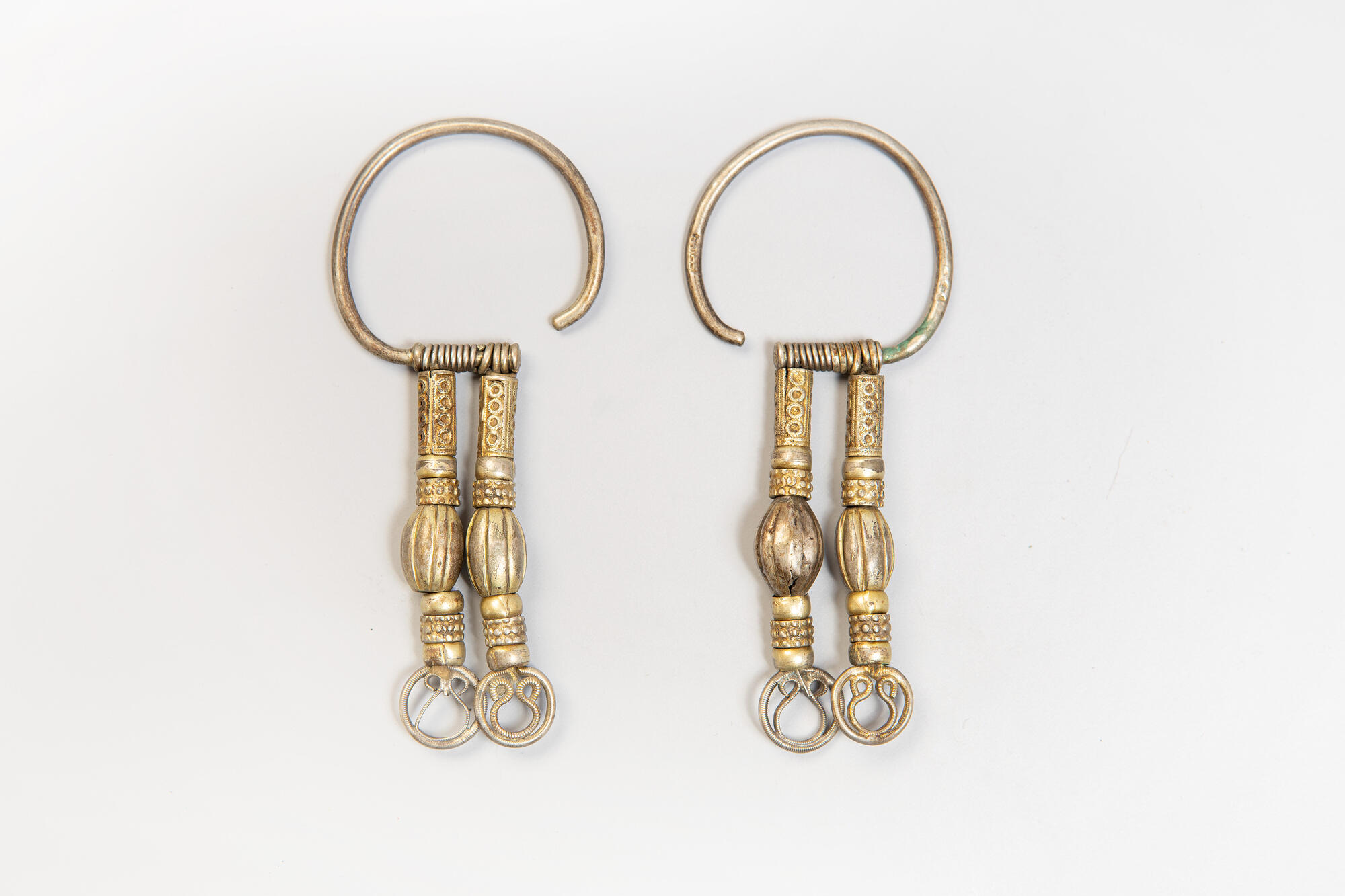
The exhibit from the museum’s collection is the so-called two-piece earrings. They are made of gilded silver using the overlay filigree technique and additional decoration with granulation.
Filigree was a technique that involved arranging smooth or twisted silver, copper or gold threads into intricate lace-like patterns and sprinkling them with a powdered alloy. Then the entire product was heated to the melting point of the material to solder all the elements together.
If the artisan used this method to decorate some other object, then the filigree was called “overlay”. If the technique was used to create a separate item, for example, a brooch, then it was called “openwork”. Such decorations were distinguished by their lightness, as they resembled fine lace.
Filigree was often combined with granulation, when silver or gold balls were soldered onto a filigree ornament, so that a special texture was created and the product looked richer and more elegant.
The granulation technique was used to make bracelets, earrings, rings and pendants. Craftsmen often completed earrings with a pyramid of granulation balls, which were soldered together.
In Russia, there were several centers for the production of jewelry, in particular earrings, which actively used granulation and filigree techniques. For example, filigree was used in Kazan for a long time. Other Russian masters subsequently adopted many jewelry motifs from this region. There was a tradition in Vologda to make patterns from small filigree rings. In Veliky Ustyug, jewelers used the motif of a rolled leaf in an effort to achieve a rounded shape.
Craftsmen used wire of different thickness to convey the play of light and shadow. Solvychegodsk products were characterized by the image of stylized herbs and enamel coating. In this case, filigree elements played a secondary role.
The exhibit from the museum’s collection is the so-called two-piece earrings. They are made of gilded silver using the overlay filigree technique and additional decoration with granulation.