Font
Color
Graphics
Изображение точки

To see AR mode in action:

1. Install ARTEFACT app for iOS or Android;

2. Find the exhibition «Mamin-Sibiryak Memorial House-Museum»

3. Push the «Augmented reality» button and point your phone's camera at the exhibit;

Скрыть точки интересаПоказать точки интереса
Показать в высоком качестве

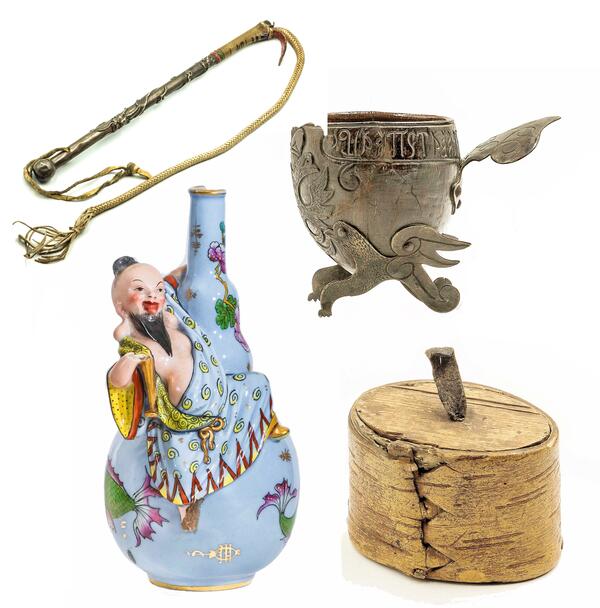
Whip, Incense burner, Snuffbox, Coconut bowl

0
Open in app
#1
Whip, Incense burner, Snuffbox, Coconut bowl
#15
Whip
#16
The whip from the collection of the house-museum was presented to Dmitry Mamin-Sibiryak by the theater director and playwright Vladimir Nemirovich-Danchenko. In 1904 — 1905, he served as a war correspondent in Manchuria, in the east of modern China, and brought souvenirs for the writer from there.

Until 1916, the whip was kept in the Ural Society of Natural Science Lovers. It was donated to the Society by the writer’s last wife, Olga Guvale. Later, the collection became a part of the Sverdlovsk Regional Museum of Local History. In 1946, it was transferred to the just opened Mamin-Sibiryak House-Museum.

The whip consists of a rod and a 36-centimeter-long metal handle. It is ornamented with dragon plates and two braided leather straps in red and green. The handle’s tip is ball-shaped. At its end, there is a hole for a belt, which allows to wear the whip on the hand.

The rod was 53 centimeters long, and it was made of thin strips of light-colored leather that were twisted together and knotted at the end. In the East, the whip was considered a cold weapon used by the military. They used it to whip their enemies.

In addition to the whip, Nemirovich-Danchenko brought the writer a carved frame for photographs, an incense burner with an idol figurine, and glasses in a case — these items are also kept in the collection of the house-museum now.

At the turn of the 19th — 20th centuries, Dmitry Mamin-Sibiryak was fond of Oriental culture and mythology, so he enthusiastically accepted the gifts. In 1898, he wrote his “Oriental Legends”, a cycle of five texts: “Maya”, “Baymagan”, “The Swan of Khantygaya”, “Tears of the Tsarina”, “The Tale of the Siberian Khan Kuchum”. They are united by the theme of love.

At the time, Mamin-Sibiryak had a passionate relationship with the dramatic actress Maria Abramova.
#17
Doesn’t passionate love make a man stronger, more determined, more self-confident, ready to fight for his beliefs, especially if they are shared by the woman he loves?
Dmitry Mamin-Sibiryak wrote
#19
The writer combined these sentiments in his works with images and symbols from Kyrgyz, Turkic, and Tatar legends.
#3
Полное наименование: Whip
Дата создания: the 18th century
Техника: leather, thread, metal, weaving, chasing, soldering
Место создания: Manchuria
Коллекция: United Museum of Ural Writers (UMUW)
Размеры: handle length — 36.3 cm; whip length — 53 cm
Правообладатель изображений: United Museum of Ural Writers (UMUW)
#20
Incense burner
#21
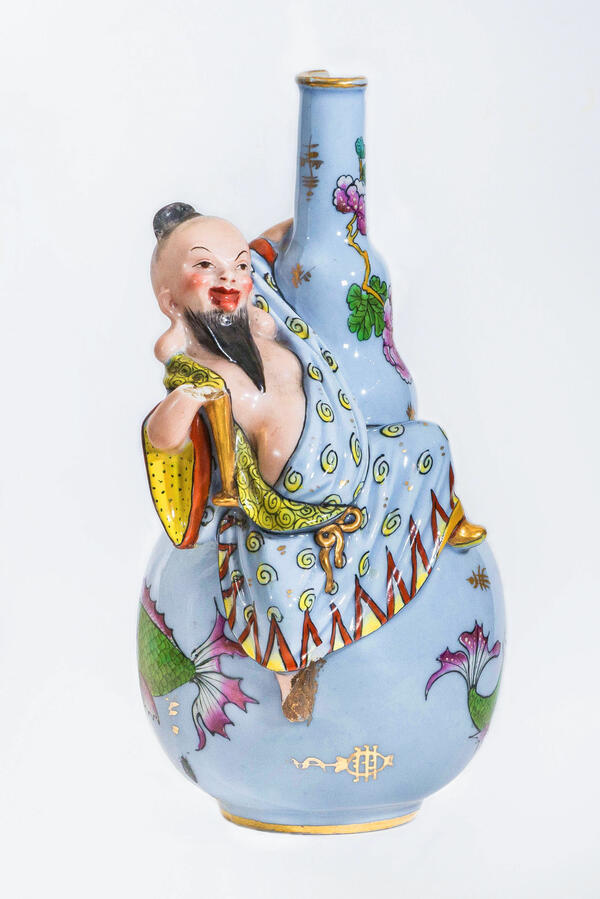
The incense burner belonged to Dmitry Mamin-Sibiryak, and it is now on display in the house-museum, in a room devoted to the St. Petersburg period of his life. The writer received it as a gift from the theater director Vladimir Nemirovich-Danchenko.

The exhibit was kept by Mamin-Sibiryak’s wife, Olga Guvale. In 1916, she gave it to the Ural Society of Natural Science Lovers. Later, his collection became part of the Sverdlovsk Regional Museum of Local History. It was transferred to the writers’ house-museum in 1946.

The item is made of blue porcelain, painted and glazed on top. The master placed the figure of a small idol instead of the handle. The small idol is an adult man with a black tuft of hair, pulled back earlobes and a long beard.

The small idol is dressed in a blue robe with yellow spiral-shaped ornament; he has gilded slippers on his feet. The figure’s right arm and leg were lost, and with his left hand he holds onto the burner’s neck.

The body is decorated with the images of green fish, butterfly and black beetle. These elements are separated from each other by a cherry blossom branch that runs from the bottom to the edge of the neck.

The decoration of the burner had a meaning. In Eastern mythology, green-colored fish symbolized abundance, butterflies symbolized lovemaking and passion, and cherry blossoms symbolized good luck.

Dmitry Mamin-Sibiryak received other gifts from Nemirovich-Danchenko along with the burner, including glasses in a case and a picture frame. They are also kept in the collection of the house-museum.

Russian writers in the 19th century were seriously interested in Orientalism — Eastern culture, mythology and folklore. They appealed to motifs, plots and characters from Eastern literature.

Dmitry Mamin-Sibiryak was also interested in the oriental world. In the 1880s — 1890s he wrote “Oriental Legends”. It is a series of texts dedicated to folk heroes and legends. Five works were included: “Maya”, “Baymagan”, “The Swan of Khantygaya”, “Tears of the Tsarina” and “The Tale of the Siberian Khan Kuchum”. His sources were the legends and parables of the different peoples that inhabited the Russian Empire: the Turks, the Tatars, the Kirghiz and others.
#5
Полное наименование: Incense burner. Personal item of Dmitry Narkisovich Mamin-Sibiryak
Дата создания: the 19th century
Техника: porcelain, underglaze painting
Размеры: 20.7×11.5×10 cm
Коллекция: United Museum of Ural Writers (UMUW)
Правообладатель изображений: United Museum of Ural Writers (UMUW)
Место создания: China
#22
Snuffbox
#23
The collection of the museum contains a tuyesok — a small container made of birch bark. Dmitry Mamin-Sibiryak kept tobacco in it. The writer smoked a lot and gathered a collection of 12 smoking pipes, one of which is displayed at the exhibition.

Researchers speculate that the word “tuyes” came from the Finno-Ugric word “tuy”, which meant a road. Mamin-Sibiryak was fond of the history of the Urals, so he often went on archaeological, geological and ethnographic expeditions. So that the tobacco would not get wet in the field, he carried it in similar cases and boxes.

The birch-bark baskets were made manually from “kap” — a solid piece of birch bark. The upper and lower edges were bent, forming a bowl. After that, the master put on top an outer layer of birch bark, which was called a “shirt”. The container was richly decorated with decorative elements in the technique of embossing, embroidery or slitting.

In Russia, birch-bark baskets were distinguished by size and purpose: there were both small boxes, boxes of a palm size, and capacious containers of 20-30 centimeters high. In the huts, they kept bulk and liquid products: sugar, salt, flour, kvass or tea.

Birch bark tuyesok was often taken with them on hunting trips or to mine for gold and rock: at home they were filled with milk, cottage cheese, salted fish or mushrooms. Because of the multi-layered body, the vessel retained its temperature well, and the food in it remained fresh for a long time. Moreover, the birch bark created an airtight environment without bacteria, so even a wet tuyesok did not rot.

Snuffboxes made of birch bark were often used during his travels. The snuffbox in the collection of the house-museum is oval in shape and compact in size: it was 5.5 centimeters long and 7.5 centimeters wide. It could easily fit in a trousers or jacket pocket.

People used to put a removable wooden lid with a finger peg on top to prevent tobacco from falling out of a tuyesok. Along the bottom edge of the snuff-box wooden pegs were driven in every 1-1,5 centimeters. They bind the parts of the structure together.

Nowadays, birch-bark containers have almost ceased to be used. They can only be seen as museum pieces.
#9
Полное наименование: Birch bark tuyesok (Snuffbox). Personal item of Dmitry Narkisovich Mamin-Sibiryak
Дата создания: the late 19th century
Техника: birch bark, wood, handmade
Размеры: 5.5×7.5×4.3 cm
Коллекция: United Museum of Ural Writers (UMUW)
Правообладатель изображений: United Museum of Ural Writers (UMUW)
Место создания: China
#24
Coconut bowl
#25
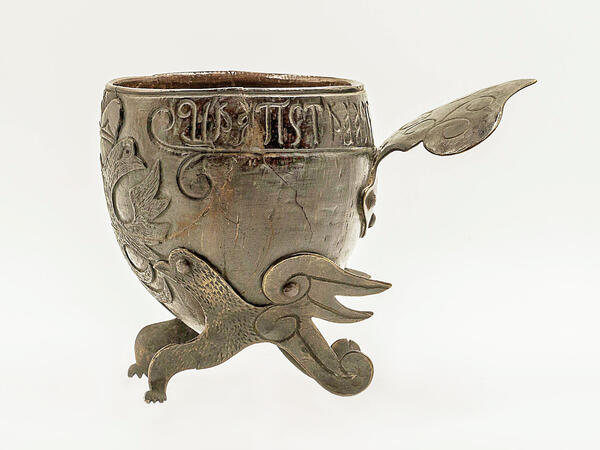
The antique coconut cup on display at the museum is a replica of an 18th century piece. It was made a century later, in the 19th century. At that time, in the era of “historicism”, an archaicized objects were especially popular.

In Russia, coconuts were called “Indian nuts” because most often the they were brought from India. Coconut cups appeared in Russia in the 16th century, but they were not made here. The items were exported from Europe. Gradually, in the second half of the 17th century, Russian craftsmen learned to work with nut and began to make bowls themselves. The cups were often given as gifts for family celebrations, anniversaries and as prizes. The coconut itself, however, was still a rare imported fruit.

The bowl from the collection of the museum belonged to Dmitry Mamin-Sibiryak. The bowl is covered with black paint on top, and its legs were made of copper in the shape of two fantastic birds. The handle was made in the same style, in the form of an exotic animal’s tail, and decorated with a painted ornament. There is a small crack on the right side of the exhibit.

The writer Dmitry Mamin-Sibiryak collected unusual things and historical relics. He often brought them back from his travels, or received as a gift from friends who knew about his hobby. The coconut bowl was a part of his collection.

After Mamin-Sibiryak’s death, the exhibit stayed with his wife, Olga Guvale, (married name Mamina). She graduated from the Women’s Patriotic Institute and worked as a tutor for the writer’s daughter, Yelena Mamina. From 1894, she lived in the house of Dmitry Mamin-Sibiryak. They started dating, and in 1900, they got married. Since then, Guvale replaced the girl’s mother.

In 1916, the writer’s wife gave the exhibit to the Ural Society of Natural Science Lovers. Later, his collection became the part of the Sverdlovsk Regional Museum of Local History, where the coconut cup was kept until 1946. Then together with other rarities from Mamin-Sibiryak’s collection, it was transferred to the house-museum. Now these items are kept in the St. Petersburg room.
#13
Полное наименование: Coconut bowl. Personal item of Dmitry Narkisovich Mamin-Sibiryak
Дата создания: the 19th century
Техника: copper, coconut, forging, carving, embossing
Размеры: 10×14×8 cm
Коллекция: United Museum of Ural Writers (UMUW)
Правообладатель изображений: United Museum of Ural Writers (UMUW)
Место создания: Russian empire
#14
read morehide
00:00
00:00
1x

Whip, Incense burner, Snuffbox, Coconut bowl

0
Point your smartphone camera to open in the app
Share
VkontakteOdnoklassnikiTelegram
Share on my website
Copy linkCopied
Copy
Open in app
To see AR mode in action:
  1. Install ARTEFACT app for 
  2. iOS or Android;
  3. Find and download the «Paintings in Details» exhibition
  4. Push the «Augmented reality» button and point your phone's camera at the painting;
  5. Watch what happens on your phone screen whilst you flip through the pictures.
 
We use Cookies
Cookies on the Artefact Website. We use cookies to ensure that we give you the best experience on our website. If you continue without changing your settings, we'll assume that you are happy to receive all cookies on the Artefact website. However, if you would like to, you can change your cookie settings at any time.
Learn more about useHide
Content is available only in Russian

X

Нашли опечатку?...

%title%%type%