Font
Color
Graphics
Изображение точки

To see AR mode in action:

1. Install ARTEFACT app for iOS or Android;

2. Find the exhibition «Mamin-Sibiryak Memorial House-Museum»

3. Push the «Augmented reality» button and point your phone's camera at the exhibit;

Скрыть точки интересаПоказать точки интереса
Показать в высоком качестве
#1
Desk, School diary
#9
Desk
#11
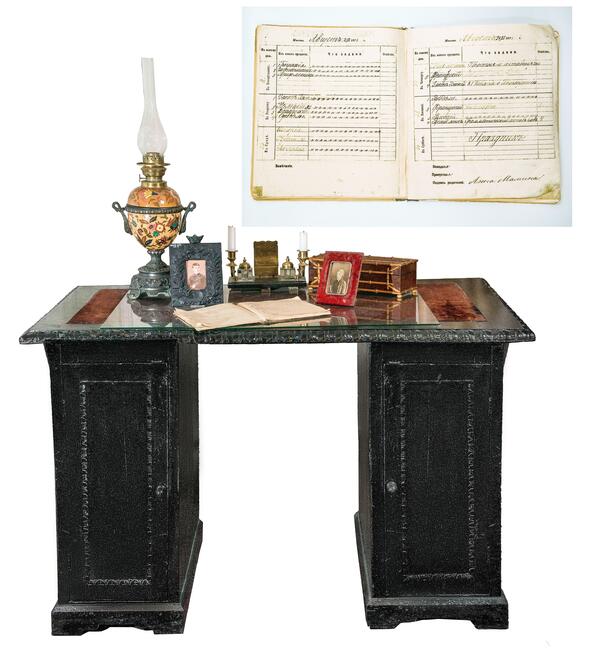
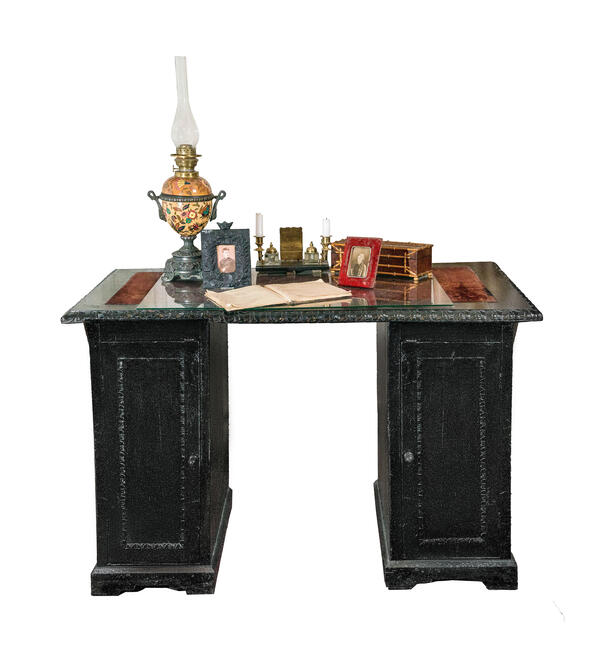
The desk in the collection of the house-museum belonged to Dmitry Mamin-Sibiryak and was part of a large bookcase. Only two cabinets and a wooden tabletop have survived to this day.

The table is displayed in the room of the writer’s sister, Yelizaveta Mamina (married name — Udintseva). She lived in the house with her children for 34 years, from 1885 to 1919.

The Mamins treasured books and taught their children to read from childhood. The first owner of the bookcase and the desk was Narkis Mamin, Mamin-Sibiryak’s father. He ordered the furniture in the 1860s and 1870s.

In those days it was difficult to buy a bookcase. Such a piece of interior design could be made optionally, so it was expensive. Besides, there were no furniture masters in the worker’s settlement of Visimo-Shaitansky plant, where the Mamins lived at that time.

As a result, the bookcase was made by carpenters from Nizhny Tagil and delivered it 40 kilometers from there to the house where the Mamins lived. However, the workshop violated the manufacturing process, which soon resulted in the surface cracking.
#12
As a child I did not know a more beautiful thing. Imagine: two drawers, a desktop on them, two small cabinets on it, and on them already the bookcase itself with glass doors. It is painted brown and varnished, but to everyone”s dismay, it soon cracked and fouled, due to the craftsman’s deviousness in sparing the oil for the paint. But this drawback did not prevent our bookcase from being the most wonderful thing in the world.
Dmitry Mamin-Sibiryak wrote about it in his childhood memoirs
#13
In 1903, the writer came from St. Petersburg to Yekaterinburg to visit his mother and sister. He wrote to his nephew Boris Udintsev after his visit, saying that he spent a lot of time by the bookcase reading books.

The piece of furniture was kept in the Mamins’ family and was handed down by inheritance. In the 1940s, Boris Udintsev presented the table to the D. N. Mamin-Sibiryak Sverdlovsk Literary Museum — it became one of the first showpieces in the collection.

Later, the cabinet was relocated to the writer’s museum in Visim, then it became part of the collection of the Nizhny Tagil Museum, and then it was brought back to Yekaterinburg.
#3
Полное наименование: Desk. Personal item of Dmitry Narkisovich Mamin-Sibiryak
Дата создания: the 1860s — the 1870s
Техника: wood, velour, turning
Место создания: Nizhny Tagil
Размеры: 78×120×65 cm
Коллекция: United Museum of Ural Writers (UMUW)
Правообладатель изображений: United Museum of Ural Writers (UMUW)
#10
School diary
#14
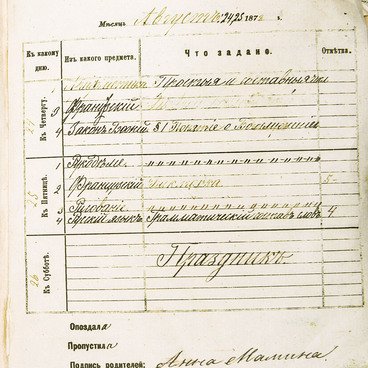
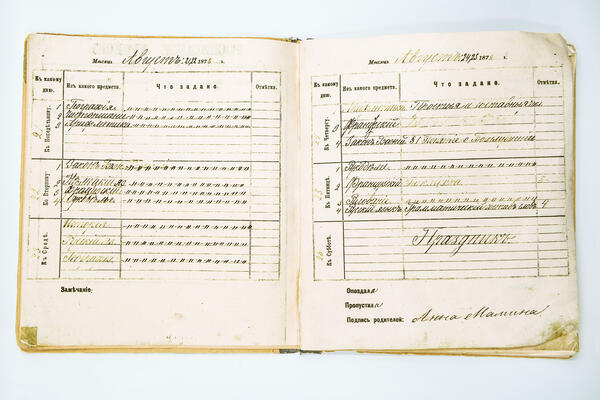
The school diary from the collection of the Mamin-Sibiryak House-Museum belonged to the writer’s younger sister, Yelizaveta Mamina (married name — Udintseva). Inside, there are ruled sheets on which school subjects, homework and grades were written.

In 1878, after a long and serious illness of Yelizaveta Mamina, Dmitry Mamin-Sibiryak moved his family to Yekaterinburg. Quickly, “in ten days”, according to his own expression, he prepared his sister for the entrance examinations to the Yekaterinburg Women’s Gymnasium. In August of the same year, she was immediately enrolled in the third grade.

The diary is a notebook in a cardboard cover. There is an inscription on it:
#15
Notebook for writing down the homework of the student Yelizaveta Mamina of the third grade of the Yekaterinburg Women’s Gymnasium. Yekaterinburg, 1878–1879.
#16
The sheets inside yellowed, and the writing ink on some of them faded over time.

The first sheet contains a class schedule. On Monday — four classes: Geography, Penmanship, Arithmetic and German. The same number of classes are planned on Tuesday: Law of God, German, French and Handcraft. On Wednesday, there were only three classes: History, Russian, Geography.

The sheet for Thursday is poorly preserved: the first class is Arithmetic, the second line is not filled in, the title of the third cannot be read, and the fourth is Law of God. On Friday, there were five lessons: Handcraft, French, Drawing, Russian, and Geography. Saturday was also a school day, on this day, Yelizaveta Mamina had French and Russian classes, as well as Geography.

The first entries in the diary are made in August: in the Russian Empire, children began school in the last month of summer, since school days during the year often fell on church holidays. On the second spread, the following days are marked: August 29 and 30.

Dmitry Mamin-Sibiryak monitored his sister’s progress, helped her, and sometimes signed in the “Parents’ Signature” column. From recollections that Yelizaveta Mamina was a diligent student with neat, beautiful handwriting. She received only “good” and “excellent” grades.

Yelizaveta Mamina graduated from high school with a gold medal in 1884, and in 1885, after the teacher’s course, received the title of class teacher. At first, she gave private lessons, and in 1903, she began working as a teacher of Russian Language and Pedagogics in the Second Yekaterinburg Women’s Gymnasium.
#5
Полное наименование: School diary. Personal item of Yelizaveta Narkisovna Mamina 
Автор: Yelizaveta Narkisovna Mamina
Дата создания: 1878
Техника: paper, writing ink, handwriting
Размеры: 20×17.5 cm
Коллекция: United Museum of Ural Writers (UMUW)
Правообладатель изображений: United Museum of Ural Writers (UMUW)
#8
read morehide
00:00
00:00
1x
Point your smartphone camera to open in the app
Share
VkontakteOdnoklassnikiTelegram
Share on my website
Copy linkCopied
Copy
Open in app
To see AR mode in action:
  1. Install ARTEFACT app for 
  2. iOS or Android;
  3. Find and download the «Paintings in Details» exhibition
  4. Push the «Augmented reality» button and point your phone's camera at the painting;
  5. Watch what happens on your phone screen whilst you flip through the pictures.
 
We use Cookies
Cookies on the Artefact Website. We use cookies to ensure that we give you the best experience on our website. If you continue without changing your settings, we'll assume that you are happy to receive all cookies on the Artefact website. However, if you would like to, you can change your cookie settings at any time.
Learn more about useHide
Content is available only in Russian

X

Нашли опечатку?...

%title%%type%