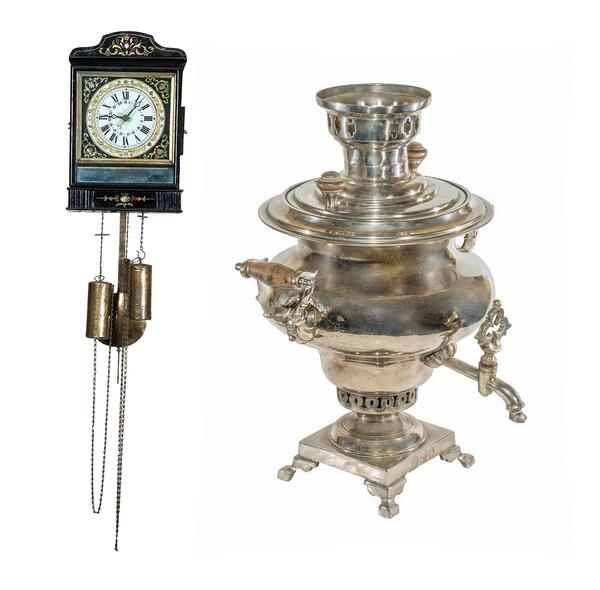
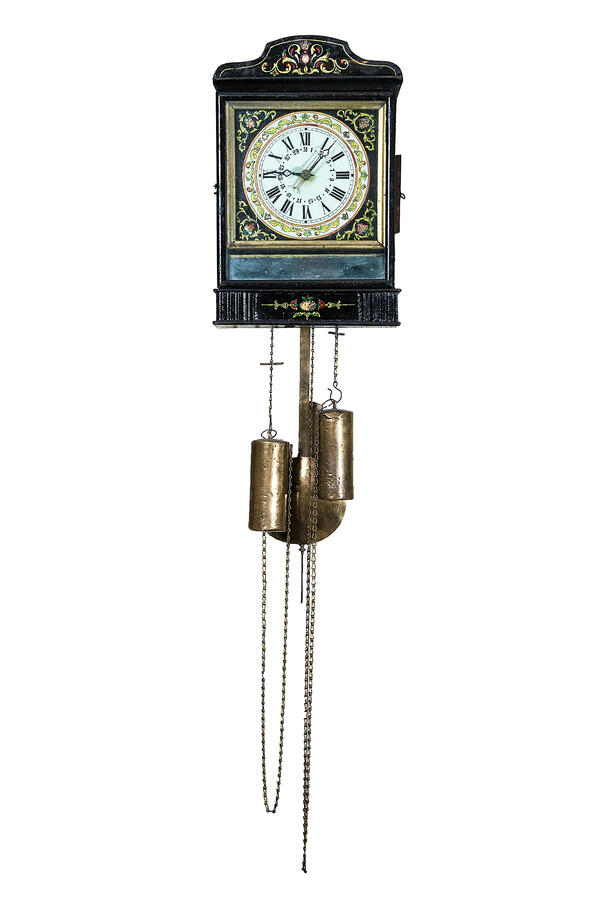
There is an antique wall clock of the Mamins in the dining room of the house-museum. They were manufactured by the trading house of “M. P. Kalaschnikoff & Fils” in the middle of the 19th century.
The writer’s father, Narkis Mamin, bought a clock at the Visimo-Shaitansky factory in 1856 — at that time Dmitry Mamin-Sibiryak was only four years old. In 1878, the family moved to Yekaterinburg and took this piece of furniture into their new home. The writer recalled that every year by the striking of this clock, the Mamins celebrated the New Year.
The clock was kept in the family; its last owner was Mamin-Sibiryak’s nephew Boris Udintsev. He brought the device from Moscow to Yekaterinburg and in 1952 presented it to the collection of the house-museum.
The wall clock has a wooden case, which is painted black and varnished on top. Painted clock face made of paper is located in the middle, behind the glass. The clock hands are made of iron. The bottom and top of the case are decorated with floral ornaments and gold scrolls.
The mechanism was equipped with two suspended weights and a pendulum on a chain — they served as a source of energy. On the side, there is a small window to wind up the clock.
Company “M. P. Kalaschnikoff” was owned by Mikhail Kalaschnikoff and was one of the most famous trading houses in Moscow. It had existed since 1832, selling clocks wholesale and retail. After the son joined the family business in the 1880s, the organization was renamed to “M. P. Kalaschnikoff & Fils”.
The trading house cooperated directly with manufacturers of clocks and jukeboxes in Europe. Kalaschnikoff brought mechanisms from Great Britain. Since they could only play English tunes, he hired craftsmen who reassembled the clocks, tuning them to native music.
One of the popular models was a clock made by the British company “Hendley & Moore”. Workers in the workshops at the Trading House reconstructed the mechanism, putting the inscription on the face clock “M. P. Kalaschnikoff & Fils Trading House in Moscow” in the old spelling and sold thes2e clocks under the Russian mark.
Kalaschnikoff’s company existed until 1917. After the revolution, the State Trust for Precision Mechanics was established on the basis of the trading house and continued to produce clocks.
The writer’s father, Narkis Mamin, bought a clock at the Visimo-Shaitansky factory in 1856 — at that time Dmitry Mamin-Sibiryak was only four years old. In 1878, the family moved to Yekaterinburg and took this piece of furniture into their new home. The writer recalled that every year by the striking of this clock, the Mamins celebrated the New Year.
The clock was kept in the family; its last owner was Mamin-Sibiryak’s nephew Boris Udintsev. He brought the device from Moscow to Yekaterinburg and in 1952 presented it to the collection of the house-museum.
The wall clock has a wooden case, which is painted black and varnished on top. Painted clock face made of paper is located in the middle, behind the glass. The clock hands are made of iron. The bottom and top of the case are decorated with floral ornaments and gold scrolls.
The mechanism was equipped with two suspended weights and a pendulum on a chain — they served as a source of energy. On the side, there is a small window to wind up the clock.
Company “M. P. Kalaschnikoff” was owned by Mikhail Kalaschnikoff and was one of the most famous trading houses in Moscow. It had existed since 1832, selling clocks wholesale and retail. After the son joined the family business in the 1880s, the organization was renamed to “M. P. Kalaschnikoff & Fils”.
The trading house cooperated directly with manufacturers of clocks and jukeboxes in Europe. Kalaschnikoff brought mechanisms from Great Britain. Since they could only play English tunes, he hired craftsmen who reassembled the clocks, tuning them to native music.
One of the popular models was a clock made by the British company “Hendley & Moore”. Workers in the workshops at the Trading House reconstructed the mechanism, putting the inscription on the face clock “M. P. Kalaschnikoff & Fils Trading House in Moscow” in the old spelling and sold thes2e clocks under the Russian mark.
Kalaschnikoff’s company existed until 1917. After the revolution, the State Trust for Precision Mechanics was established on the basis of the trading house and continued to produce clocks.