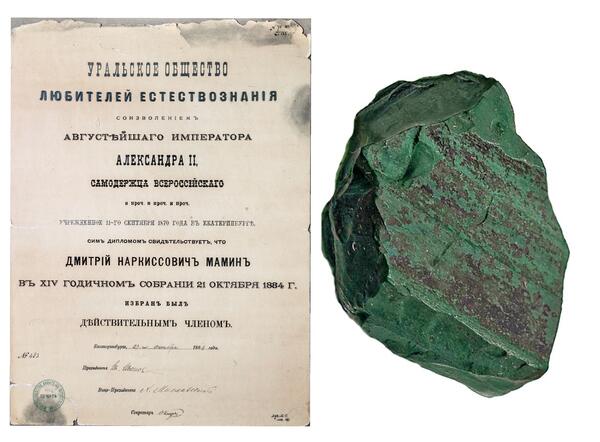
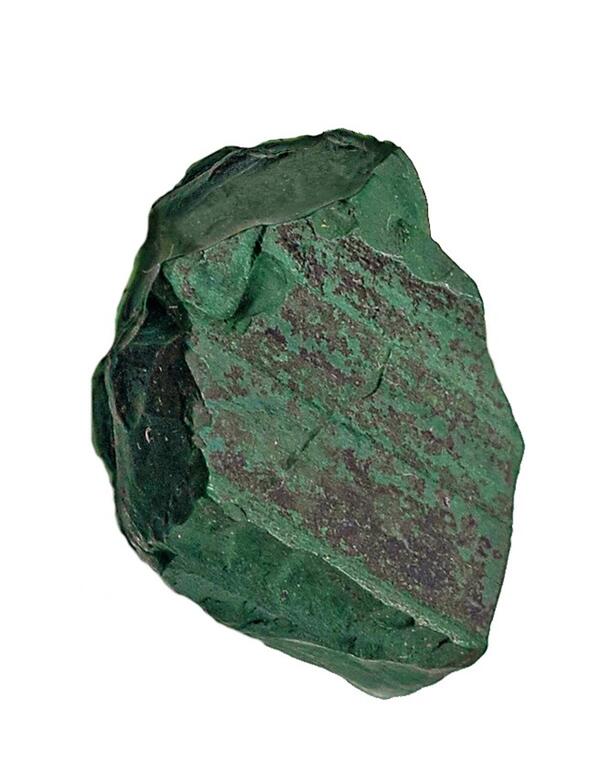
Volkonskoite, a rare mineral in the room of the writer’s sister, Yelizaveta Mamina, (married name Udintseva), was found by Dmitry Mamin-Sibiryak during one of his trips to the Ural deposits.
Volkonskoite is a hard dry clay of a rich emerald color. The stone is opaque, its surface has a greasy sheen. The mineral is very soft to the touch. Freshly found Volkonskoite can easily be cut with a knife or scratched.
The peasant Yegor Bormant discovered this mineral in the Urals. In 1830, he escaped exile, and later, told the authorities that he had discovered a before unknown green stone in an old quarry near the village of Yefimyata in the Perm Governorate. His find aroused interest, but instead of an award, Bormant was arrested for running away.
The found gem was reported to Alexander Volkov, an official of the udel office, an engineer. He examined the mineral and suggested that it could be used as paint because of its soft structure. According to one version, Volkov informed Lev Perovsky, deputy minister of the court, and he decided to coincide the discovery to the 50th anniversary of Prince Peter Volkonsky, Minister of the Imperial Court.
In 1830, at a ceremonial dinner Volkonsky was presented with a description of a new mineral. The stone was given the name “Volkonskoite”, in honor of the birthday person. The discoverer of the mineral, Yegor Bormant, had been forgotten for many years. A century later, Perm local historians made a research and restored his name.
Volkonskoite was used by ancient Russian icon painters long before its official discovery. It was used to make green pigment for icons. Researchers established that the mineral was used in the 11th century during the work on the icon of the Holy Apostles Peter and Paul in the Cathedral of St. Sophia in Novgorod.
Artists valued Volkonskoite paints because after drying, a film formed on the picture, which protected it from moisture. You could also get different colors out of it, from emerald, olive and deep green to brown and black.
Today Volkonskoite is used to restore paintings and icons, and to make enamels and glazes for ceramics. The mineral can withstand temperatures up to 1500 °C.
Volkonskoite is a hard dry clay of a rich emerald color. The stone is opaque, its surface has a greasy sheen. The mineral is very soft to the touch. Freshly found Volkonskoite can easily be cut with a knife or scratched.
The peasant Yegor Bormant discovered this mineral in the Urals. In 1830, he escaped exile, and later, told the authorities that he had discovered a before unknown green stone in an old quarry near the village of Yefimyata in the Perm Governorate. His find aroused interest, but instead of an award, Bormant was arrested for running away.
The found gem was reported to Alexander Volkov, an official of the udel office, an engineer. He examined the mineral and suggested that it could be used as paint because of its soft structure. According to one version, Volkov informed Lev Perovsky, deputy minister of the court, and he decided to coincide the discovery to the 50th anniversary of Prince Peter Volkonsky, Minister of the Imperial Court.
In 1830, at a ceremonial dinner Volkonsky was presented with a description of a new mineral. The stone was given the name “Volkonskoite”, in honor of the birthday person. The discoverer of the mineral, Yegor Bormant, had been forgotten for many years. A century later, Perm local historians made a research and restored his name.
Volkonskoite was used by ancient Russian icon painters long before its official discovery. It was used to make green pigment for icons. Researchers established that the mineral was used in the 11th century during the work on the icon of the Holy Apostles Peter and Paul in the Cathedral of St. Sophia in Novgorod.
Artists valued Volkonskoite paints because after drying, a film formed on the picture, which protected it from moisture. You could also get different colors out of it, from emerald, olive and deep green to brown and black.
Today Volkonskoite is used to restore paintings and icons, and to make enamels and glazes for ceramics. The mineral can withstand temperatures up to 1500 °C.