Font
Color
Graphics
Изображение точки

To see AR mode in action:

1. Install ARTEFACT app for iOS or Android;

2. Find the exhibition «Mamin-Sibiryak Memorial House-Museum»

3. Push the «Augmented reality» button and point your phone's camera at the exhibit;

Скрыть точки интересаПоказать точки интереса
Показать в высоком качестве

Candle holders, Framed picture, Notebook

0
Open in app
#1
Candle holders, Framed picture, Notebook
#10
Candle holders
#9
The last room of the museum is dedicated to the St. Petersburg period of Dmitry Mamin-Sibiryak’s life. Among the exhibits one can see two wooden candle holders. They were made by the writer’s daughter Yelena Mamina together with her stepmother’s brother Vladimir Guvale.

Candle holders were kept in the Mamins’ apartment in St. Petersburg. In 1978, the writer’s niece, Natalia Udintseva, donated them to the collection of the house-museum in Yekaterinburg.

The candle holders are made of Karelian birch, light brown wood. Four spheres form the shape of the objects: three of them form the base and the fourth is placed on top of others. An elongated stand is attached to it; a candle was fastened to this stand.

Yelena Mamina was born on March 21, 1892. Her father, Dmitry Mamin-Sibiryak, met his future wife, actress Maria Abramova, in Yekaterinburg — she came on tour with the theater. The writer spent a long time wooing his beloved and seeing her home after the performances.

Mamin-Sibiryak’s family was against their relationship. A year later, however, the writer left for Abramova to St. Petersburg. A year later, they had a daughter, Yelena, who was affectionately called Alyonushka at home.

Maria Abramova died soon after giving birth, and Mamin-Sibiryak became a single father. A few days after the tragedy, he wrote about his daughter:
#19
I will live for this little creature; I will work for it and be happy with it.
#20
After the birth of his daughter, Mamin-Sibiryak began to write children’s stories. He dedicated “Fireflies” and “Tales for Alyonushka” to her.

Yelena Mamina grew up as a sickly child, and over time she began to show signs of nervous illness. She could walk only by hand with an attendant, so she studied from home and rarely traveled.

The writer’s nephew Boris Udintsev recalled: “Lena was nervous, exhausted, but she loved going to church.” Yelena Mamina spent most of her time at home and avoided society.

Despite this, she grew up a creative child: she wrote poems, played the piano and drew. Yelena Mamina also collected portraits and postcards with autographs of famous writers who came to their house.

Mamin-Sibirya’s daughter died in September 1914, at the age of 22. She was buried with her father in the cemetery of the Alexander Nevsky Lavra.
#3
Полное наименование: Candle holders. Personal item of Yelena Dmitriyevna Mamina
Автор: Yelena Dmitriyevna Mamina, Vladimir Frantsevich Guvale
Дата создания: the late 19th century — the early 20th century
Техника: wood, turning, gluing
Размеры: 16×9×9 cm
Коллекция: United Museum of Ural Writers (UMUW)
Правообладатель изображений: United Museum of Ural Writers (UMUW)
Место создания: St. Petersburg
#11
Framed picture
#12
In a room devoted to the St. Petersburg period of Dmitry Mamin-Sibiryak’s life, there is a carved wooden frame. It was brought from Manchuria by the theater director and playwright Vladimir Nemirovich-Danchenko. He gave the frame to Mamin-Sibiryak, who was fond of Eastern culture.

Inside the frame, there is a portrait of 19-year-old Yelena Mamina, the writer’s daughter. The exhibit was donated to the collection of the house-museum by Boris Udintsev, Mamin-Sibiryak’s nephew.

The four-cornered frame is made of walnut and decorated with carved elements. In the upper part, there is a thematic picture that illustrates four exotic birds: two of them sit at the feeder, and the other two fly in the sky. There is a branch of a tree nearby. The ledge at the top is crowned by a half flower.

On the sides of the upper part two pheasants were carved, under them — two dragons and two goats. Fantastic fish are depicted next to them. In the center, there is another rectangular frame, which is highlighted by floral ornamentation and carvings in the form of scales.

Yelena Mamina was a sickly child and home-schooled at first. In 1908, she was sent to the eighth grade of a St. Petersburg gymnasium. Classmates knew her as Mamin-Sibiryak’s daughter.
#13
The next morning a tall, thin girl walked into the classroom. We had uniforms — blue aprons — and she wore an English blouse and a black skirt (she never wore an apron). Small braids were pinned around her head. Her face was slightly childish, with a gentle blush and regular features. She would have been pretty if she hadn’t been spoiled by her always open mouth. Her gait was uneven — one leg she dragged a little, and her arm hung along her body and trembled a little on the same side.
Alyonushka’s classmate Yekaterina Chekhova recalled her first day at school
#14
Since childhood, Yelena Mamina was fond of creative activities: playing the piano, composing poems and drawing. The collection of the house-museum contains her watercolor “Country Yard in Pavlovsk”, as well as a notebook where she recorded her poetry.

Yelena Mamina died at the age of 22, in 1914. Along with her stepmother, Olga Guvale, she left a will:
#15
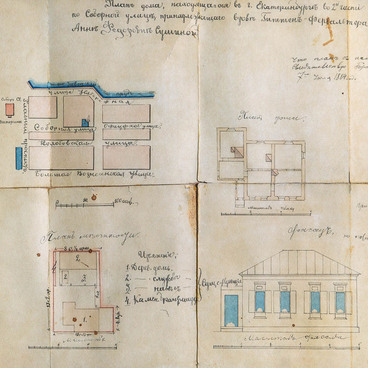
We bequeath the real estate <…> at 27, Pushkina street, to the city of Yekaterinburg. If possible, “Mamin-Sibiryak museum” shall be created in the bequeathed house or in the house to be built in its place.
#5
Полное наименование: Framed Picture of Yelena Dmitriyevna Mamina (Alyonushka)
Дата создания: the 19th century
Техника: walnut, carving, photo paper, photo printing
Место создания: Manchuria
Размеры: 26.5×17 cm
Коллекция: United Museum of Ural Writers (UMUW)
Правообладатель изображений: United Museum of Ural Writers (UMUW)
#16
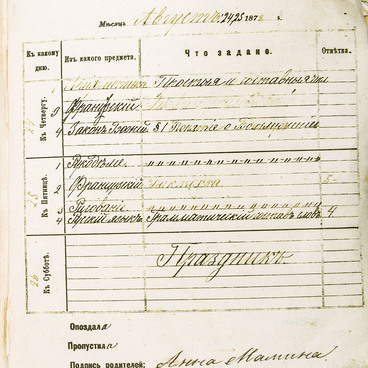
Notebook with poems by Mamina
#17
A room devoted to the writer’s life in St. Petersburg contains a notebook with poems by Yelena Mamina. It is under a special glass dome.

The paper cover of the exhibit had faded, so the blue color turned to a dirty gray. In the center, in an octagonal frame, there is the word “Poem”, and below, also in a frame, is the signature: “Ye. Mamina”. They are written by the hand of the author.

Yelena Mamina was the only child of Dmitry Mamin-Sibiryak. She was born when the writer turned 40. At home, the girl was affectionately called Alyonushka, and her father referred to her as “that little drop”.

Yelena Mamina grew up a creative child. She drew watercolors by herself, one of which is stored in the funds of the United Museum of Ural Writers. A drawing “Country Yard in Pavlovsk”, created in the early 20th century, is presented in the exhibition of the house-museum.

Mamina also wrote poetry — researchers noted the original language of her works. Inside, all the sheets of the notebook are scribbled, but the handwriting is not easy to discern. Her health problems made it difficult for her to control her movements, so she even walked only by hand with an attendant. Experts had a long time to decipher the text to read the poems and study her poetic style.

Yelena Mamina’s poetry had the characteristics of a deep reflexion: the lyrical heroine was constantly, agonizingly searching for ways to overcome her spiritual suffering in order to find the light and meaning of life. According to recollections, the writer’s daughter appreciated the poetry of Sergey Nadson, a volume of his poems was her favorite book. His pessimistic works were largely autobiographical in nature, they were called “rebellious, pure suffering”. Dmitry Mamin-Sibiryak’s daughter imitated Nadson in her work in many ways.

Here is one of the most famous poems by Yelena Mamina from the notebook:
#18
Autumn has come and quietly covered
The trees and bushes with a golden veil.
The first frost with a friend blizzard
Spattered blush on maple leafage.
Yellow leaves on the branches sway,
Yellow leaves rustle underfoot,
Goodbye to the earth, yellow leaves say,
Soon they will be lost.
Summer has passed, and the autumn, bright
Sky looks into the tear-stained pond.
The summer is over, with the cherished thought
Leaves will waive and quietly leave.
Soon winter, all white as the bride,
From heaven to earth will descend by clouds,
Quietly cover the lonely leaves,
Sweep their trail with a blizzard.
#7
Полное наименование: Notebook with poems by Yelena Dmitriyevna Mamina (Alyonushka)
Автор: Yelena Dmitriyevna Mamina
Дата создания: the early 1910s
Техника: paper, drafting ink, autograph
Размеры: 17.7×22 cm
Коллекция: United Museum of Ural Writers (UMUW)
Правообладатель изображений: United Museum of Ural Writers (UMUW)
Место создания: Saint Petersburg
#8
read morehide
00:00
00:00
1x

Candle holders, Framed picture, Notebook

0
Point your smartphone camera to open in the app
Share
VkontakteOdnoklassnikiTelegram
Share on my website
Copy linkCopied
Copy
Open in app
To see AR mode in action:
  1. Install ARTEFACT app for 
  2. iOS or Android;
  3. Find and download the «Paintings in Details» exhibition
  4. Push the «Augmented reality» button and point your phone's camera at the painting;
  5. Watch what happens on your phone screen whilst you flip through the pictures.
 
We use Cookies
Cookies on the Artefact Website. We use cookies to ensure that we give you the best experience on our website. If you continue without changing your settings, we'll assume that you are happy to receive all cookies on the Artefact website. However, if you would like to, you can change your cookie settings at any time.
Learn more about cookie useHide
Content is available only in Russian

X

Нашли опечатку?...

%title%%type%