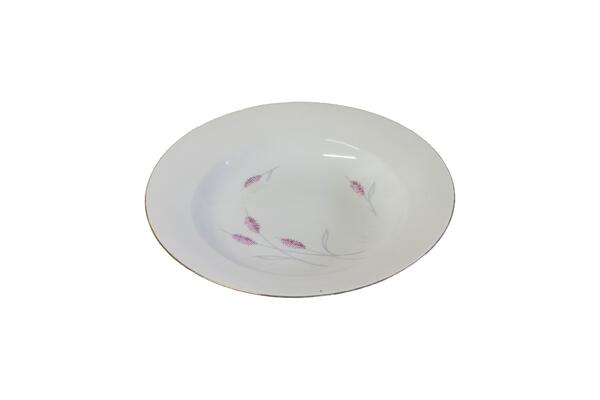
A porcelain soup plate from the exhibition of Nizhnevartovsk Museum of Local History was made between 1957 and 1964 in Germany, at the factory “Kahla”. Its bottom is round, flat, with a protruding rim. Its walls are rounded; the edges are decorated with a thin gold rim.
The German merchant Christian Eckard founded “Kahla” porcelain factory in 1844. It was named after the city of its location. At first, the factory produced porcelain doll heads, cups, and smoking pipes. Later, tableware also became a part of its goods.
After World War II, Germany was divided into two parts: the Federal Republic of Germany and the German Democratic Republic. “Kahla” became a part of a large national porcelain factory on the territory of the GDR. Its goods were exported abroad, including the USSR. Table sets from the GDR were considered valuable in Soviet families. They were gifted as wedding presents, passed down through generations, and were put on the table only on holidays.
Madonna sets were the most popular goods produced by “Kahla” in the USSR. They included dinner, tea, and coffee sets. Such sets differed in design and number of items. Their common detail was the pastoral Baroque pictures. In addition to them, the USSR imported dishes with geometric and floral ornaments, such as those presented in the museum collection.
The first plates appeared in the Neolithic era. Then, they were molded of clay and burned in a fire. Such dishes were primitive and crude, with uneven edges. However, gradually they became better and better. The dishes were ground with correct geometric shapes as well as decorated with ornaments.
Around AD 600, Chinese craftsmen invented solid transparent porcelain. Goods made of it were highly valued and became popular all over the world. Europeans adopted this technology only in the 18th century. In 1708, the potters from the German city Meissen started producing porcelain, which quality was not worse than Chinese. Their dishes were sold all over the world. The first Meissen sets appeared in Russia under the reign of Empress Elizabeth Petrovna (Peter the Great’s younger daughter). For a long period, such dishes were considered a luxury item. They were put on the table only during great celebrations. The rest of the time, they were stored on the shelves in glassed cases.
The German merchant Christian Eckard founded “Kahla” porcelain factory in 1844. It was named after the city of its location. At first, the factory produced porcelain doll heads, cups, and smoking pipes. Later, tableware also became a part of its goods.
After World War II, Germany was divided into two parts: the Federal Republic of Germany and the German Democratic Republic. “Kahla” became a part of a large national porcelain factory on the territory of the GDR. Its goods were exported abroad, including the USSR. Table sets from the GDR were considered valuable in Soviet families. They were gifted as wedding presents, passed down through generations, and were put on the table only on holidays.
Madonna sets were the most popular goods produced by “Kahla” in the USSR. They included dinner, tea, and coffee sets. Such sets differed in design and number of items. Their common detail was the pastoral Baroque pictures. In addition to them, the USSR imported dishes with geometric and floral ornaments, such as those presented in the museum collection.
The first plates appeared in the Neolithic era. Then, they were molded of clay and burned in a fire. Such dishes were primitive and crude, with uneven edges. However, gradually they became better and better. The dishes were ground with correct geometric shapes as well as decorated with ornaments.
Around AD 600, Chinese craftsmen invented solid transparent porcelain. Goods made of it were highly valued and became popular all over the world. Europeans adopted this technology only in the 18th century. In 1708, the potters from the German city Meissen started producing porcelain, which quality was not worse than Chinese. Their dishes were sold all over the world. The first Meissen sets appeared in Russia under the reign of Empress Elizabeth Petrovna (Peter the Great’s younger daughter). For a long period, such dishes were considered a luxury item. They were put on the table only during great celebrations. The rest of the time, they were stored on the shelves in glassed cases.