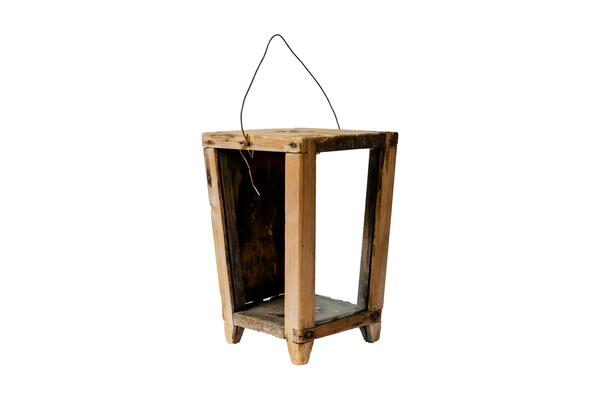
A candle lantern from the collection of Nizhnevartovsk Museum of Local History is handmade. Many peasants created such lanterns themselves and used them in their households. As a rule, they made them in winter, when there was no work in the fields or the yards. At that time women wove, spun, and sewed, and men made shoes, mended household utensils and tools.
Wooden lanterns were more common than metal lanterns because the wood was more affordable and it was easier to work with. However, wood was not as durable as iron. The frame was constructed of shaved-down bars. Sometimes the craftsmen added small legs to the bottom to put the lantern on the ground. A thin metal bow used for the hanging was usually attached to a top part. It was possible to carry a lantern or put it in the right place.
Three sides of the lantern displayed at the museum collection are glassed. Instead of the fourth side, there is a special door used to place a candle inside. Its bottom part is square as well as the top part, but it is a bit larger. Four vertical wooden bars connect two parts at the corners. The blind door can be lifted. Hanging wire is attached to two metal straps, which are placed on the sides of the top cover.
Hand lanterns appeared in ancient times. We first heard of them from Greek sources. It is known that a famous philosopher Diogenes of Sinope walked with such a lantern along the city streets in the daytime.
The first street lanterns appeared in England in the Middle Ages. The candles made of fat or wax served as light sources. They were placed under a glass cover so that the flame did not go out when it was windy or rainy.
By the beginning of the 20th century, paraffin became the main material for candles. Otherwise, it was called petroleum wax. It burned cleaner, longer, brighter, and smoother than natural wax or fat. Moreover, it was simpler and cheaper to produce such candles. That is why paraffin candles became the main source of lighting both outdoors and in town and country houses. They were used almost until the middle of the 20th century. Then they were finally replaced by electricity.
Wooden lanterns were more common than metal lanterns because the wood was more affordable and it was easier to work with. However, wood was not as durable as iron. The frame was constructed of shaved-down bars. Sometimes the craftsmen added small legs to the bottom to put the lantern on the ground. A thin metal bow used for the hanging was usually attached to a top part. It was possible to carry a lantern or put it in the right place.
Three sides of the lantern displayed at the museum collection are glassed. Instead of the fourth side, there is a special door used to place a candle inside. Its bottom part is square as well as the top part, but it is a bit larger. Four vertical wooden bars connect two parts at the corners. The blind door can be lifted. Hanging wire is attached to two metal straps, which are placed on the sides of the top cover.
Hand lanterns appeared in ancient times. We first heard of them from Greek sources. It is known that a famous philosopher Diogenes of Sinope walked with such a lantern along the city streets in the daytime.
The first street lanterns appeared in England in the Middle Ages. The candles made of fat or wax served as light sources. They were placed under a glass cover so that the flame did not go out when it was windy or rainy.
By the beginning of the 20th century, paraffin became the main material for candles. Otherwise, it was called petroleum wax. It burned cleaner, longer, brighter, and smoother than natural wax or fat. Moreover, it was simpler and cheaper to produce such candles. That is why paraffin candles became the main source of lighting both outdoors and in town and country houses. They were used almost until the middle of the 20th century. Then they were finally replaced by electricity.