Chairs made of beech steam bent wood are called Viennese chairs. Such furniture items were invented by Austrian cabinetmaker Michael Thonet. In 1819, he founded and opened his workshop in the German city Boppard. Since that time, he had been looking for a way to produce lightweight, durable and elegant items that would fit any interior. In 1842, Thonet moved to Vienna. There, he received a royal patent for “bending any kind of wood, including the most inflexible species, using a chemical and mechanical method to obtain the desired shapes, including rounded ones.” Chairs, which were made in such a way, were called by the place of their creation — Vienna.
The chair back consisted of two parallel bows — the largest of them merged into back legs. Each furniture item was made of only six parts, fastened with screws. This method allowed to transport the chairs in parts. They took less space which meant lower transportation costs.
In the second half of the 19th century, in Austria, there were two competing companies, which produced Viennese furniture: “Thonet Brothers” and “Jacob & Josef Kohn”. In 1851, the chairs produced by “Thonet Brothers” received a bronze medal at the World Exhibition in London. And in 1878, in Paris, both manufacturers got golden awards.
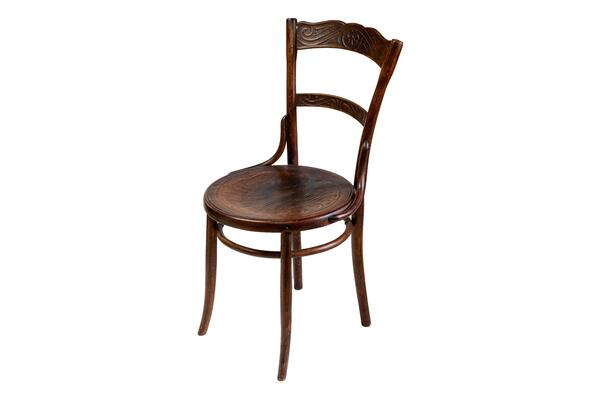
The chair displayed at the collection of Nizhnevartovsk Museum of Local History was made in Austria-Hungary at the early 20th century. To produce it the masters pretreated beech wood with hot steam, shaped it as necessary, and dried it. The back of this chair differs from usual items made by “Thonet Brothers”. It does not consist of a solid arc, but of two separate vertical details that merged into back legs. Two horizontal slightly concaved bars connect them. The upper one is wider. It is also decorated with carvings and has a curly edge. A similar ornament in the form of smoothly curved lines is located on a round seat. There is a wooden hoop under it. Four legs are attached to a hoop with some screws. Both a back and a seat are connected by two small rounded side bows. They give additional ruggedness to the whole design and serve as a decoration.
The chair back consisted of two parallel bows — the largest of them merged into back legs. Each furniture item was made of only six parts, fastened with screws. This method allowed to transport the chairs in parts. They took less space which meant lower transportation costs.
In the second half of the 19th century, in Austria, there were two competing companies, which produced Viennese furniture: “Thonet Brothers” and “Jacob & Josef Kohn”. In 1851, the chairs produced by “Thonet Brothers” received a bronze medal at the World Exhibition in London. And in 1878, in Paris, both manufacturers got golden awards.
The chair displayed at the collection of Nizhnevartovsk Museum of Local History was made in Austria-Hungary at the early 20th century. To produce it the masters pretreated beech wood with hot steam, shaped it as necessary, and dried it. The back of this chair differs from usual items made by “Thonet Brothers”. It does not consist of a solid arc, but of two separate vertical details that merged into back legs. Two horizontal slightly concaved bars connect them. The upper one is wider. It is also decorated with carvings and has a curly edge. A similar ornament in the form of smoothly curved lines is located on a round seat. There is a wooden hoop under it. Four legs are attached to a hoop with some screws. Both a back and a seat are connected by two small rounded side bows. They give additional ruggedness to the whole design and serve as a decoration.