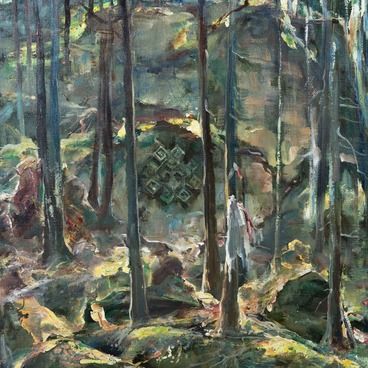
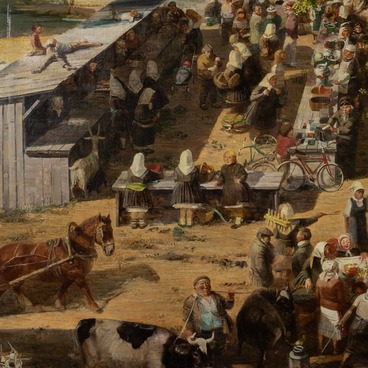
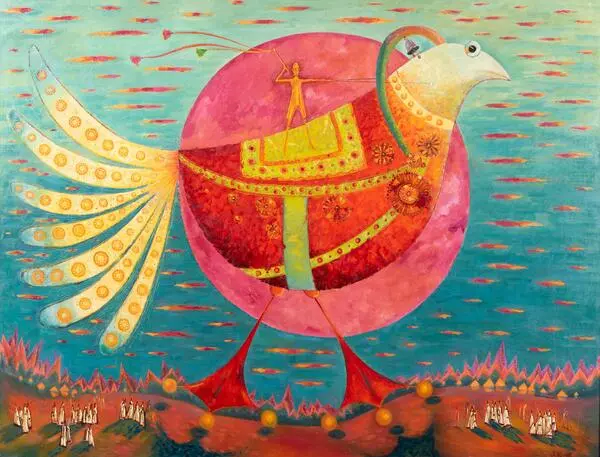
Ethnofuturism is one of the promising trends in contemporary art that combines genuine folk knowledge and modern technologies. In his work, Yury Tanygin has managed to find a transition from universally recognized realistic art to iconic, symbolic, vivid painting, which marked the beginning of a new trend in the visual arts of the Mari El Republic. The plots of his paintings are often layered, in them one narrative is superimposed on another, expanding the boundaries of the theme. Thus, the viewer should carefully contemplate Tanygin’s paintings, examine every detail. All of them breathe with the serene happiness that the artist experienced as a child.
Yury Tanygin was born in the village of Maska-Roda, Sovetsky District, Mari ASSR. He spent his childhood in a village where life was rife with tasks and work and at the same time filled with a cheerful spirit. The artist’s grandmother sang traditional folk songs to him and told him the legends of the Mari people — he has interpreted all this rich heritage on his canvases. The artist recalls that as a child, he loved to take the cattle out to the meadows in the early summer morning, and run around and roll in the dew, enjoying the beauty of the Mari nature.
In the painting “Lullaby”, presented in the museum’s exhibition, the artist uses his characteristic technique: the interior space of the house smoothly flows into the world, nature, and forest. The source of light at the head of the cradle opens one space to the viewer, the window with a star opens another, and the space of the house merges with the expanses of the native land — the forests and fields. Right here we also see a bird that either sings in the sky, or rocks the cradle under the ceiling, and a deer that either gazes from a wall tapestry, or has come running from the forest to look at the baby. The artist emphasizes the conventionality of the entire space presented on the canvas with a theatrical attribute — a curtain. This technique in art is called “simultaneity” (from Latin “immediately”, “at one time”), it is typical of primitive art. And for the artist, “this is a way to develop a sense of a single undifferentiated fabric of space-time, ” which is so characteristic of dreams.
Yury Tanygin was born in the village of Maska-Roda, Sovetsky District, Mari ASSR. He spent his childhood in a village where life was rife with tasks and work and at the same time filled with a cheerful spirit. The artist’s grandmother sang traditional folk songs to him and told him the legends of the Mari people — he has interpreted all this rich heritage on his canvases. The artist recalls that as a child, he loved to take the cattle out to the meadows in the early summer morning, and run around and roll in the dew, enjoying the beauty of the Mari nature.
In the painting “Lullaby”, presented in the museum’s exhibition, the artist uses his characteristic technique: the interior space of the house smoothly flows into the world, nature, and forest. The source of light at the head of the cradle opens one space to the viewer, the window with a star opens another, and the space of the house merges with the expanses of the native land — the forests and fields. Right here we also see a bird that either sings in the sky, or rocks the cradle under the ceiling, and a deer that either gazes from a wall tapestry, or has come running from the forest to look at the baby. The artist emphasizes the conventionality of the entire space presented on the canvas with a theatrical attribute — a curtain. This technique in art is called “simultaneity” (from Latin “immediately”, “at one time”), it is typical of primitive art. And for the artist, “this is a way to develop a sense of a single undifferentiated fabric of space-time, ” which is so characteristic of dreams.