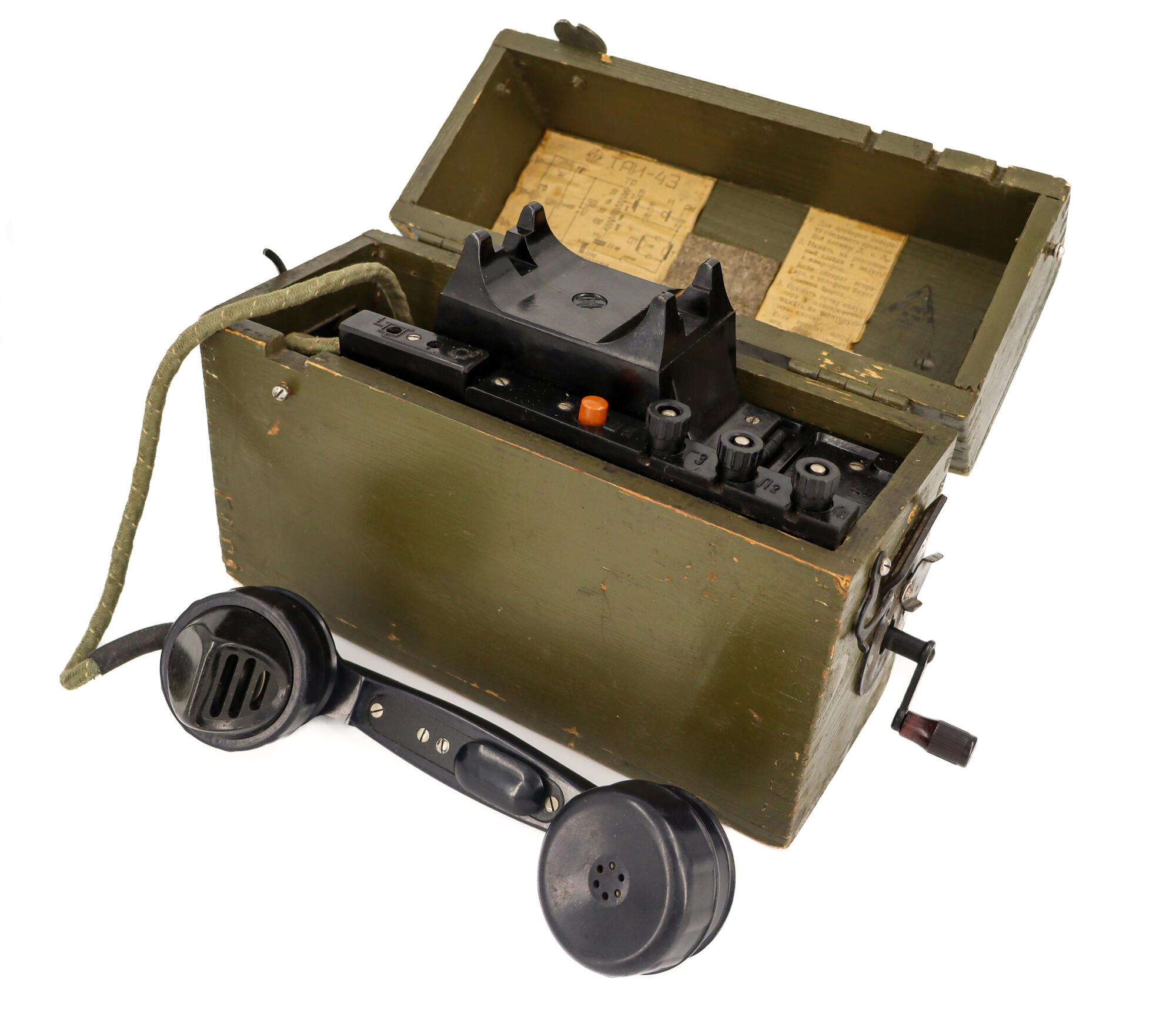


The TAI-43 field telephone was a 1943 telephone with an electromagnetic ringer. This type of communication device was first used by Germany during the First World War. It was intended for establishing communication in the field and combat and, since it was portable, was very convenient to use.
The field telephone was designed as a rectangular case, including an electronic amplifier, a receiver with a PTT (a button for switching between the reception and transmission mode), an electromagnetic ringer, and a hand-cranked generator.
The TAI-43 was developed by the Red Army Research and Testing Institute of Communications under the leadership of engineer lieutenant-colonel Olga Ivanovna Repina. She was also involved in creating the subsequent modification TA-57, used in peacetime.
Mass production of telephones with an electromagnetic ringer was launched at Moscow Plant No. 1 in 1944. Initially, their casing was wooden and khaki. However, by the end of 1945, the same Plant No. 1 began to produce the devices in brown bakelite cases. The TAI-43 entered service with the Soviet army in the middle of the Great Patriotic War. It replaced the heavy, unreliable, and cumbersome counterparts, which used to be made at the Lenin Radiotelephone Plant.
The TAI-43 was created based on trophy German FF-33 field telephones. At first glance, these devices looked very similar to the Soviet ones, however, they had little in common in terms of design and layout of nodes.
The device was powered by a single 3V or 3 °C element with a voltage of 1.5 V. The communication range of the field wire reached 25 km and could even be increased to 150–200 km with the use of a constant 4-mm aerial line. The device could be connected to the line both through two-wire and single-wire circuits.
Repina supervised the production of about half a million TAI-43s in total. For 20 years, this device was the main field telephone first of the Red Army and then the Soviet one.
The field telephone was designed as a rectangular case, including an electronic amplifier, a receiver with a PTT (a button for switching between the reception and transmission mode), an electromagnetic ringer, and a hand-cranked generator.
The TAI-43 was developed by the Red Army Research and Testing Institute of Communications under the leadership of engineer lieutenant-colonel Olga Ivanovna Repina. She was also involved in creating the subsequent modification TA-57, used in peacetime.
Mass production of telephones with an electromagnetic ringer was launched at Moscow Plant No. 1 in 1944. Initially, their casing was wooden and khaki. However, by the end of 1945, the same Plant No. 1 began to produce the devices in brown bakelite cases. The TAI-43 entered service with the Soviet army in the middle of the Great Patriotic War. It replaced the heavy, unreliable, and cumbersome counterparts, which used to be made at the Lenin Radiotelephone Plant.
The TAI-43 was created based on trophy German FF-33 field telephones. At first glance, these devices looked very similar to the Soviet ones, however, they had little in common in terms of design and layout of nodes.
The device was powered by a single 3V or 3 °C element with a voltage of 1.5 V. The communication range of the field wire reached 25 km and could even be increased to 150–200 km with the use of a constant 4-mm aerial line. The device could be connected to the line both through two-wire and single-wire circuits.
Repina supervised the production of about half a million TAI-43s in total. For 20 years, this device was the main field telephone first of the Red Army and then the Soviet one.