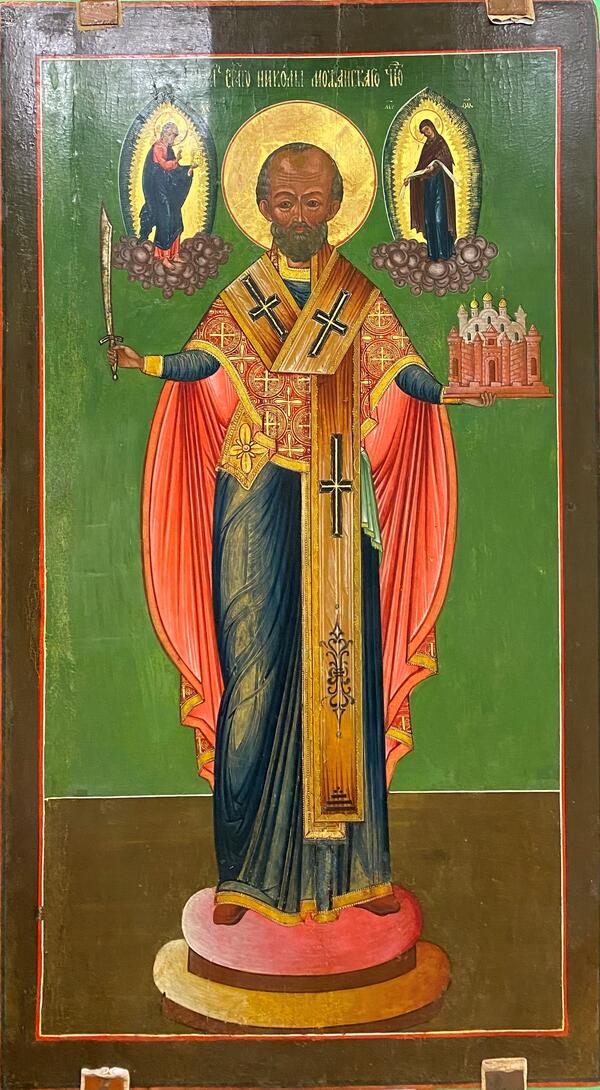
Saint Nicholas of Mozhaysk is one of the names of St. Nicholas the Wonderworker, “the first intercessor before God, ” as Russian Orthodox Christians have long called him. For the first time the name appears in the Mozhaysk Scribal Books of 1595–1598 in connection with the miraculous liberation of the town from enemies thanks to the saint’s intercession. Initially, the images of the saint with a sword and a fortress-church were wooden sculptures, later they entered the Russian iconographic tradition.
In addition to the story of the protection of Mozhaysk, another event from the life of St. Nicholas is revealed in this image.
In 325, when the saint was bishop of Myra in Lycia, the First Ecumenical Council of Nicaea dedicated to the discussion of Arianism took place. Adherents of this heresy revered Jesus as a Son of God, but did not see Him equal to God the Father.
Having entered into a heated dispute with the founder of Arianism, the Alexandrian presbyter Arius, and defending the positions of Orthodoxy, Nicholas of Myra slapped his opponent on the cheek. This act angered the Church Fathers who deemed it a manifestation of inappropriate audacity, so the bishop was defrocked and imprisoned. However, that same night, many of those who criticized the disorderly conduct of St. Nicholas received a vision: Christ and the Mother of God did not condemn, but blessed the fervor of St. Nicholas and handed him the Gospel and the omophorion from their hands. Having listened to the instructions from above, the members of the council returned to the bishop the symbols of episcopal dignity and title.
This episode is referenced to in the images of Christ with the Gospel and the Virgin with the omophorion on both sides of the saint’s halo.
Saint Nicholas of Mozhaysk is depicted in full length in the pose traditional of this iconographic type — he prays with his arms outstretched to the sides. His features are painted differently from the canonical representation: his face and beard are not rounded, as prescribed by the “Iconographic Manual”, but slightly elongated.
The color palette of the icon is light and bright. The natural green color of the background symbolizes the Kingdom of God, harmony and new life; gold — eternity and grace; red, in this case, — the flame of faith; blue — the yearning for God.
The icon was restored in the Moscow Interregional Scientific and Restoration Art Department of the Ministry of Culture of the Russian Federation by the restorer Valery Fyodorovich Kosushkin.
In addition to the story of the protection of Mozhaysk, another event from the life of St. Nicholas is revealed in this image.
In 325, when the saint was bishop of Myra in Lycia, the First Ecumenical Council of Nicaea dedicated to the discussion of Arianism took place. Adherents of this heresy revered Jesus as a Son of God, but did not see Him equal to God the Father.
Having entered into a heated dispute with the founder of Arianism, the Alexandrian presbyter Arius, and defending the positions of Orthodoxy, Nicholas of Myra slapped his opponent on the cheek. This act angered the Church Fathers who deemed it a manifestation of inappropriate audacity, so the bishop was defrocked and imprisoned. However, that same night, many of those who criticized the disorderly conduct of St. Nicholas received a vision: Christ and the Mother of God did not condemn, but blessed the fervor of St. Nicholas and handed him the Gospel and the omophorion from their hands. Having listened to the instructions from above, the members of the council returned to the bishop the symbols of episcopal dignity and title.
This episode is referenced to in the images of Christ with the Gospel and the Virgin with the omophorion on both sides of the saint’s halo.
Saint Nicholas of Mozhaysk is depicted in full length in the pose traditional of this iconographic type — he prays with his arms outstretched to the sides. His features are painted differently from the canonical representation: his face and beard are not rounded, as prescribed by the “Iconographic Manual”, but slightly elongated.
The color palette of the icon is light and bright. The natural green color of the background symbolizes the Kingdom of God, harmony and new life; gold — eternity and grace; red, in this case, — the flame of faith; blue — the yearning for God.
The icon was restored in the Moscow Interregional Scientific and Restoration Art Department of the Ministry of Culture of the Russian Federation by the restorer Valery Fyodorovich Kosushkin.