The word “Menaion”, or minei, (from the Greek μηνιαῖος — “of the month”) is used in the Orthodox tradition to refer to a liturgical book with texts of annual prayers and to a special type of icons depicting certain saints.
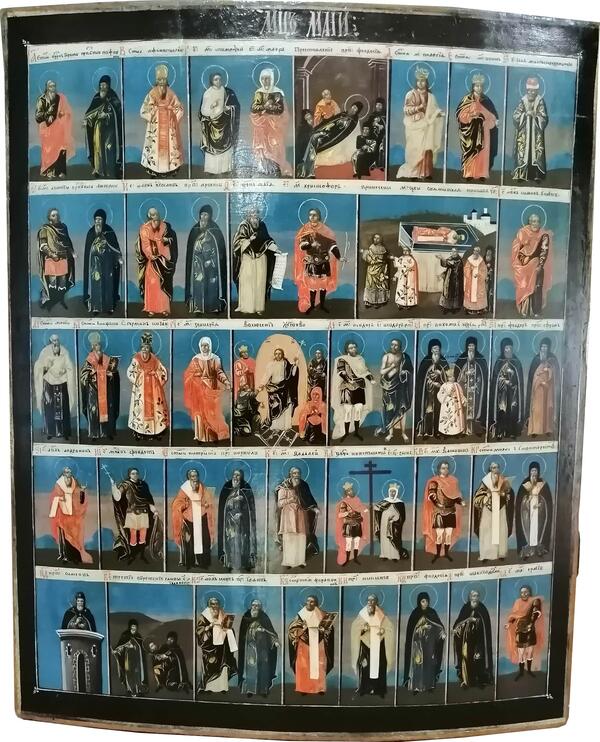
Monthly minei are dedicated to the glorification of church holidays that fall on a particular month. On the presented Menaion icon for the month of May, the number of framed images is 34, as they depict and commemorate different saints, whose memorial day is celebrated on the same day. The icon space is divided into five rows and reflects the calendar sequence of holidays; the viewer should look at the images from left to right and from top to bottom. Each framed image is a multi-figure plot composition, a miniature, in which the faces and details are finely painted.
The central place is occupied by the depiction of the main feast in May and the whole church year — Easter. The Savior steps over the broken gates of hell, in His left hand is a cross as a symbol of suffering and redemption of human sins. The Lord faces the progenitors Adam and Eve and virtuous pagans; He stretches out His right hand to Adam to lead him first out of the underworld. Jesus is surrounded by an oval shining mandorla — a sign of Divine Glory.
The second row from the top includes a depiction of the transfer of the relics of St. Nicholas the Wonderworker from Myra of Lycia to the Italian city of Bari. This event is described in detail by chroniclers: in the 11th century, when the Greek Empire was under the threat of Turkish raids, it was decided to transport the relics to a safer place. On May 21, the ship with them arrived in Italy, and the next day the relics were placed in the Church of St. Stephen. The icon painter depicted a solemn procession moving from a dilapidated church to the ship; a halo is marked with white above the head of the elder lying in the coffin. A dark brown stripe frames the image, giving completeness to it.
The depiction of the Third Finding of the Head of John the Baptist (bottom row) is quite interesting: it does not correspond to a holiday. According to tradition, this happened in the 9th century: the head was moved from Constantinople to Emesa, and from there to the city of Kamani, where it was hidden during the period of Iconoclasm. When icon veneration was restored, Emperor Michael III sent representatives of the nobility to bring it back.
In the miniature, two monks dig the head of the prophet out of the cave, which corresponds to the plot of the second finding of the shrine.
Monthly minei are dedicated to the glorification of church holidays that fall on a particular month. On the presented Menaion icon for the month of May, the number of framed images is 34, as they depict and commemorate different saints, whose memorial day is celebrated on the same day. The icon space is divided into five rows and reflects the calendar sequence of holidays; the viewer should look at the images from left to right and from top to bottom. Each framed image is a multi-figure plot composition, a miniature, in which the faces and details are finely painted.
The central place is occupied by the depiction of the main feast in May and the whole church year — Easter. The Savior steps over the broken gates of hell, in His left hand is a cross as a symbol of suffering and redemption of human sins. The Lord faces the progenitors Adam and Eve and virtuous pagans; He stretches out His right hand to Adam to lead him first out of the underworld. Jesus is surrounded by an oval shining mandorla — a sign of Divine Glory.
The second row from the top includes a depiction of the transfer of the relics of St. Nicholas the Wonderworker from Myra of Lycia to the Italian city of Bari. This event is described in detail by chroniclers: in the 11th century, when the Greek Empire was under the threat of Turkish raids, it was decided to transport the relics to a safer place. On May 21, the ship with them arrived in Italy, and the next day the relics were placed in the Church of St. Stephen. The icon painter depicted a solemn procession moving from a dilapidated church to the ship; a halo is marked with white above the head of the elder lying in the coffin. A dark brown stripe frames the image, giving completeness to it.
The depiction of the Third Finding of the Head of John the Baptist (bottom row) is quite interesting: it does not correspond to a holiday. According to tradition, this happened in the 9th century: the head was moved from Constantinople to Emesa, and from there to the city of Kamani, where it was hidden during the period of Iconoclasm. When icon veneration was restored, Emperor Michael III sent representatives of the nobility to bring it back.
In the miniature, two monks dig the head of the prophet out of the cave, which corresponds to the plot of the second finding of the shrine.