The figure of Hieromonk Paphnutius of Balakhna is a mystery to researchers. Little is known about him: he was the founder of the Intercession Monastery who also discovered a holy spring in the forest nearby.
It is not known exactly when the monastery was constructed and the name of its builder is not established. The stone Intercession Church (which was at first wooden) that has survived to our time is dated to the mid-17th century, the St. Nicholas Church — to 1552. In the 16th–17th centuries, the generous donors of the monastery were large salt producers, therefore, the monastery was not poor. Judging by royal charters, it also owned lakes with “fishing grounds”, saltworks, fields, mills and other lands.
Hieromonk Paphnutius is mentioned as the founder of the monastery in the writings of Archimandrite Makarius and the historian of Orthodox monasteries Vasily Vasilyevich Zverinsky.
The State Archive of the Nizhny Novgorod Oblast houses family documents of the Latukhins, who were salt producers. One of them, dated to the 1830s, is a petition from residents and noble people of Balakhna to Ambrose, Bishop of Nizhny Novgorod and Arzamas, calling for the establishment of a church in the name of St. Paphnutius, who rested under the crypt of the St. Nicholas Church and “to whom zealous worshipers have been holding many memorial services until this day.”
In 1884, the governor of Nizhny Novgorod reported to His Imperial Majesty about persistent rumors regarding the miraculous relics of the long-deceased hieromonk. According to the governor, cases of “miraculous healings allegedly received by those who come to this tomb” are noted in a special book, but “nothing can be read from it”.
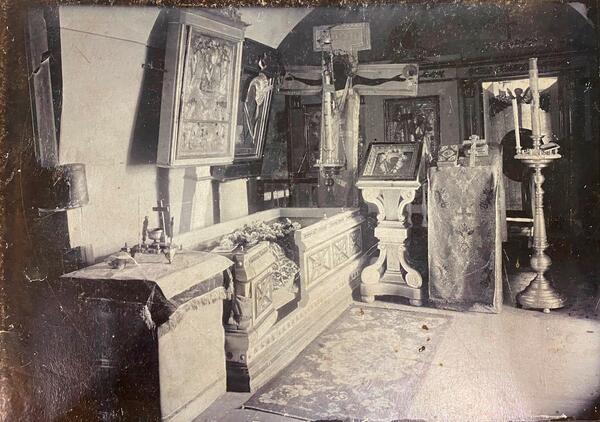
Despite this, in the basement of the St. Nicholas Church, with the blessing of the diocesan bishop, a church was built where prayer services were held. The governor described “cracked stone coffin turning into sand, over which a small somewhat raised cut was made, covered with a brocade veil” and asked to stop unreasonable worship. However, both the memorial services and the testimonies of miracles continued.
In June 1999, when the floor of the church’s basement was opened, a coffin was found, probably, of St. Paphnutius. Metropolitan Nicholas gave his blessing to place the remains of the saint in a shrine in the main Nativity Church.
In February 2011, Archbishop George blessed the reburial of the remains in the basement of the St. Nicholas Church.
The Memorial Day of Paphnutius of Balakhna is celebrated on May 14.
This photo shows the interior of the St. Nicholas Church. On the left, at the four-sided pillar with an arched vault, there is a tomb covered in brocade.
It is not known exactly when the monastery was constructed and the name of its builder is not established. The stone Intercession Church (which was at first wooden) that has survived to our time is dated to the mid-17th century, the St. Nicholas Church — to 1552. In the 16th–17th centuries, the generous donors of the monastery were large salt producers, therefore, the monastery was not poor. Judging by royal charters, it also owned lakes with “fishing grounds”, saltworks, fields, mills and other lands.
Hieromonk Paphnutius is mentioned as the founder of the monastery in the writings of Archimandrite Makarius and the historian of Orthodox monasteries Vasily Vasilyevich Zverinsky.
The State Archive of the Nizhny Novgorod Oblast houses family documents of the Latukhins, who were salt producers. One of them, dated to the 1830s, is a petition from residents and noble people of Balakhna to Ambrose, Bishop of Nizhny Novgorod and Arzamas, calling for the establishment of a church in the name of St. Paphnutius, who rested under the crypt of the St. Nicholas Church and “to whom zealous worshipers have been holding many memorial services until this day.”
In 1884, the governor of Nizhny Novgorod reported to His Imperial Majesty about persistent rumors regarding the miraculous relics of the long-deceased hieromonk. According to the governor, cases of “miraculous healings allegedly received by those who come to this tomb” are noted in a special book, but “nothing can be read from it”.
Despite this, in the basement of the St. Nicholas Church, with the blessing of the diocesan bishop, a church was built where prayer services were held. The governor described “cracked stone coffin turning into sand, over which a small somewhat raised cut was made, covered with a brocade veil” and asked to stop unreasonable worship. However, both the memorial services and the testimonies of miracles continued.
In June 1999, when the floor of the church’s basement was opened, a coffin was found, probably, of St. Paphnutius. Metropolitan Nicholas gave his blessing to place the remains of the saint in a shrine in the main Nativity Church.
In February 2011, Archbishop George blessed the reburial of the remains in the basement of the St. Nicholas Church.
The Memorial Day of Paphnutius of Balakhna is celebrated on May 14.
This photo shows the interior of the St. Nicholas Church. On the left, at the four-sided pillar with an arched vault, there is a tomb covered in brocade.