#1
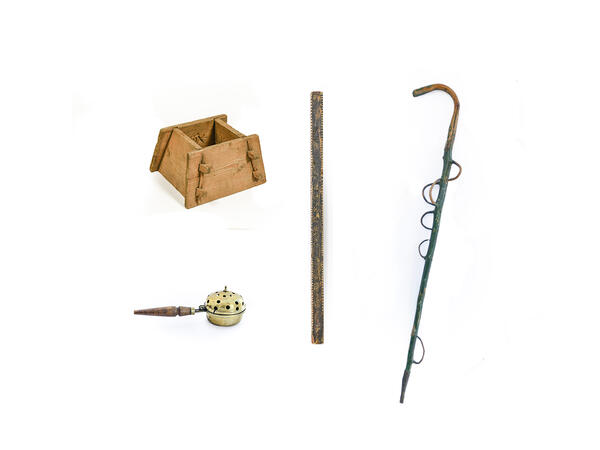
Wooden Church calendar, Pilgrim’s staff, Cheese mold, Censer
#2
#18
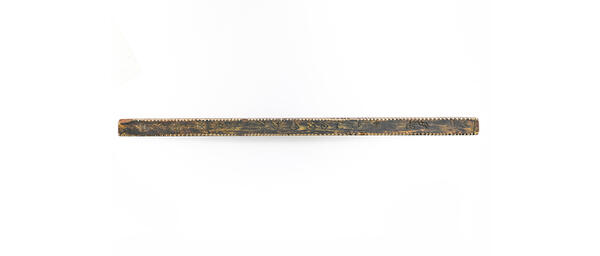
Wooden Church calendar
#4
In some regions of Russia, menologions were folk wooden calendars, where different marks were cut for each day. The version, which is housed in the collection of the Bishop’s House, is a square rectangular bar, which is 87 centimeters long. Each side is painted to represent a particular season: white for winter, green for spring, red for summer, and yellow for fall. The cuts on all sides are the designations of the days. Months are separated by small indents, but their names are not labeled in any way. Other markings can be seen on the sides: crosses of different shapes, circles, straight lines, and letters. They were used to mark church holidays, important events in the family, and the dates on which different works were to begin.
The first calendars of the Russian peasant farmers appeared because their whole life was connected with the change of season. They had to plan work in the field, prepare supplies for the winter and feed for livestock, calculate the timing of parturition in cattle, sheep and swine. In addition, religion played a big role in the life of peasants.
Forgetting about a fast, a religious holiday, or a saint’s memorial day was considered a sin. Therefore, all important dates were marked in wooden calendars. Such a calendar was convenient to keep and carry along, so people often took it with them when they went to work in the field or fish, so as not to miss the significant dates. It was not necessary to buy calendars: they were made of any suitable wooden bar, and it did not take much time to make them. Therefore, this type of calendar quickly became popular.
In Old Rus, the calendar year began on March 1 — along with the cycle of agricultural works. In 1492, Prince Ivan III of Moscow issued a decree, according to which the calendar year was to begin from September 1. This was the custom in Byzantium, and Russia adopted many of its cultural and religious traditions. Almost a century later, in 1581, the printer Ivan Fyodorov created the first printed Orthodox calendar. The first secular calendar, without church feasts, appeared only during the reign of Peter the Great. By that time, the start date of the year had changed again: the emperor moved it to January 1.
#5
Полное наименование предмета: Wooden Church calendar
Дата создания: 1896
Техника: carving
Место создания: Tobolsk Governorate, Serebryanka village
Владелец коллекции: Bishop’s House
Размеры: 87×4,5×5,5 cm
Номер в Госкаталоге: 4099850
Техника: carving
Место создания: Tobolsk Governorate, Serebryanka village
Владелец коллекции: Bishop’s House
Размеры: 87×4,5×5,5 cm
Номер в Госкаталоге: 4099850
#7
Pilgrim’s staff
#19
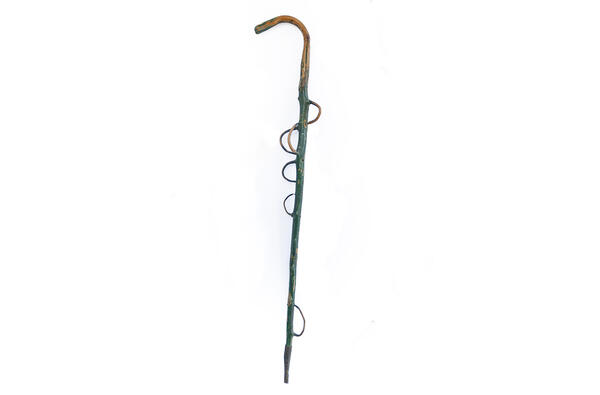
Pilgrim’s staff
#8
The pilgrim’s staff from the collection of the Bishop’s House was made in the 19th century from a single trunk of a small tree. Its surface was given a smooth look and polished, then painted green.
The length of the staff is 70 centimeters. The upper end of the staff is a hook: such a handle was convenient to hold on to when the pilgrim was walking, and when the person stopped for the night or to rest, the staff could be hung on the wall. The stick has six loops at uneven intervals: an unknown artisan made them by bending small branches and securing the loops so that they did not unwind. These loops made it possible to hold the staff at any level of the stick. Sometimes pilgrims would hang lightweight items on these loops, so as not to carry them along in their hands.
The pilgrim’s staffs were not decorated in any way, and most of them had a simple and unsophisticated look. Pilgrims usually made staff sticks on their own, using whatever materials were at hand. Staffs were seldom preserved: they were not considered relics and were not taken care of, and when they got old or broke, they were simply replaced by new ones.
Pilgrims, or palmers, were worshipers who set out on a journey to holy places. People made decisions to embark on such a journey in order to see Christian holy sites, to pray to miraculous icons and ask for health for themselves or their loved ones, to visit the righteous elders and get their advice. People set out on a journey on foot, taking only the basic things — most often only a staff and a small bag with rusk made of bread.
These journeys were often long, difficult, and dangerous: the route did not always follow good, well-traveled roads, the traveler could come across wild animals or bandits, and bad weather could occur. However, Christians saw these difficulties as a way to strengthen their spirit and faith. Some pilgrims described their wanderings in detail. Such notes later became not only spiritual literature but also valuable historical documents.
The staff was a mandatory attribute both of a pilgrim, and also of any traveler who traveled on foot. With its help, it was easier for wanderers to go up and down the mountains, climb over ravines, and protect themselves from dogs or snakes. In addition, the extra support reduced the load on the legs and spine, so the person got less tired.
#9
Полное наименование предмета: Pilgrim’s staff (stick)
Дата создания: the 19th century
Техника: handmade
Место создания: Shadrinsky Uezd of Perm governorate
Владелец коллекции: Bishop’s House
Размеры: Length — 70 cm
Номер в Госкаталоге: 4099899
Техника: handmade
Место создания: Shadrinsky Uezd of Perm governorate
Владелец коллекции: Bishop’s House
Размеры: Length — 70 cm
Номер в Госкаталоге: 4099899
#10
Cheese mold
#20
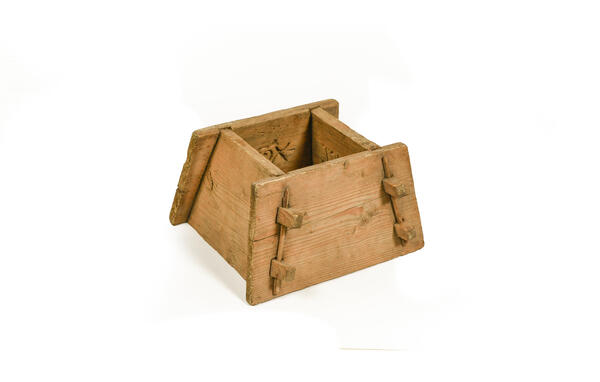
Cheese mold
#12
People used a wooden mold to prepare a traditional festive Easter dish. The dish was called ‘paskha’ and made from quark or curd cheese. This kind of mold was popular among Siberian families — both among peasants and rich citizens. The mold was traditionally made in the form of a truncated tetrahedral pyramid: it symbolized Calvary, where, according to the New Testament, Jesus Christ was crucified.
The mold from the collection of the Bishop’s House was assembled from four smooth boards pressed tightly together. They are connected through special grooves. A shallow pattern is carved on the inner surface. On one side there is a cross, a spear, and a sponge, with which the crucified Christ was given a drink in the biblical legend. The other three sides have an inscription in the Church Slavonic language, which reads “Truly Christ has risen!” The craftsman cut out the mirror images of the letters so that the text would look correctly on the dish. The patterns on the wooden surface became flatter over time.
In addition to the images of the cross and the inscription “Christ has Risen”, other drawings were carved on the paskha: doves, angels, vines, silhouettes of churches, and church domes.
The paskha was traditionally made of quark, sour cream, sugar, and egg yolks. They were mixed into a smooth paste, then raisins, nuts, or candied fruits were added. The mold was filled with the mixture and left overnight in a cool place so that the dish would freeze. Then it was placed on a large plate, and the mold parts were removed. In wealthy homes, the paskha was decorated with grated chocolate and candied figurines. It was customary to place colored eggs around the paskha on the plate: in the Easter tradition, they symbolized eternal life.
Easter, or the Resurrection of Christ, is considered the main and oldest holiday among Christians of all denominations. The festivities on this occasion began right in the churchyard, immediately after the divine service, and lasted from one to seven days depending on the province. At this time, it was customary to exchange Easter eggs and greet one another with the phrases “Christ has Risen” and “He has Risen indeed!” Only at Easter, anyone was allowed to ring the church bells.
#13
Полное наименование предмета: Wooden mold for making Easter cheese
Дата создания: the late 19th — early 20th century
Техника: carving
Место создания: Russia
Владелец коллекции: Bishop’s House
Размеры: 37×31,5×21,5 cm
Номер в Госкаталоге: 4159698
Техника: carving
Место создания: Russia
Владелец коллекции: Bishop’s House
Размеры: 37×31,5×21,5 cm
Номер в Госкаталоге: 4159698
#14
Censer
#21
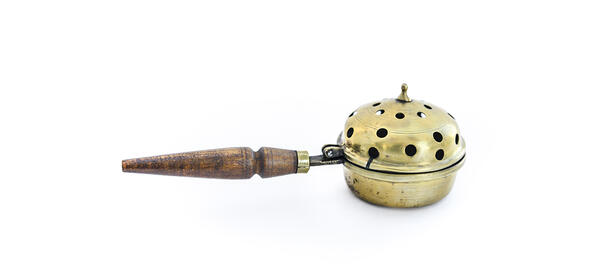
Censer
#16
A censer is used during most services in Orthodox churches. A censer is a special metal vessel made for burning coal with incense, a type of resin producing a fragrant odor. The vessels and censers are kept in a special niche. The process of incense burning is accompanied by obligatory prayer.
The censer from the collection of the Tobolsk Museum-Reserve looks like a small ladle or bowl with a long wooden handle. The main part, a round-shaped body, is made of yellow metal and consists of two parts. The upper half is hinged, it has small round holes that allow air in and smoke out. It is decorated with thin rims. The upper and lower parts are connected by a hinge.
A ladle censer was considered a simpler device than a thurible with a lid hanging on a chain. The version with a long handle was used most often in monastic cells or at home. When censing, the device was moved in the air in such a way as if to make an imaginary sign of the cross in front of the icons.
Most often hand censers were made of metal — copper or bronze. The handle had a wooden cover so it would be less heated by coals and hot smoke. The simplest models were made of clay or stone. Similar censers are still used in Greek Orthodox churches — they are called “hand-censers” there. In Russia, they are still used by the Old Believers, who perform services without priests. Sometimes such censers are set over the iconostasis as incense burners, and the embers in them smolder constantly.
In the modern liturgical canon, there are two types of censing: full and short. During the full ceremony, the censing is performed around the whole temple. This variant symbolizes the grace of the Holy Spirit, which is believed to descend on the people praying during the service. The short one is intended for God and is held only in the altar and near the iconostasis, where the sacred objects of the Church are kept. The coals in the censer symbolize the human nature of Christ, the fire is his divine essence, and the fragrant incense is the prayer that ascends to heaven. In response to each act of censing the congregation must bow.
#17
Полное наименование предмета: Censer
Дата создания: the early 20th century
Техника: casting, stamping
Место создания: Russia
Владелец коллекции: Bishop’s House
Размеры: 20,5×7,7×6,5 cm
Номер в Госкаталоге: 8159687
Дата создания: the early 20th century
Техника: casting, stamping
Место создания: Russia
Владелец коллекции: Bishop’s House
Размеры: 20,5×7,7×6,5 cm
Номер в Госкаталоге: 8159687
#22
Ministry of Culture of the Russian Federation
read morehide
00:00
00:00
1x
Calendar, Pilgrim’s staff, Cheese mold, Censer
Collection
0
 Point your smartphone camera to open in the app
Open in app
Share